



Diamond Mining
Before diamonds ever reach the sales floor of a jewelry store, they must first endure billions of years of extreme forces of nature, such as volcanic eruptions and glacial freezing. Locating diamond deposits involves a great deal of preliminary reconnaissance. Thankfully, today's technology makes finding these deposits much easier than in the past. Prospectors no longer need to endure harsh climate conditions while walking miles through rugged, desolate areas just to reach a potential site. Instead, aerial photography, electromagnetic mapping, core sampling, radar, land rovers and helicopters are of tremendous assistance.
While modern technology has definitely accelerated the discovery process, in most cases, excavating diamond rough is still no simple task. Each diamond deposit is a unique challenge in and of itself. For example, to reach the diamond-bearing strata in Siberia, the frozen ground was thawed using jet engines. Over thousands of years, the winds in Botswana's Kalahari Desert buried an extremely rich diamond pipe under 150 feet of sand which needed be removed before mining could begin.
While some diamond deposits are still mined using quite primitive methods, most mining operations are highly sophisticated and require a tremendous amount of manpower and machinery to unearth the tiny gems from the volcanic rock that is their home. In fact, an average of 250 tons of rock, sand and Earth is moved, crushed and processed just to produce a single, one-carat polished diamond.
Today, the majority of mines are almost completely computer operated; this reduces labor costs and minimizes theft. The manner in which diamonds are mined is determined by the size and type of deposit being considered. Additional factors include location, economic viability, climate and political climate.
Mining Primary Deposits
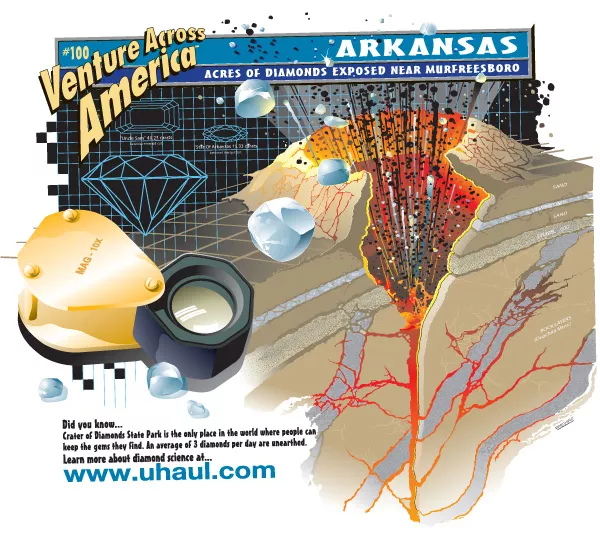
Primary deposits are mostly found in kimberlite/lamproite pipes (ancient volcanoes) and mining requires the use of heavy construction machinery and high-technology equipment. The diamond-bearing rock is blasted and removed by bulldozers to create an open-pit mine. An open-pit mine is a large hole in the Earth outlining the top of the pipe. (The surface area of most diamond pipes range anywhere between one and 350 acres.) A series of steps or benches are carved along the crater's interior to prevent cave-ins as well as to serve as a roadway.
The blueground is taken to an underground crushing plant where it is broken down into more manageable pieces before it is hoisted to the surface and sent to a final treatment plant on a conveyor belt.
When an open-pit mine becomes too deep and the rock too hard, it becomes impractical to continue operations from the surface. In these cases, underground mining begins, which is more complex and expensive. The first step in creating an underground mine is to drive a vertical shaft into the rock next to the blueground. This shaft serves as a "highway", carrying workers and supplies to and from various areas of the mine.
At the main shaft, tunnels are drilled which run horizontally through and around the pipe. These tunnels, referred to as drifts, are where the mining of blueground occurs. Underground mining is done using a variety of techniques.
From the collection areas, ore is broken into smaller pieces and hauled away for further processing. On average, large pipe mines process 13,000 tons of ore daily. Conveyor belts carry the diamond-bearing ore to the direct-treatment plant where it is put through the separation process.
Ore is sieved by running it across a series of screens (called grizzlies) to separate the large chunks. The first screen is very coarse with relatively generous openings; subsequent screens become finer. The chunks of ore that did not make it through the first pass are crushed and sieved again until they measure 1.2 inches or less. Next, the bits of blueground are put in large washing pans, where mechanical paddles stir the gravel, causing the lighter materials to float off the top. Heavier items, like diamonds, settle on the bottom. In most mines, the concentrate (material left in the washing pans) is then spread over a conveyor belt coated with grease. Diamonds are known to adhere to grease, so anything found sticking to the a conveyor belt is retrieved.
Other diamond recovery methods include the use of modern x-ray separation. When diamonds pass through an x-ray beam, they fluoresce, giving off visible light. During the separation process, the fluorescence activates a stream of air that shoots the stone into a separate shaft.
Mining Secondary Deposits
Secondary diamond deposits are known as alluvial deposits. Alluvial deposits are formed when rivers and streams carry diamonds away from their source of origin. Oftentimes, alluvial deposits have been found by accident when pretty, sparkling stones recovered from loose sand and gravel have turned out to be diamonds. In some areas, diamond deposits are far more elusive. For instance, when rivers have changed course or dried up, detecting these deposits often means tracing the paths of ancient waterways.
Alluvial mining operations take a variety of forms depending on the size of the deposit. The small deposits are usually worked by small groups of miners who use very primitive and inexpensive methods. The tools of choice are picks, shovels, circular sieves and wide, shallow pans.
Miners pan for diamonds just like gold miners panned for gold, by twirling silt and sand in a pan with water. Diamonds will sink to the bottom of the pan and most of the silt and sand floats out of the pan. Circular sieves or baskets are used to wash river gravel. Just like panning, the sieve is twirled, washing out the small grains. The gravel left over is searched by hand.
Mining larger deposits involves the use of rocker boxes, which have been used for the past one hundred years. Rocker boxes achieve the same results as panning, but on a larger scale. Miners put river gravel in the box and rock it back and forth, sifting the gravel through a screen. The light materials are washed away while diamonds and other heavy materials remain and are sorted by hand.
Some alluvial deposits are very prolific and warrant damming the river or using wooden flumes to temporarily reroute the stream away from the work site. These areas often include older deposits that have filled depressions and potholes left by whirlpools and waterfalls.
In areas like Zaire's Mbuji-Mayi River, heavy machinery such as front-loaders and bulldozers are necessary to access the diamond-bearing areas. If the diamond deposit is on the surface of the riverbed, divers can be used to guide pneumatic suction pipes along the river bottom to pull gravel onto a barge for processing. This process is called dredging.
Alluvial deposits left by streams that no longer exist are often difficult to mine because layers of sediment, called overburden, have covered the deposit. To remove overburden, miners use a variety of resources from hand shovels and bulldozers to explosives and high-pressure water jets. Several alluvial deposits are also found off South Africa's Atlantic coast. Mining these areas is a massive undertaking because the diamond-bearing gravels lie approximately 65 feet below the sea level. To access these deposits, powerful Earthmovers must build and maintain an enormous wall of sand. This wall holds back the surf, so the excavation crews can extract and sift tons of sand, gravel and bedrock. Meanwhile, pumps work continuously to remove any water that seeps into the mining area.
The Debmar Pacific is a unique mining operation unlike any other. This deep-sea mining vessel just off the coast of Namibia is operated by De Beers, the only company with access to the technology and resources in the industry. The Debmar Pacific uses large pneumatic drills to loosen gravel and rock on the sea floor. This gravel is then vacuumed up and processed onboard.