


Other meteorite structures on earth
Impact structures on Earth are classified as either simple or complex structures. Simple impact structures measure up to four kilometers in diameter and contain uplifted and overturned rim rocks which surround a classic bowl-shaped depression. Complex impact structures, also called basins, are more than four kilometers in diameter. The center of the complex structure is uplifted, forming a central peak, and the rim and crater walls are slumped. Large-diameter craters often display one or more peak rings, rather than a single central peak.
To date, scientists have identified approximately 150 visible impact craters across the globe. While most of the Earth's craters were recognized as geologic features before 1950, it was only since the mid 1960s that the meteorite-impact origins began to be recognized. Technological advances in spacecraft orbital imagery have been tremendous aids in identifying several new craters, especially in remote locations.
We now know that meteorite impacts are a major earth-modifying process, but there is still much to be learned about these remarkable craters. Continued study will provide more insight to the geologic history of Earth's bombardment by meteorites, comets and asteroids, as well as advance our understanding of how cratering affects the Earth today.
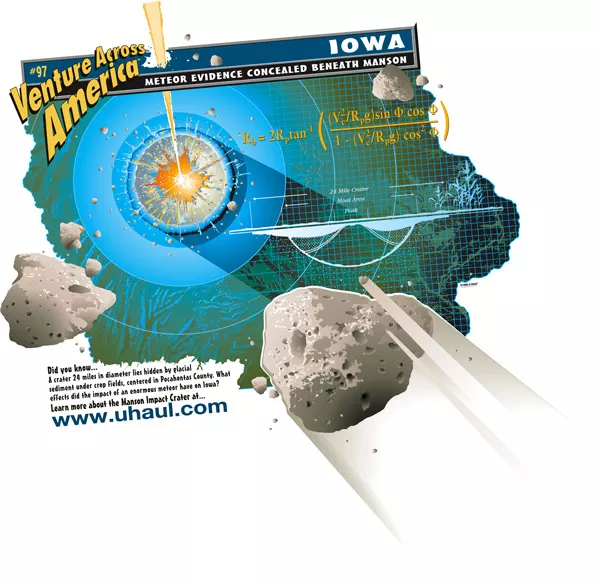
When studying craters and crater formation, scientists and geologists not only study the structure and geologic makeup of these impact sites, they also try to understand everything that took place as the crater developed. One common calculation used by scientists and geologists involves the analysis of the distance that debris was thrown from the crater. A small fraction of the materials actually escape the Earth's gravitational field. To calculate the distance material is ejected from the crater, with relation to the angle it is being ejected and the velocity at which it is being ejected, scientists use the Ballistic Range-Velocity Formula.
Rb - Ballistic range
Rp - Radius of the Earth
g - Acceleration due to the Earth's gravity
Ø - Ejection angle
Ve - Ejection velocity
More about this equation can be found in Impact Cratering: A Geologic Process by H. J. Melosh.
A few significant meteorite impact structures include:
-
Barringer
Meteor Crater, Arizona
In the 1920s, the Barringer Meteor Crater, near Winslow, Arizona, was the first crater to be identified as an impact crater. This crater was formed approximately 49,000 years ago when a small asteroid, roughly 80 feet in diameter, impacted the Earth. This simple-impact crater measures three-quarters of a mile in diameter and 650 feet deep. The Barringer Meteor Crater is said to be the best preserved and most studied crater on Earth. -
Chicxulub Crater -- Yucatan Peninsula, Mexico
Chicxulub impact crater, named after a village located near its center, has been linked to a major biological catastrophe: the extinction of the dinosaurs. Scientists believe this crater, which spans 110 to 180 miles in diameter, was formed by an asteroid that could have been 12 miles wide. The massive asteroid crashed into the Yucatan Peninsula more than 65 million years ago, within the same time frame when more than half of the Earth's species, including the dinosaurs, vanished.The asteroid landed on a uniquely sulfur-rich region, which caused billions of tons of sulfur and other debris to explode into the atmosphere. Scientists claim that the Earth was dark for approximately six months after the impact, causing temperatures to plunge to near freezing, resulting in the mass extinction at the end of the Cretaceous period. It is estimated that 1,000 to 3,000 feet of limestone currently rest atop this gigantic crater, concealing it from view.
-
Manicouagan
Crater, Quebec, Canada
The 62-mile-wide Manicouagan impact structure in Quebec is one of the largest and best preserved impact craters on the surface of the Earth. This crater is estimated to be 206 to 214 million years old. -
Aorounga
Crater, Chad, Africa
Approximately 200 million years ago, the impact of an asteroid or comet scarred the landscape we now call the Sahara Desert. Spanning 10.5 miles in diameter, the Aorounga Crater is believed to be accompanied by two additional craters. It is possible that the proposed string of impact craters was formed when an object (less than one mile in diameter) broke away from the asteroid before impact. -
Roter
Kamm Crater, Namibia, Africa
The Roter Kamm Crater reaches more than one and a half miles across the Namibia Desert. This impact structure is far deeper than it looks. Since the crater floor is covered by at least 300 feet of sand deposits, the 400-foot-deep crater appears to be only 100 feet deep. Geologists believe this crater to be approximately 5 million years old. -
Gosses
Bluff, Northern Territory, Australia
The Gosses Bluff Crater in Australia has endured more than 140 million years of erosion, and it shows. Spanning 14 miles in diameter, the rim of this large, complex structure has been completely eroded. The central peak ring, which spans three miles, is often mistaken for the crater's rim.