



What is it exactly?
The Armillaria Gallica
Armillaria gallica is commonly found in hardwood forests of North America, Europe and Japan and is one of about 10 Armillaria species found in North America. Each of the 10 species produce very similar looking mushrooms which decay wood for food and produce rhizomorphs. Rhizomorphs look a lot like plant roots and are the primary means by which Armillaria colonizes new woody food bases. The 10 Armillaria species do not interbreed and have slightly different ecologies. For instance, some species are more likely to cause tree disease than others, some prefer hardwood to conifer wood, some grow more rapidly in warmer temperatures and some grow more quickly where it is cooler.
The Armillaria gallica is commonly known by two names: as the "honey mushroom", because of its color, and as the "shoestring mushroom," because of the appearance of its rhizomorphs. The mushrooms, which are the only edible part of the Armillaria gallica, are normal in size, 3-10 cm in width and 8-20 cm in height and grow above ground on stumps or above decaying wood in the autumn (typically late September and early October). They grow scattered over the entire colonized area and form most abundantly several years after logging. Mushroom production then declines with time between forest disturbances.
Armillaria gallica provides essential benefits to our environment. As the microscopic fungus filaments (hyphae) branch through the soil, they seek out dead wood for food. As the Armillaria gallica grows, it produces water and carbon dioxide. Plants, in turn, require carbon dioxide for photosynthesis, which releases oxygen. Without organic matter decomposition, the supply of oxygen would be depleted in a matter of decades. Decomposition also reduces the amount of fuel in the forest, reducing the likelihood of catastrophic forest fires. Additionally, decomposition adds organic matter to the soil, improving soil fertility.
How to spot an Armillaria gallica
It is very important to look at many details of a mushroom to be able to accurately identify it. The shape and texture of the upper- and underside of the fruitbody, the appearance of the stem and how it is attached to the substrate, and how the gills are joined to the stem are all keys to identification.
"All Armillaria species also have their fruiting bodies attached to black shoestring-like rhizomorphs, which help the fungus grow through the substrate," says Tom Volk. "Armillaria gallica can be distinguished from other Armillaria species by the cobwebby partial veil and usually has a bulbous base. There are some microscopic characteristics that help distinguish it also. Unlike many other Armillaira species, it is not pathogenic -- it does not kill trees as A. mellea and A. ostoyae do."
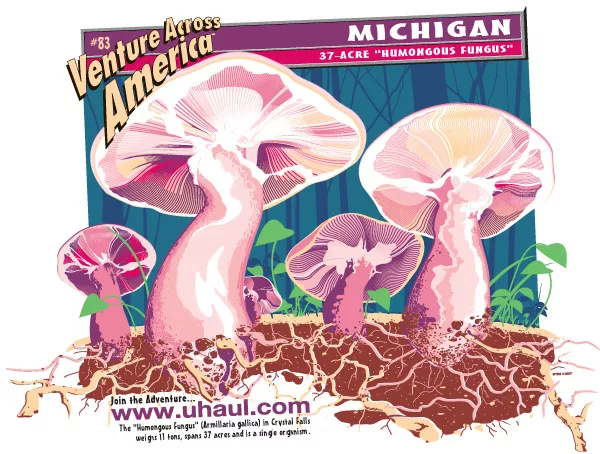
The U-Haul SuperGraphic of the Humongous Fungus is an artist's rendition of what a true Armillaria gallica looks like. There are additional pictures of Armillaria gallica specimens available on the web; one is pictured below.