





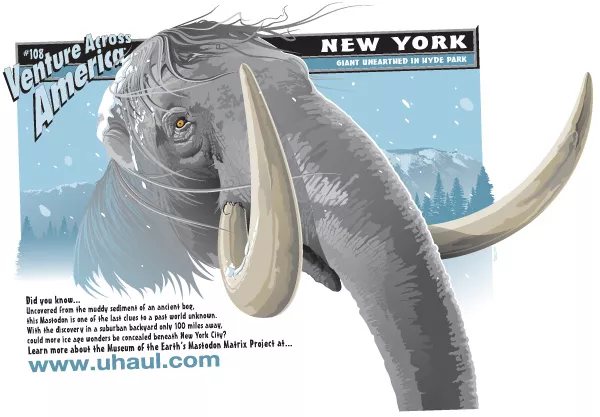
Meet the relatives
Modern elephants are part of the Elephantidae in the mammalian order Proboscidea. There are two types of modern elephants: the African elephant and the Asian or Indian elephant. The African elephant is the largest living land animal, weighing approximately 16,500 pounds, and measuring 25 feet long, with a 4.5 foot tail and stands 13 feet tall at its shoulders. The biggest Asian elephant is 20 feet long with a 5-foot tail and weighs 11,000 pounds.
The most distinguishing characteristic of the elephant is its long, muscular trunk, or the proboscis. The trunk is an elongated nose with nostrils at the end. It also has one or two fingerlike projections which allow these animals to investigate and grasp small objects. The trunk is also used to detect danger. Elephants drink by sucking water into their trunks and then squirting it into their mouths. An elephant's head is quite large and they have a very little neck. Both male and female African elephants have tusks, which are elongated incisor teeth, one on each side of the upper jaw. Female elephants have smaller tusks than males. An elephant's skull consists of "inflated" bones, which are divided into numerous pockets that allow the huge skull to be lightweight, yet still very strong. The size allows for greater surface area on the outside so that muscles can attach themselves to the bone. Paleontologists study these animals' teeth to determine what the similarities are between modern elephants and extinct mastodons and mammoths. The teeth of a modern elephant and the extinct wooly mammoth are so alike that it provides evidence that these are the most closely related of the three.