

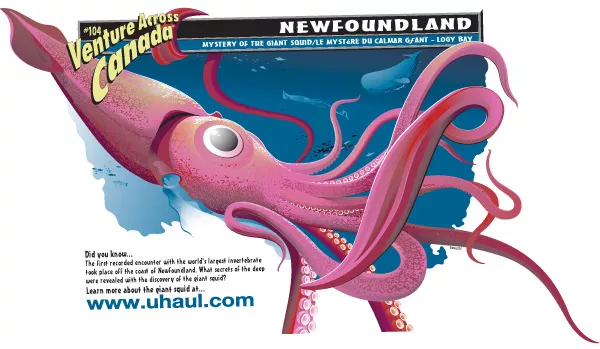
Chief of the Squids
Twenty-thousand leagues under the sea - or somewhere beyond - lives a deep-sea mystery. This mysterious underwater world is considered by many marine biologists to be the last frontier.
Author Jules Verne fascinated and frightened many with his book, 20,000 Leagues Under the Sea, which depicted a terrible sea monster that would strike at seamen's hearts, overturn fisherman's boats and drag them beneath the ocean to their doom.
So little is known about this massive creature, its story is comparable to the Loch Ness Monster, a tall tale, or some Hollywood scary movie full of mystery of the deep, dark waters.
Imagination and fear-mongering aside, this sea creature is simply known as the giant squid - a squid that can weigh up to 1,000 pounds - the weight of an average horse - and grow to about 60 feet when the tentacles are extended, similar to a large whale.
No one has ever seen the giant squid in its natural habitat, and perhaps no one ever will. But one thing is for certain: wherever it lives in the deep, dark recesses of the ocean, its home is its kingdom. And its kingdom is a well-kept secret. But what little is known about this creature is fascinating and eye opening. Follow along in our deep-sea voyage as we uncover the mysteries of the giant squid.
Giant squid can measure up to 60 feet long, about as long as two school buses. Because of the creature's eight long arms measuring about 9 feet and two tentacles that reach out to between 32 and 39 feet and heavily lined with powerful suckers, scientists surmise that most sea animals probably don't escape an encounter with it. The giant squid has the ability to easily seek and destroy in dark seas because it has enormous, highly developed eyes - about the size of 10-inch dinner plates -- positioned on the side of its head. Scientists have studied the gigantic retinas of the eyes and concluded that they bring in much light and give the squid the superior viewing power it needs to stay ahead of its predators and find its prey.
The giant squid, with its streamlined, oblong body, can slice through the waters because it is jet-propelled. A funnel located just under its head acts like an engine to give it the speed and the mobility it needs to move in all directions. The squid gets water from the mantle opening and shoots it out through the funnel. These quick movements can send it zooming away from predators in the blink of an eye. The funnel is also the organ through which waste, ink and eggs flow. However, scientists believe that it isn't as fast a swimmer as smaller squid, which can race through the waters at 20 m.p.h., making it hard for fishermen to catch them. Its fins, which point sideways at the end of the mantle, act as stabilizers to keep it steady and adjust its position but scientists believe that these are unusually small and weak, and don't work as well on a very large body. Squid aren't always racing around, though. They can also just use their fins to swim slowly through the waters.
Scientists can make only educated guesses about what the giant squid is like, based on information known about other squid, which are a part of the cephalopod class. For example, squid are known to grow very fast and reach maturity in less than two years. Scientists have found out that they don't live very much longer. And examinations of dead specimens of giant squid suggest that they, too, live only for perhaps five years. During mating season, squid release large quantities of eggs that are only a few millimeters long. So for a squid to put on 1,000 pounds (500 kg) or more and grow into a giant in three years is astounding. They must eat a lot and still escape from their own food-chain enemies, sperm whales, who work up a healthy appetite and crave a diet of squid.
But, even then, scientists know that giant squid put up a good fight. They have observed round battle scars on the bodies of sperm whales that could only be from the numerous suckers that line the inner sides of the squid's arms. Each arm is lined with two rows of suckers from one end to the other. One of the arms of the male giant squid, however, is a little different. Instead of suckers on the tips, they have rectangular pads used to transfer packets of sperm called spermatophores to the female squid. In oceanic squids in general, spermatophores are implanted inside the mantle cavity or around the head. Spermatophore implantation in giant squids has been observed very rarely, in the tissues of the head and arms.
The two tentacles that reach out to grasp prey are longer than the arms and have suckers too, but suckers appear only where the tentacles widen to a club shape and then burst into four neat rows.
Suckers rise from the base of the arms as cups of muscle equipped with sharp, tooth-like, chitinous structures lining the circumference that can stick into prey or predator when the suction of the cups is applied.
An animal caught by a squid goes from this powerful grasp to the horny-toothed parrot-like beak of a mouth that bites into prey and tears it to pieces. The radula, mounted on the tongue, is the thorny gate that pushes the food down the throat before it gets to the digestive system. Researchers don't know exactly what giant squid eat, but it's guessed that they eat small deep-sea fish and other species of squid.
Little is known about giant squid because no one has ever been able to observe one in its natural habitat. Scientists have made repeated attempts to travel to the deep parts of oceans, but no one has had any success in catching even a glimpse of a giant squid! They are simply one of the most elusive creatures on the planet.
Unlike tales of other sea monsters that may or may not exist, scientists know that the "chief squid" does indeed exist because many have washed up on shores around the world or have been caught in fisherman's nets. But this raises another question: Why have these giant squid only turned up one by one? No one knows that answer either. If scientists could find the giant squid's exact habitat they would be able to learn much more. For now, research can be done only on the washed-up, white, decaying and entangled bulk that lands on shores or decks far from its home.
When huge squid come up to the surface, seafood lovers of calamari might think that if they got a hold of one, they could feast. Think again. Scientists have sampled this species and, to their dismay, found it not palatable because of its bitter taste. But for the tasting, the courageous scientists never would have discovered that this species concentrates huge amounts of bitter ammonia that give the animal its ability to float in the water.
Squid stories
For many years, this giant, with its super-long flailing arms and tentacles, has been the source of many a sailor's harrowing sea stories. Others have just let their imagination run wild. In 20,000 Leagues under the Sea, Jules Verne wrote about a sea monster of "colossal proportions." Ian Fleming featured it as the creature that was going to bring about the demise of his dashing hero, James Bond, in Dr. No.
It wasn't until 1873 that a real-life sighting of this ink-squirting enigma, the world's largest invertebrate, was recorded. For the folks of Portugal Cove, Newfoundland, this brought much notoriety.
As the story goes, a 12 year-old boy named Tommy Picco was out fishing with two others when all of a sudden his boat started getting sucked underwater. The sea monster wrapped its long, powerful tentacles around the small fishing boat. Tommy found himself face to face (or rather face to tentacle) with the fabled sea monster. He quickly grabbed an axe and whopped off an arm and a tentacle! The severed limbs were then taken ashore. One was stolen and eaten by dogs and another was given to a local collector.
Reverend Moses Harvey examined this 19-foot appendage and displayed it for all to see. He believed that an appendage of this size could come only from a creature that he estimated to be about 72 feet long, weighing around 1,200 pounds. Over the years, other specimens of the giant squid have been found. Reverend Harvey eventually managed to get his hands on a whole squid at Logy Bay near the city of St. John's.
But, until recently, studies showed that giant squid were turning up on Newfoundland's shores only every 30 years or so. The 1870s were a popular time for such "visitations." Then they resurfaced and started popping up again in the 1900s. They disappeared once more and came back in the 1930s and then went away and showed up prominently again in the 1960s.
It's hard to know if this is an accurate picture, since Newfoundland has many hidden coves and giant squid can wash ashore without anyone ever knowing. High rocky cliffs, secluded bays and a multitude of coves characterize this land that juts solitarily out into the North Atlantic Ocean. Newfoundland, the most easterly place in North America, consists of two sections that make up this province: the mainland called Labrador and the island of Newfoundland. The island features a rugged coastline that measures about 8,498miles (13,678 km), with numerous inlets and islands.
Scientists have noted that most of the giant squid sightings and strandings in Newfoundland have occurred on its northeastern shores, in the Bonavista and Trinity bays, and there have been strandings in the 1970's and 1980's.
Travels along a current
Giant squid are deep-sea creatures. Since the waters around Newfoundland are not deep, why or how do they end up there? One theory is that the Gulf Stream, a powerful current that flows northward along North America's east coast, carries them from the deep oceans. The Gulf Stream is a fast-flowing warm water current that eventually meets up with the Labrador Current, a very cold and fast-moving current that flows south from the Arctic. These two currents meet off the northeastern shores of Newfoundland, where there is a sudden drop in temperature. Scientists know that squid in general don't react well to a drastic change, so that could help to explain why giant squid succumb to this environment. Evidence of this theory is provided by the fact that Newfoundland has been the landing place for more giant squid in the fall and winter months. However, some scientists believe that squid may already be worn out and sick by the time they reach these waters. They may indeed be driven from their home waters in search of food. While there is no conclusive evidence of what happens to a giant squid traveling along these currents, this theory could explain why the shores of Newfoundland become their ultimate, if unintended, destinations.
Giant squid appear to be the loners of the squid class and scientists don't know if they ever swim with others, or if they are generally creatures who prefer their own company.