
Fire on the Water
On September 15, 1773, 189 very tired Scottish settlers arrived in Nova Scotia after spending two and a half months inside the rotting Hector ship. Thirty three families and 25 single men were the passengers who first settled in the town now known as Pictou.
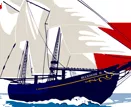
The Hector, a Dutch "Boot Ship" designed to carry cargo in the mid-18th century, left for Nova Scotia in July 1773. She was rigged as a three-masted ship with an overall length of 110 feet.
The passengers had to endure a very hard trip, which included a gale off the coast of Newfoundland that blew them off course and added two weeks to the trip and a smallpox outbreak that killed 18 children. Water had to be rationed, and a food shortage became so severe that the moldy scraps of bread discarded earlier in the voyage were eaten during the last days of the journey.
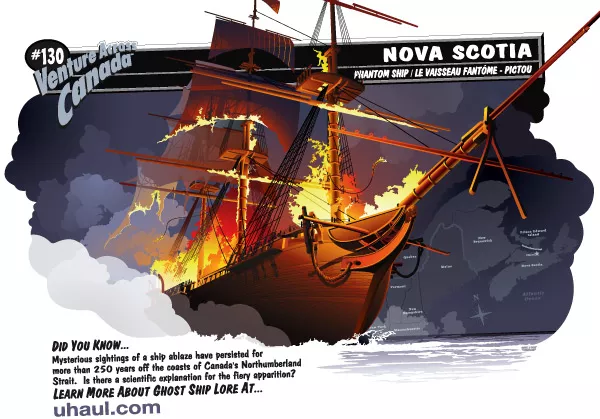
Today, a full-size replica of the Hector sits at the Hector Heritage Quay as a reminder of those first hardy Scottish settlers, and the voyage that established Pictou as the "Birthplace of New Scotland." It was also the same settlers who brought word of another ship that sailed from Scotland, but never made it to Pictou, perhaps becoming the infamous Phantom Ship. Are those lost voyagers doomed to forever sail the waters of Nova Scotia, searching for their final resting place?
Or perhaps the Phantom ship existed even before these Scottish settlers. The Mi'kmaq, a First Nations people indigenous to the area, originally called Pictou Pictook, which means exploding gas. It is thought that this is a description of the "fire" that was seen out in the water, or, more specifically, underwater coal beds igniting. Does this mean that there could be a scientific explanation for the Phantom Ship?