
Introducing the Inuksuk
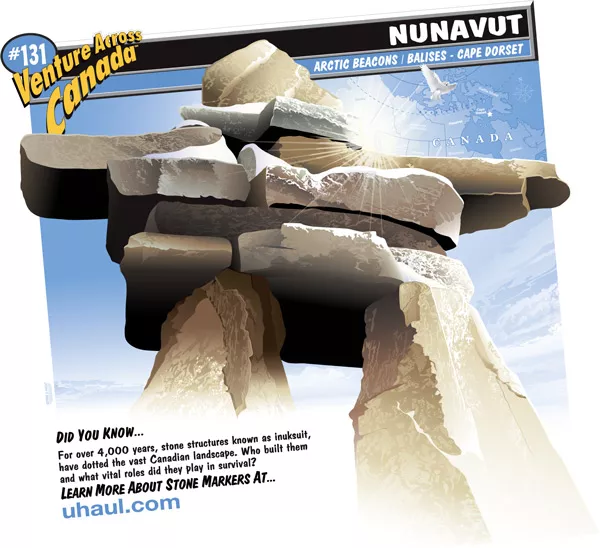
The flag of the Canadian territory of Nunavut bears an Inuksuk as its symbol. Once seen only in the north, groups of Inuksuk, known as Inuksuit, look down from roadside perches across Canada.
In gardens and campsites and trailheads across North America and even around the world, Inuksuit bear a message from the land and those who have come before: you are not alone.
A few stones can form a greeting, a guidepost, or warning. They can mark a tragedy or the scene of a great event. Inuksuit require no money, no electricity, not even a common spoken language. All that is needed is a builder, a few stones, and the knowledge needed to decipher the Inuksuk's message.
The Inuit knew animals captured in the hunt were not game so much as allies, willing to sacrifice their lives so the Inuit could continue theirs. That's why the bear whose rib supplied a hunting knife was often depicted on the knife's handle.
Because obtaining the staples of life was never easy, the Inuit harvested only what was needed and used every bit of what they took. Connected to the earth, they used her gifts wisely and reverently.
It is that spirit of connectedness that makes the traditional Inuit life a model for civilizations around the world and makes the Inuksuk such a worthy symbol for all.
– Mike Ulmer, author ofThe Gift of the Inuksuk
The inuksuk was an important figure in the Inuit culture of the past. The word inuksuk means "thing that can act in the place of a human." Two or more inuksuk are called inuksuit. A number of inuksuit built many years ago still dot the Canadian landscape and some of these have been standing for hundreds of years. These ancient inuksuit can be identified by their lichen-covered rocks, which were stacked so as to withstand fierce Arctic storms. These old inuksuk shared a common purpose of communication and navigation for the Inuit people of long ago. Most importantly, they saved lives in a harsh environment.
A basic form of inuksuk was a stack of rocks – a form still recognized in the modern world as a trail marker. Rocks were carefully selected so they could be stacked upon each other and balanced so they would not fall even in 100-mph winds. The rocks were stacked to help show a traveler a route when they were unfamiliar with the area or when they were a long way from home. In a flat and snow-covered environment without many natural landmarks, a stack of rocks provided travelers with a directional marker and a sense of reassurance that someone had passed here before. An inuksuk could also mark the site of a dangerous place or mark the site of good fishing or hunting. Sometimes inuksuk were used to mark where food was stored (a cache ) or mark a spot where something important happened to indicate this was a place where people should be respectful.
One of the most important reasons an inuksuk was built was to assist Inuit hunters. This was accomplished in several ways. The Inuit caribou hunters could build inuksuit so that they would "act in the place of a human." Passing caribou could be frightened by inuksuit . To avoid passing near inuksuit , caribou would often change their route and head towards waiting hunters. There are stories of some inuksuit in the Inuit hunting culture being built with moss atop their "heads" in a way which reminds us of the scarecrows of a farming culture. The specific word for inuksuk that were built in the way to frighten caribou, meaning "scarecrow" or "bogeyman," was aulaqqut . In this way, an inuksuk did the work of an Inuit hunter.
Inuksuit , such as the aulaqqut, are named for the many different purposes they served. For example, an inuksuk built at a good place to cross a river was an ikaarvik , an inuksuk signaling a good place to hunt seals was an inuksuk natsiqarniraiju and inuksuit used to drive caribou towards hunters were usukjuaq. There is even a term for the kind of inuksuk that was built to demonstrate the great strength of its builder: it is an sakamaktaq. In the glossary of this site you will find some of the Inuit terms used to describe the numerous and very important reasons inuksuit were built.
Inuksuit which were actually built in the shape of humans are called innunguaq (often spelled inunnguaq). Innunguaq means "in the likeness of a human" and they were built with stones stacked and placed to look like a human body with arms and legs. They were also built with a round-shaped rock placed on top of the stack to look like a human head. There were many reasons for building innunguag. They were built as a way to express gratitude, or signal that humans are living in the area or as a monument to a person who had died. Innunguaq continue to be built in modern times.
In an ancient time and place, there was a need for humans to navigate and communicate.
In order to be able to hunt in many different places and seasons it was necessary to travel long distances and communicate many messages. Long before high-tech devices such as global positioning satellites (GPS) systems and digital communications (cell phones) existed, and long before wire or radio transmissions and electricity, and even long before telescopes, compasses and maps were made, humans found ways to navigate and communicate. The ancient inuksuk was built for these purposes and were vital for the survival of ancient people and for the Inuit people as recently as a few hundred years ago.
Inuksuit and the innunguaq are still built in many parts of the world. They are built in modern times to symbolize teamwork and a spirit of connectedness. Building an inuksuk honors the culture of the spirited people who built them to ensure their very survival.