
Lewis in Pennsylvania
In January 1803, President Jefferson asked Congress to approve the expenditure of $2,500 for a fact-finding expedition overland to the Pacific Ocean. This was a wild idea for many people, especially considering that in 1803 two out of three Americans lived within 50 miles of the Atlantic Ocean.
The West seemed a million miles away for most Americans.
Despite some opposition from Federalists, many of whom opposed any talk at all of westward expansion, Congress overwhelmingly approved the expenditure. Some historians reason that the expense may have been approved so easily because only a week earlier Jefferson had the much tougher task of winning approval for the expenditure of up to $9 million for the famous Louisiana Purchase. Compared to that, what was a mere $2,500?
Shortly after getting the green light from Congress, Jefferson named his personal secretary, Meriwether Lewis, as the man who would lead the mission. Lewis, who grew up in Jefferson's own Albermarle County, was 28 years old at the time. While some didn't believe Lewis would be the best man for the job, Jefferson remained convinced that he had his hero.
To prepare for the expedition, Jefferson decided to send Lewis to Philadelphia, home to some of the finest scientific minds in the nation. Jefferson wanted Lewis to get a quick schooling on everything from astronomy to botany to geography so that he'd be better equipped to record facts during the trip. It was during this trip to Pennsylvania that Lewis began working on the details of the upcoming journey; deciding how many men to bring with him; choosing what supplies to bring and what to leave behind; deciding the type of vessels to use.
It was also in Pennsylvania that Lewis hatched the idea to bring another officer on the journey.
On his way to Philadelphia, Lewis stopped in Harper's Ferry, located at the confluence of the Potomac and Shenandoah rivers, in present day West Virginia. Maryland lies just across the waters, and Pennsylvania is but a few miles away. Here, he began purchasing supplies for the trip. He bought 15 muzzle-loading rifles, sometimes referred to as "Kentucky" rifles, but as historian Stephen Ambrose writes in his Lewis and Clark book "Undaunted Courage," they should more properly be called "Pennsylvania" rifles. Also at Harper's Ferry, he bought dozens of knives, tomahawks and fishing equipment.
The first town he stopped at in Pennsylvania was Frederickstown, where he purchased nearly $300 worth of "portable soup." Historian Ambrose writes that it was, by far, the most money he spent on any provisions, and more than he originally intended to spend on instruments, arms and ammunition combined.
From Frederickstown, it was on to Lancaster, where he spent several weeks with the United States' leading astronomer and mathematician, Andrew Ellicott. The scientist taught Lewis how to use a sextant (a navigational instrument), the chronometer (an old school clock) and other instruments. Also in Lancaster, Lewis bought more rifles.
From Lancaster, it was on to Philadelphia, where Lewis began studying with another scientist, Robert Patterson. His medical instructor was Dr. Benjamin Rush, a signer of the Declaration of Independence and the most well-respected physician in the nation. He provided, among other things, 50 dozen "Rush's Pills," also known as "Thunderclappers," a powerful drug made of mercury, chlorine and jalap. During the journey, Lewis, Clark and the rest of the band would use "Rush's Pills" for any and all ailments.
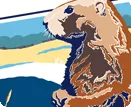
In the field of botany, Lewis consulted with Dr. Benjamin Smith Barton, who proved incredibly helpful. Barton taught Lewis how to preserve animal and plant specimens and, just as important, how to label each one. This proved valuable during the journey when Lewis discovered prairie dogs along the Great Plains. After much effort, the men on the journey finally were able to kill one of the small animals and send it back to Jefferson on the keelboat. Evidence exists that Jefferson received the prairie dog and was intrigued by it.
Finally, Lewis met with Dr. Caspar Wistar, who talked to Lewis about mastadons that he and Jefferson believed might still inhabit the western part of the continent.
In addition to his studies, Lewis also continued to buy supplies for the trip: medicines, dry goods, tobacco, clothes and carrying cases. On these items alone he spent nearly $2,500, the initial budget for the whole trip. Lewis also bought gifts, or trade items, that he would use to offer to Indian tribes along the journey. The gifts included everything from silk to scissors to knives to sewing threads to earrings.
Of all the supplies he bought, the only things he made sure he had enough of were rifles, ammunition and gunpowder. And while he ran out of many supplies during the journey, including whiskey, salt and other non-essentials, the team actually returned from their journey in 1806 with enough powder, lead and rifles to turn around and do it again! As historian Ambrose writes,
"Lewis had the frontiersman's faith in his rifle. As long as a man had his rifle, ammunition and powder, he would take on anything the wilderness could throw at him."
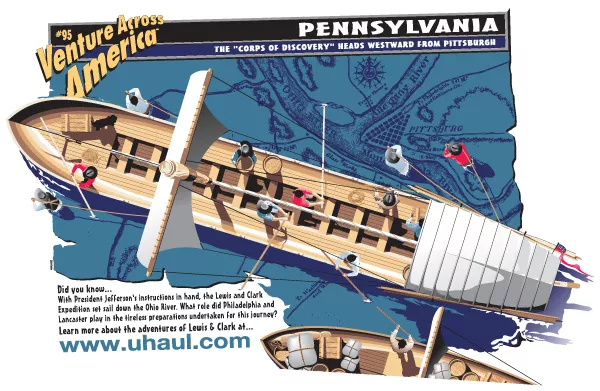
After completing his studies and buying supplies, Lewis finally left Pennsylvania for a final meeting with Jefferson. All in all, he remained in Pennsylvania for about two months. After meeting with Jefferson, however, he would return to Pennsylvania, this time to get the keelboat that would carry them on their journey.