


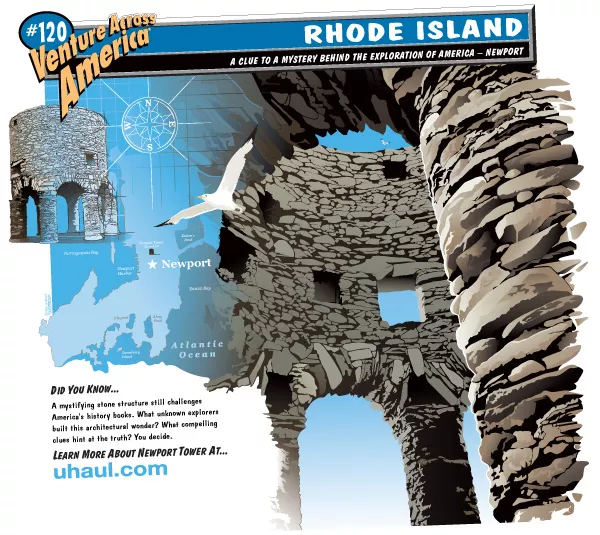
Old Stone Mill
One of the most popular theories regarding the origin of the tower dates back to the colonial time period of Governor Benedict Arnold (ancestor of the infamous Benedict Arnold). To many, the tower appears to be much older than the 17th century. However, the first written record of the tower can be found in Arnold's will, dated 1677. On Christmas Eve of that year, he detailed in his will who his executors should be, who would receive each piece of his property and where he should be buried. From his will:
"My body I desire and appoint to be buried at ye North East corner of a parcel of ground containing three rod square being of and lying in my land in or near ye line or path from my swelling house leading to my Stone Built Windmill, in ye old town of Newport... "
This Stone Built Windmill that Arnold was referring to is, of course, the same tower that sits in Touro Park today. The tower is mentioned twice in his will, once as the location in which his body was to be buried, and again to describe the acres of land he wished to leave to his wife. While he does state that he owns the structure, and refers to it as a windmill, nowhere in his will does he state that he built the windmill.
After his death in 1678, the tower was passed on throughout his lineage for many years, finally being sold to former Rhode Island Governor William C. Gibbs in 1808. In 1848, Gibbs told historian Brian Lossing, who was doing research on the tower, that it was used by the British as a powder magazine during their occupation of Newport from 1776 to 1779. He stated that upon their retreat, they tried to blow it up with a keg of gunpowder, a fact that could be corroborated by the previously mentioned shrinking of the tower. A 1770-1775 painting by Gilbert Stuart does indeed depict the tower as being approximately six feet taller, which could prove that there could be some truth to Gibbs' story.
The Newport Tower does not resemble a typical windmill; the only similarity seems to be the cylindrical shape. However, in 1847, David Melville, a Newport pewterer, chanced upon a picture of the English Chesterton Windmill, in Warwickshire. The Chesterton Windmill, as seen in the photograph on this page, is very similar to the Newport Tower. Melville also pointed out that Arnold was said to have been born near Warwick, England. Since that date, supporters of the Arnold theory believe that the Chesterton Windmill was the inspiration for Arnold's windmill in Newport.
In 1993, researchers Jan Heinemeier and Hogne Junger used a new C-14 (carbon dating) technique to date the mortar of the Tower. They took a total of seven samples of mortar from the Tower, and, as a control, a small piece of mortar from the Wanton-Lyman-Hazard House of Newport, which was known to have been built between 1676 and 1698, the same time period Arnold would have built his windmill. After four years of study, the Danish-sponsored Committee for Research on Norse Activities in North America, the group responsible for the carbon dating, released their findings. They stated that there was a 95 percent probability that the Newport Tower was built between 1635 and 1698, making it likely that the tower was built by Benedict Arnold or one of his contemporaries.