
Beneficial Bog
At nearly 8,000 acres, Burns Bog is the last of its kind and is the only bog in North America. Burns Bog's height and size are so distinct and large that it can be seen from outer space. Ecosystems similar to Burns Bog were drained long ago and converted to agricultural, making Burns Bog a rare treasure.
Burns Bog can be divided into two worlds: terrestrial and aquatic. It is a biodiverse mecca of water, moss, plants, trees and ecological rarities.
Burns Bog is symbiotic, as are many of nature's works of art. The Earth feeds it with nutrients, while the bog permanently stores carbon dioxide (a greenhouse gas). Life on Earth relies on this storage of carbon and release of oxygen to maintain balance in the air we breathe.
Carbon is stored underneath the surface of the bog, where plant remains decompose very slowly due to the acidic and oxygen-poor nature of the sphagnum peat - the predominating layer that makes up the bog.
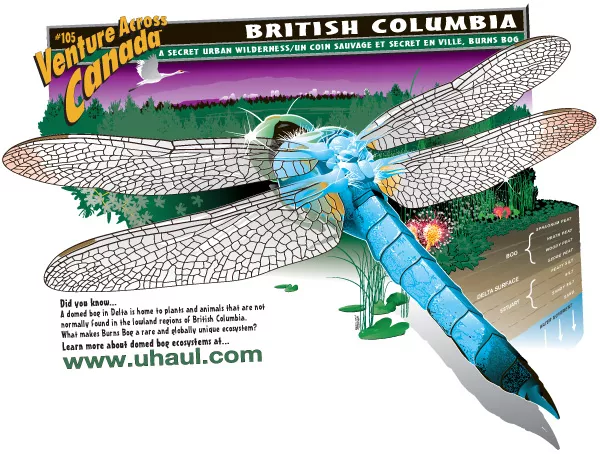
Two subarctic species of Blue Darner dragonfly reside in the bog and are among a large variety of plants and animals that have been known to live only hundreds of miles to the north, in colder climates. It is very unusual to find these dragonflies this far south.
Some scientists believe that more carbon is stored in bogs than in rainforests – up to three times as much. And so if bogs disappear, thousands of years' worth of stored-up carbon dioxide would be released into the atmosphere. This would worsen the greenhouse effect - the warming of the Earth's surface and lower atmosphere as a result of carbon dioxide and water vapor in the atmosphere. The main greenhouse gas is carbon dioxide.
These benefits are often taken for granted because the benefits cannot be seen with the naked eye.
Bogs also absorb precipitation, an important ecological function in preventing downstream flooding. They also filter runoff water.
Preservation
"Burns bog is one of a vanishing kind..."
– David Suzuki, Ph.D.
There are two sides to every story. And so is the case with Burns Bog. It has been called a place of "spiritual serenity in the midst of the maddening crowd of noise, traffic congestion and air pollution" and "a wilderness in the midst of a metropolis."
It's an issue that has been debated for years.
Burns Bog has captured the attention of urban developers and conservationists alike with its available resources and unique environment.
The issue at hand for developers is land and peat. Cranberry and blueberry farming exists along the borders of the 8,000-acre bog. But once upon a time, Burns Bog was actually larger. In fact, it used to occupy 10,000 acres, but farming and other development has nibbled away at its edges.
Conservationists are worried about pollution, as the fertilizers, pesticides and herbicides used by farmers are seeping into the land. Also, Burns Bog is the site of Canada's largest landfill west of Toronto, and receives one quarter of all of British Columbia's solid waste.
In addition, there is a high demand for peat, as it has many commercial uses. And the bog happens to be a primary resource for this material. Peat is a valuable fuel source, utilized in Ireland as fuel during the winter and mined in the old Soviet Union to supply fuel to generating stations. Drained peatlands are very fertile and often used for farming. Peat also can be sold as a soil conditioner for seedlings in nurseries. Other uses include: absorbing oil spills, hot peat baths used in the treatment of injuries and rheumatism, a mineral wax for leather polish and crayons, and a medication for eczema, ulcers, burns and poor eyesight.
However, the downside is that peat takes 40 years to renew itself after being harvested. But there are alternatives to peat, such as chipped bark and wood waste. The waste from beer brewing can also be composted and used in a garden as an alternative to peat.Conservationists claim that development is changing the climate. The bog was once entirely covered with plants that thrived in a very wet and acidic environment. Today, only about half of these plants cover the area, which is becoming an increasingly drier, forested area.What cannot be ignored is that the survival of Burns Bog has ecological and global significance. It has proven invaluable as both an educational and recreational tool. The ecosystem of Burns Bog is unique, fragile and threatened. It took a few millennia to grow but, sadly, it has only taken about 100 years to see the changes that could destroy it.
In the 1980s, a private company bought more than half of the bog and proposed turning it into a port, a racetrack or a golf course. Nearby residents strongly opposed these ideas and, thus, the Burns Bog Conservation Society was founded. The Burns Bog Conservation Society is a nonprofit organization formed by people determined to conserve and preserve Burns Bog.
Less than two percent of Burns Bog has been preserved in the Delta Nature Reserve. The rest of the bog is owned by various public and private interest groups. A study conducted by the Provincial Ecosystem Review concluded that 6,000-8,000 acres must be protected in order for the bog to survive. Its wetland community and all surrounding areas have become so intertwined that in order to save the bog, the whole area must be kept intact.
The report urged the cooperation of all levels of government to maintain the size of the bog and stabilize its unique ecosystem. If the correct measures are taken, the authors of the report believe that, for generations to come, the unique ecological environment of Burns Bog will remain an urban wilderness filled with some of Canada's rarest plants and animals.
After all, extinction is forever.