
Interview with an expert
Burns Bog Dr. Richard Hebda
Friday, September 8, 2000, and this is Tracey Price with U-Haul International speaking to Dr. Richard Hebda, head of Botany and Earth History at the Royal British Columbia Museum. Good day Dr. Hebda.
T. I wanted to start by asking you, in brief, how was Burns Bog formed?
H. Burns Bog developed on the newly emerging surface of the Fraser Delta at about ... Well, the story really began around 5,000 years ago as the sediments in the Fraser Delta continued to accumulate and get thicker. The surface of the Delta where the bog is today essentially rose from beneath the ocean waters. In marine deltas, what happens is that the surface becomes emergent during low tide and then is submerged during high tide.
At the point where the delta surface was below water about half of the time, plants began to grow there. These were largely marsh or brackish marsh plants, As they grew, their remains, plus organic material added from the river itself, began to change the character of the sediment. It changed from mainly sand and silt with a little clay to having a lot of plant material in it. As the surface emerged and the plant material accumulated, it became a really nice setting for plants, such as sedges and cattails and other kind of plants that grow in an environment that is wet and sometimes flooded.
As the plants died and added more of their bodies to the accumulating delta materials – the sediment on top of the delta – they further changed the chemistry of the surface. In fact, the plants raised the surface by the addition of their very slowly decomposing bodies. As the chemistry changed and as the surface rose closer to the waters' surface, a different group of plants came in … sedges. At first they predominated but, as their material added to the surface and the delta surface rose, woody plants began to grow. That, of course, added more material to the surface of the area where the bog was developing. Being woody, it was even less likely to break down quickly.
Progressively, the chemistry became quite acidic and the surface turned relatively dry compared to what it had been. About 3,500 years ago, the landscape was mostly above flood water and acidic enough that special plants began to grow there, such as sphagnum mosses and other shrubs. At that time, the bog truly took form, and from that point on, it was really constructed or engineered by the sphagnum mosses. Their decomposing body mass made the bog more acid and changed the hydrology in such a way that the bog was essentially retaining most of the water that it received during the wintertime. This kept the bog wet throughout the entire year. Even as the mosses grew upward, they still maintained that wet layer because of the properties of the mosses.
In this wet, acid, spongy environment, other species typical of the bog like Labrador Tea, Lodgepole Pine, bog blueberries, and the Insectivorous Sundew moved in and began to grow very well. At this time, the bog was not only was growing upward, but was growing outward and to cover much of the Fraser Delta, south of the Fraser River.
T. How large is the bog currently?
H. The bog today occupies about 2,800 hectares. It once occupied about 4,800 hectares, before significant parts of it were either filled, turned to agriculture or used for other purposes. This is quite a large area for a domed bog. It was one of a number of raised bogs that occupied the Fraser Delta, such as Lulu Island Bog which grew on the other side of the south arm of the river, and the bogs that occurred further up the Fraser Valley on the flats of the Fraser Delta. So, 4,800 hectares originally; 2,800 hectares now, but part of what was probably well over 10,000 hectares worth of raised bog in the Fraser Delta.
T. We're talking about a raised or domed bog. What are the main differences between a domed bog ecosystem and other bogs?
H. Let me begin by explaining a little about wetlands. Many people think of wet places with a bunch of plants growing in it as being a bog or boggy. More strictly speaking, we have three broad categories of wet environments.
We have swamps, which are full of trees and other woody plants usually quite shaded, but nevertheless wet. Their parts fall to the ground and add to the peat.
We have marshes, which are open, don't have woody vegetation, and the water table goes up and down. However, these usually don't accumulate a great deal of peat.
And then we have bogs. These are wetlands that can be partly wooded or not, but are very acidic and have sphagnum mosses as the dominant carpet of the ground. Domed bogs are a peculiar type of bog in which the sphagnum mosses continue to accumulate and grow. The outline of the bog on a flat surface looks like a big blob or sponge of material rising up off the surface, rather than filling in a depression which might be typical of the bogs people are familiar with. The plant material accumulates and maintains the water table up quite high. So in a very strange way, domed bogs, which are higher than the surrounding area, are often wetter than the surrounding area and their sources of water.
T. What exactly is a self-contained ecosystem?
H. Domed bogs are remarkable. They advance in and of themselves into the surrounding landscape and define their own margins in part. The limits of the bog are essentially the limits to which the sphagnum moss and the associated community occur. As sphagnum moss grows upward and the peat accumulates upward and outward, it spreads into surrounding environments. They are self-contained by virtue of the properties of the sphagnum moss and the way it changes the hydrology. Then the moss takes over the surrounding area. In a way, the moss spreads out onto the surrounding landscape until it is constrained or contained by factors such as uplands or mineral rich waters. Raised bogs can grow outward rather than being limited to suitable soils and conditions as is the case with forested ecosystems.
T. What exactly makes up the bog with the different layers of sphagnum starting from the water table?
H. What are the layers in the bog? The layers in a bog are related to a bog's history.
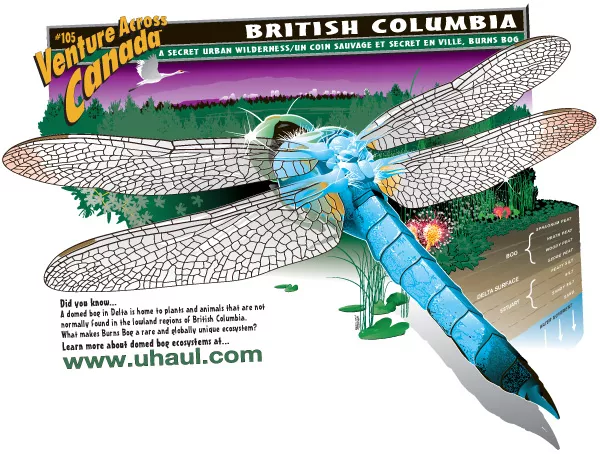
If I were to take a knife and cut through the bog, pulling part of it away like a big piece of pie, we'd see a very sandy layer at the bottom. This represents the kind of material that was laid down below the surface of the sea at the front of the Fraser Delta. Progressing upwards, we would run into layers that have much less sand and have a lot more silt or clay. These are the layers that form right at the surface of the Delta where the water level goes up and down. In this sediment, we'd also find a quite a bit of organic material; the remains of some of the sedges and rushes that grew at the front of the delta. Above this is the zone or layer that's dominated by sedge peat, which are grass-like wetland plants. Above this layer, we would find a woody layer, dominated by the remains of shrubby plants like Hardhack or Sweet Gale. Above this layer is the only layer in which we would find peat that is composed mainly of sphagnum mosses as well as the remains of the other plants.
One important role for peat forming wetlands is the storage of carbon. The plants die, the plant parts go below the water table, and then either don't break down at all or break down very, very slowly. In effect, the carbon that is turned into plant mass through photosynthesis is then stored below the water table. In effect, the carbon dioxide is scrubbed from the atmosphere very, very slowly.
It is important to note that if you change the characteristics of the bog, such as the stored carbon, then you're essentially releasing back into the atmosphere thousands and thousands of years of carbon. For the moment, this carbon is stored and kept out of the atmosphere.
T. What sort of plants can be found in the bog? I know you mentioned other plants. We wanted to talk specifically about the carnivorous Sundew and plants like that.
H. If you go wandering into the bog, you see a couple of things that are fairly obvious. First of all, you see a lot of pine trees and usually in the open or acid and wet part of the bog, the pine trees are very small--they look like bonsai pine trees. In among the trees and right up against the trunks of many of them is often a dense layer of beautifully and exotically scented Labrador Tea.
Under the Labrador Tea, especially in more open areas, there is a mass or mat of sphagnum moss – either in the form of carpets or in the form of hummocks or in nice pillow-like mounds. On this surface of moss, you'll find a lot of blueberries, especially Bog Blueberry or Bog Bilberry.
Toward the edges of the bog where it is a little bit drier, you'll find Velvet-Leaf Blueberry. The bog is the southernmost occurrence of this particular species. You can also find other members of the heather family – the family to which blueberries and Labrador Tea belong.
In little depressions there may be stands of cotton grass with their cottony heads waving in the breeze, and other sedge relatives such as the White Beakrush. In these wet sites or near these wet sites, growing in the sphagnum hummocks and in the mats are some remarkable plants, perhaps the most noteworthy of these is the Sundew.
The Sundew is an insect-eating plant or an insectivorous plant. Growing as a perennial, its leaves come up from a tiny little crown. It has a few, short tendrils just a few centimeters long that are bright red and attached by a narrow stem. The narrow leaf stalk joins a round, pad-like structure to the crown. Upon on it are these reddish hairs with glands on the tips. And on the tips, there are glistening drops of digestive fluid. Insects are attracted by these leaves, land on them, and are stuck to the glands of the tips of these hairs. The leaf begins to fold in toward the insect and begin digesting the soft parts of the insect. Nitrogen and phosphorus compounds are then taken back into the hairs of the leaf. This way, the plant gets the mineral nutrients that it needs. There are actually two species of Sundews, the round-leaf and the narrow-leafed one. The narrow-leafed Sundew is much rarer in the bog. So these remarkable insect-eating plants find the bog a great place to live, in fact, are superbly adaptable to surviving in the bog.
T. Is it unusual for any of the plants you described to be found in this area of British Columbia?
H. The bog provides quite a remarkable contrast to the surrounding area. These days, we are concerned about a feature of the landscape called biological diversity – the diversity of life.. A bog environment is different than the surrounding environment. They (bog plants) grow either in the Tundra or the Boreal Forest of Canada. The bog allows these plants to grow much further south – hundreds of kilometers south. The bog essentially provides a northern environment in a southern climate. Consequently, it's really very different and people can get a chance to see the North while not having to travel up to the Boreal Forest and also avoid all the insects and black flies, too.
T. So it is pretty unusual to see some of those plants there because it is a lowland area?
H. Yes, indeed. Well, it's not only a lowland area, but it's a bog habitat.
T. Can you comment on some of the animals that can be found also in the bog?
H. Because the bog is an unusual habitat, it also provides a different kind of habitat for animals. It remains a relatively large wild area within an urban setting and provides refuge for animals that used to roam around the landscape.
The first thing that people might think about is that bogs are wet places so there must be lots of opportunity for water birds. Canada geese, mallard ducks and, perhaps the most notable, the Sand Hill Cranes live there. Burns Bog is one of the last places for Sandhill Cranes in the Fraser Lowland. There are not many of them left anymore. They have raised young in the bog until recently and it's a staging point for these magnificent birds as they gather to head south where they spend the winter. There are all sorts of raptors such as eagles, hawks, and owls using the bog. Of course, a lot of the smaller birds, too. One of the things that you'll note when you come in through the forested margin of the bog are the chickadees, and the Juncos.
The bog also has blacktail deer, coyotes and a few bears. I had the pleasure of having a direct eye-to-eye encounter with a black bear. He shambled off after he realized I wasn't threatening his berries or him. On a smaller scale, there are beavers who build dams and have lodges and there are many raccoons, too. When you get down to the smallest scale, there are many, many deer mice. Deer mice occur all over the place. There are voles. There are shrews. There are frogs, unfortunately, the most abundant frogs, the American Bull Frog and the Green Frog, have come uninvited from other places. There used to be animals such as porcupine and even the red fox, but they appear to have disappeared because of the growing human influence around the edge of the bog.
Among these small animals, which play a very important ecological role in our recent work in the bog, is the Red-Backed Vole. This animal was thought to be extinct in British Columbia since about 1950, but a population of it was found living in the bog and apparently thriving. So, there is a large collection of animals that use the bog. If you look carefully when you're walking through it, you'll certainly see signs of them and, indeed, you may well see the animals themselves.
T. What are the main threats to the bog?
H. Burns Bog – because it sits in a large suburban, rural, and growing urban area really has two significant threats to it. The first one is simply something called conversion – that means converting the bog ecosystem into other types of ecosystems to agricultural land, a landfill, an urban development or industrial uses. And as I've mentioned already, probably about 2,000 hectares of bog have been converted in such a manner in the last century.
The other more challenging threat is changing the hydrology of the bog. Anything that changes the balance of water within the main mass of the bog threatens the bog's future. Even a little poke from the side, or a ditch that cuts right into the bog, especially one that cuts right through the bog, is a great hazard to the bog's future. It really takes away the winter water, increases the drainage during the summer and makes it very difficult for the water level within the bog to stay high. The mosses are no longer sustained and the bog begins to degrade.
T. Why is Burns Bog such an ecological treasure and why should people work hard at preserving it?
H. Though many people have many reasons for thinking of Burn's Bog as a special place, in an ecological sense, in a kind of a global sense looking at it's biological diversity significance. There is really no place like it on Earth. Its combination of plant species, the setting in the Fraser Delta, the water chemistry and the size of the bog all combine to indicate that this is unlike any other.
Domed bog ecosystems themselves are not that abundant because they are a special creation based on the work of sphagnum mosses. Also, many domed bogs occur in Northwestern Europe and have long been converted for agricultural and other purposes. There is a great interest and effort to restore those bogs or to maintain the small fragments of them.
On a global scale, the bog is ecologically exceptional. What makes it unique and important is that it is a self-contained ecosystem. It is self-constructed and grows out of its own accord. The bog provides an opportunity for people in Southern Canada and the Pacific Northwest to see species much further south than they would normally encounter them. And above all it's part of the region's natural heritage. Burns Bog is thousands of years in the making and is different than anywhere else on Earth. It is important to the history of the region and provides us all an opportunity to observe and learn about this heritage and really maintain it in perpetuity as long as we can for others in the world to see.
T. Well, it certainly sounds like a wonderful place; definitely worthy of being protected.