


Evolution of the Valley's Environment
Triassic Period
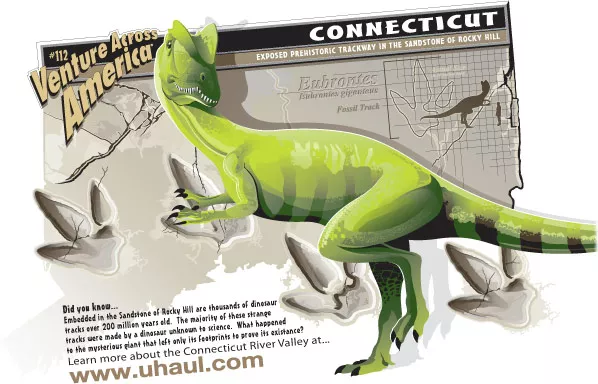
Two hundred and fifty million years ago, the Earth had only one huge landmass: a supercontinent directly over the equator. Geologists named this supercontinent Pangea. The interior of Pangea was hot and dry. Savannahs of drought-resistant cycads and conifers replaced the once-lush swamps, forcing a decrease in amphibians and an increase in dry-skinned reptiles. By the end of this time, known as the Triassic Period, reptiles were dominant; dinosaurs ruled the land. In central Connecticut, thecodonts such as Rutidon and Stegomus competed with early crocodiles and small dinosaurs. Small ornithopod dinosaurs related to Fabrosaurus had beak-like jaws and fed on cycad fronds. Coelophysis, a seven-foot-long carnivorous dinosaur, preyed on the ornithopods and small lizard-like Hypsognathus and Sigmala.
As the Triassic Period was beginning to end, crustal movements created deep crevices in central Connecticut and floods of lava completely engulfed the Valley. While this was occurring, a widespread extinction eliminated most of the primitive reptiles, leaving dinosaurs to dominate the land.
The Jurassic Period
Pangea began to break up, causing Africa and North America to drift apart. The climate became more moderate in the early Jurassic Period. Lakes and forests became more common within the valleys of central Connecticut. Cycads and conifers still dominated the forest, but tree ferns and ginkgoes were common. Ferns, mosses, horsetails and mushrooms thrived on the forest floor, as they do today. Long-necked prosauropod dinosaurs such as Anchisaurus fed upon the higher branches of shrubs and trees - food that was out of reach of other plant-eaters.
The Jurassic Period was named after the Jura Mountains on the border between France and Switzerland, where rocks of this age were first studied. The largest land animals of all time, and of course, the biggest dinosaurs were the sauropods, such as Diplodocus, Brachiosaurus and Apatosaurus. Other herbivorous dinosaurs during the Jurassic Period included the plated stegosaurs. Predatory dinosaurs of this period consisted of the carnosaurs, such as Allosaurus, coelurosaurs and ceratosaurs, such as the Dilophosaurus. The Jurassic Period also saw the origination of the first birds, including the well-known Archaeopteryx, probably from coelurosaurian ancestors.
See all the periods and epochs surrounding the Triassic and Jurassic Periods: