


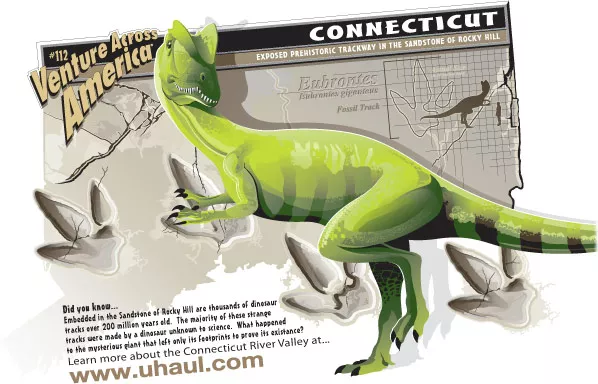
Footprints come to life
Strangely, no remains of the mysterious dinosaur that left the three-toed tracks have ever been found in the Valley. However, after closer observations of the footprints that were uncovered, geologists determined that the footprints belonged to a carnivorous creature similar in size and shape to the Dilophosaurus, the "double-crested lizard." The actual tracks were named Eubrontes by one of the first great American geologists, Edward Hitchcock. (Actual fossil tracks are called a different name by geologists than the dinosaurs that made the tracks.) Eubrontes has since become the official state fossil of Connecticut.
The Dilophosaurus, made famous in Steven Spielberg's box office smash, "Jurassic Park," roamed the Earth approximately 200 million years ago during the early Jurassic Period. Sometimes snacking on plant-eating dinosaurs, they stood 20-feet long, approximately eight-feet tall and weighed in at a massive 650 to 1,000 pounds. They were also quite speedy on their two very muscular legs. Two thick, bony, semicircular crests stood on top of their head and possibly were used for mating displays and/or as heat radiators to cool the blood and brain, allowing them to pursue prey in hot environments. The tip of each crest narrowed into a spike at the back of the skull.
Although Spielberg depicted this creature as spitting poison, no evidence has been found, that prove these animals had poison glands. The Dilophosaurus is considered to be a Ceratosaurus, the earliest and most primitive of the theropod groups. This medium-size creature was the largest predator in its environment. Three specimens were found in Arizona in the 1940s, leading paleontologists to believe that these gigantic creatures may have traveled in packs or small family groups.
Dinosaur State Park is home to numerous other dinosaur footprints that have a tale of their own.
- Otozum tracks have been found at the Park as well, and are attributed to larger relatives of the Anchisaurus, which fed on shrubs and trees.
- The Anomoepus tracks have been discovered at the Park and can be attributed to the Lesothosaurus, a three-foot-long Fabrosaurus. An abundance of tracks demonstrates that a lot of these creatures were around.
- There were a good amount of various-size Grallator tracks, suggesting that the smaller meat-eating dinosaurs were very common in the Valley.
- The Batrachopus tracks can and are thought to have been made by a small, early crocodile like the Stegomosuchus.
- Antipus tracks could have been made by a lizard-like sphenodontid.
- Beetle fossils have been found in the area and dragonflies, cockroaches and crickets must have been common. Flying insects were probably pursued by pterosaurs like Dimorphodon.
- Many of the Valley's mysterious fossil tracks cannot be attributed to any known animals.
The Valley not only contains dinosaur tracks that confess a unique story about the past, but the lakes in the Valley contain information that has allowed archeologists to look deeper into our history.
The lakes within the Valley were often large and deep and beautifully preserved fossil fish have been found in the black shale lake beds. Small Semiontus, Redfieldius and Ptcholepis fishes were preyed upon by the 20-foot long, lobed-finned Diplurus.