


Interview with an expert
In order to understand a little more about the fossilized remains of the Tully Monster, U-Haul interviewed an expert on paleontology and geology, Dr. Donald Mikulic, geologist with the Illinois State Geological Survey.
U-Haul: How would you describe the Tully Monster?
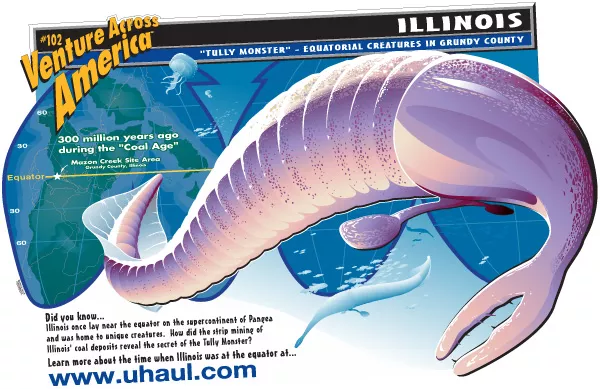
Dr. Mikulic: The Tully Monster is an interesting creature. Of course, it is an extinct animal that lived about 300 million years ago. As best we can tell from fossil evidence, it had a long wormlike sort of body and a number of unusual features, which makes it very difficult to classify because it doesn't look like anything living that we have today or any other type of fossil animal. It's unique for a variety of reasons, not just its appearance. It's also a symbol of how amateur naturalists have contributed to scientific discoveries in this country over the last 200 years.
U-Haul: So the Tully Monster is in a class of its own. It is sometimes said that it could be grouped with the mollusk family. Could that be possible?
Dr. Mikulic: It's possible. There have been a number of proposals over the years as to what the Tully Monster may or may not be related to. There is certain evidence suggesting that it may be a distant relative of a number of different types of living organisms; however, the evidence is not conclusive in any case and it still has enough unusual features by itself to suggest that it might be a unique animal.
U-Haul: What are some of those unusual features?
Dr. Mikulic: The most conspicuous thing is its bar structure, which is sort of a little stick with maybe an eye sticking out on either end of it. I think there is no other type of animal that has that sort of structure. Whether or not they were really eyes is disputed, but one way or another, it is a very unusual feature. It also has the long proboscis with what's been interpreted as a claw or a jaw on the end of it, which is a very unusual feature.
U-Haul: Do you know how it ate or what it ate?
Dr. Mikulic: Nobody knows that either. It looked like it might have had some tooth structure, but there is no evidence of a digestive tract extending from that structure all the way down to the end of the body. It also has a little structure near the bar which is called a “crescent,” that may or may not have been a mouth. So is the Tully Monster grabbing things with the front of its body and, once it grabs them, what is it doing with them? Is it possibly swallowing them at that end or sucking out juices? Or is the claw and proboscis used to turn food around and stick it into the crescent, which might be a mouth structure? These are all possibilities but there is no conclusive evidence.
U-Haul: How big was the Tully Monster?
Dr. Mikulic: It certainly was large for an invertebrate marine animal; the biggest specimen is about a foot long. Many other invertebrates living in marine environments are smaller.
U-Haul: How was reconstruction of the Tully Monster done?
Dr. Mikulic: We have a blessing in that there are literally thousands of specimens of Tully Monster fossils that have been found, which makes it easier to study the animal and see it from different angles and different types of preservation, with an emphasis on various parts. So you have a tremendous fossil record to work with, whereas a lot of other animals are known only from a single specimen or only partial specimens. A lot of dinosaurs that we're familiar with are not actually known from complete specimens. In fact, a lot of them are known only from just a few bones. Because we have so many specimens of the Tully Monster, we can really get a good view of what it was like from all different perspectives.
U-Haul: Why have so many fossils of the Tully Monster been found in the Mazon Creek area?
Dr. Mikulic: I would have to say the main reason so many specimens have been found there is because of the activities of amateur collectors. The Tully Monster is a symbol of the tremendous contribution of amateur paleontologists and amateur naturalists, who have spent hundreds of thousands of hours going through this area looking for fossils. Tully Monsters are certainly common there, but I wouldn't say they were abundant, and it is simply through the activities of amateur collectors that we are able to have a lot of these specimens preserved and available for science.
U-Haul: What other fossils have been found in that area?
Dr. Mikulic: Many types of plants and invertebrate animals have been found there, including animals that have absolutely no hard parts, like jelly fish. There are also fish, amphibians, chitons, horseshoe crab and sea cucumbers. These are very unusual fossils that you don't normally see preserved very well or very often in the fossil record.
U-Haul: What do these Mazon Creek fossils tell us about life hundreds of millions of years ago? Can you give us a brief description of what Illinois would have looked like 300 million years ago?
Dr. Mikulic: Right at that site you would have had a vast coastal swamp with a lot of tropical vegetation and large deltas being built out into the ocean to the south. It would be similar to what you might see around Louisiana and places like that today. So Illinois was certainly a very different place.
U-Haul: Do we know exactly where in that area the Tully Monster lived?
Dr. Mikulic: By interpreting the geology of the rocks where Tully Monster fossils have been found, it looks like they lived in the more marine or oceanic deposits related to this coastline and delta area.
U-Haul: Why have so many fossils been so well preserved?
Dr. Mikulic: To get a good fossil, you generally need to have plants and animals buried quickly after they die because, of course, otherwise they rot apart and disappear. In the case of the Tully Monster, that area of Illinois during the Carboniferous Period was an ancient coastline with a lot of river deltas washing out into the ocean. These river deltas transported a lot of sediment from land areas out into the ocean and it piled up very rapidly, so we had very rapid burial in that area.
U-Haul: Can fossils of Tully Monsters still be found today?
Dr. Mikulic: You can still find them in the Mazon Creek area, but they are becoming harder and harder to find. Back in the 1970s, coal mining stopped in that area and so the only places left to look are older piles that are becoming vegetated or built over. So you can still find Tully Monster fossils, but it is much more difficult now than it was 25 years ago.
U-Haul: What is the current debate among scientists with regard to the mysterious Tully Monster?
Dr. Mikulic: Scientists are always interested in trying to classify things, of course, and when they see an animal like the Tully Monster, everybody is intrigued. What does it mean? What does it represent in the history of life? Here are some possibilities: it might represent a life form related to things that we have living today or it might be a distant cousin, but just looks different to us because of fossilization and the way it was preserved. However, there is another possibility: it might be a life form that essentially has no living relatives. So these kinds of animals and plants are intriguing because they give us an idea of what different life forms existed at different times. There's a lot of interest in things like the Tully Monster because it's such a different kind of animal.
U-Haul: Why did the Tully Monster become extinct?
Dr. Mikulic: In the history of life, extinction is the norm - everything becomes extinct eventually. We have no idea of how long the Tully Monsters lived or how successful they were. They certainly were abundant in the Mazon Creek area, which suggests that they were well adapted to the conditions at that time. We don't know if that was the only time they lived or if they have a much longer record that we simply don't see because of problems with fossilization. So the question then is: Were they living only at that time or did they have a much longer range in the history of life, but we see them preserved only at certain times throughout geologic history? Extinction doesn't mean that the Tully Monster would have been a failure; it just means that it may have had bad luck, as many types of plants and animals have had throughout the history of the planet. They were simply in the wrong place at the wrong time, and the conditions changed and they couldn't survive.
U-Haul: Are there any other places in the Midwest where they could be uncovered a little more easily?
Dr. Mikulic: The only places they have been discovered so far are essentially in northern and central Illinois. Similar types of deposits with similar types of fauna are found in Iowa, Missouri, Indiana and Oklahoma, but none of them have produced Tully Monsters.
U-Haul: How did the swamps in that area give rise to Illinois' coal-mining economy of recent times?
Dr. Mikulic: Over millions of years, dead and decaying plant material built up in these vast swamps in what is now Illinois. With increased burial over time, this plant material was compressed into coal.
U-Haul: Why has the coal in that area been such a rich economic resource?
Dr. Mikulic: The main reason that coal was mined was because it was close to Chicago during the late 19th and early 20th Centuries, when coal was used in that city. So it was the coal source of the city and it was economical to mine it there and transfer it to Chicago.
Scientists remain intrigued by the Tully Monster because of its uncertain identity. However, fossil discoveries like the Tully are vital to understanding the planet; they give scientists a better idea of how plants and animals lived in ancient times. There are still more puzzle pieces of the Earth's past to be uncovered. Who knows, perhaps another monster is waiting for you to find it.