

The Mysterious Tully Monster
The Tully isn't the average mollusk … or worm. Actually, the Tully isn't average by any measure of the word. It's in a class of its own, deemed unclassifiable by scientists to this day. That's what makes the Tully so mysterious. What is it, really?
Sure, there are a handful of theories. It could be a relative of the worm because of its soft, flexible body. But the Tully's fins suggest otherwise. It's been associated with mollusks, particularly heteropods shell-less relatives of snails. Still others thought the Tully could be distantly related to modern hagfish (slimy, deep-sea fish) or lampreys (eel-like fish that swim by rhythmic undulations). No one knows for sure.
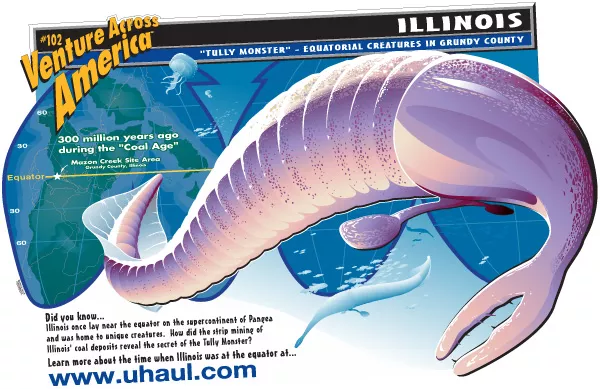
How it ate is another question. Scientists think it must have gotten its nourishment though its “nose,” as though it were a straw. At the end of its long, flexible snout may have been a jaw with tiny teeth. However, scientists don't think it ever chewed. One possible explanation is that the monster clenched its prey then sucked out the animal's fluid. It is thought that the Tully fed on a “blob” a prehistoric creature about three inches wide that resembles a jellyfish.
Another curious characteristic are the Tully's eyes. A bar, attached straight across the body and ending in two stalks, appears to have been locked in place. If these were eyes, as scientists suspect, they would have moved in opposite directions at the same time.
Scientists believe the Tully Monster loved swimming in its natural environment. However, it's not known exactly how it swam. If the creature's fins were horizontal, it would have moved slowly over short distances. If the fins were vertical, as has also been suggested, it could have moved in a pulsating or waving motion, like a snake or eel.
While scientists have been able to put together a good model of the Tully Monster, there are still many unanswered questions and inconclusive theories. And so the Tully Monster will remain an enigma for many more centuries to come.