



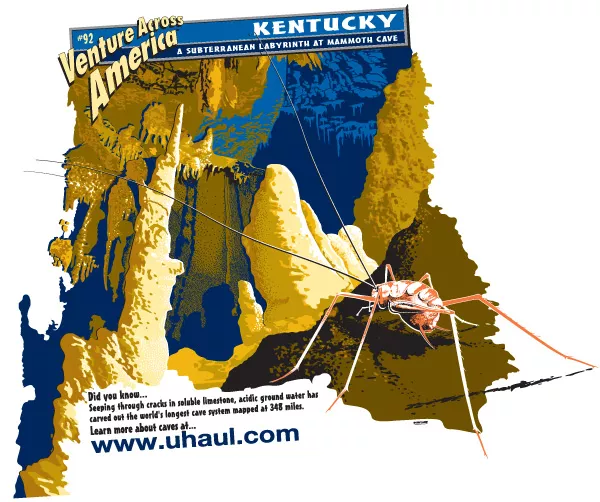
Cave Formations
Caves have long been regarded as places of mystery and intrigue. Prehistoric people used them for shelter and decorated them with some of the earliest-known works of art. Pirates used them to hide their ill-gotten booty. By definition, a cave is simply a natural open space found underground. Sometimes caves form when large rocks get stacked up after a landslide, but most often they're the result of the chemical solution of limestone by subsurface water.
In pure water, limestone is actually quite stable. However, when water gets a little acidic, the limestone dissolves. When water percolates through the soil, it picks up carbon dioxide from rotting plants. This forms carbonic acid, the same acid found in soda pop. As this acid water flows through the soil, it eats away at the underlying limestone rock and a cave is formed. Some larger caves are formed by sulfuric acid -- the same acid found in battery acid. Sulfuric acid is created when the percolating water mixes with hydrogen sulfide from underground oil and gas and from acid rain.
Over time, small caves can grow to become elaborate systems of caverns containing large, needlelike structures that seem to grow down from the ceiling (stalactites) and up from the floor (stalagmites). These structures are formed by the slow, steady accumulation of calcium carbonate precipitating from the chemical-rich water dripping off the stones. Sometimes, these two "dripstones" meet, creating large pillars with spectacular colors.
Very few plants can grow in a cave because of the lack of light. Instead, fungi, algae, and even some simple mosses dominate caves. Insects, reptiles, and bats also are uniquely adapted to the cave environment. One of the most unusual cave dwellers is the "cave fish." Totally blind, this colorless creature navigates by touch, using tactile sensors on its body.
Sometimes, so much solution takes place inside a cave that the caprock can no longer support the weight of the surface above. The roof caves in and a feature known as a sinkhole forms. Each year, there are news stories about people returning home from work to find a large hole in the ground where their house once stood. By understanding the dynamics of what's happening inside a cave, scientists hope to minimize the risk of sinkholes in populated areas.
Not all cave passages in soluble rocks form in precisely the same way. There are three principal or important modes of cave development; underground streams, quiet water solution and water flowing vertically.
Underground Streams
In many caves, underground streams, have been very important. Water enters the cave system through sinkholes, losing streams, and other points on the surface. It travels underground and exits at a spring. Most of the large springs of Kentucky are examples of such cave systems; of course, they are still filled with water.
Quiet water solution
Sometimes water moves very slowly underground, rather than rushing along underground streams. Many of the caves formed this way are mazes of passages with many interconnections.
Water flowing vertically
Domes and pits can be formed by vertical solution. Water flowing vertically down cracks can develop passages almost like elevator shafts, except that the passages are circular or oval.
Types of Caves
- Fissure Cave
- A cave formed from a narrow opening in rocks, caused by the earth's movement.
- Ice Cave
- A cave in limestone that contains ice formations.
- Lava Tube or Cave
- A tunnel or cave formed from flowing lava, when the outside of a finger of lava cools and the hot center drains away.
- Landslip Cave
- A Cave formed by the movement of rock.
- Sea Cave
- A cave in rock formed by the forces of waves.
- Solution Cave
- These are the caves most are familiar with. Dissolved out of limestone by acidic water, they can contain an astounding variety of speleothems, things such as stalactites and stalagmites, and much, much more.
- Weathering Cave
- A cave formed or expanded by the freezing and thawing of water, root growth or the eroding action of wind-carried sand.