



Cave Life
On first glance, in walking into Mammoth Cave, the dark and quiet passageways may appear nearly devoid of life. But first impressions can be deceiving, and surprisingly, biologists have discovered over 200species of animals in Mammoth Cave! Animals in the cave include everything from surface animals that have accidentally stumbled or tumbled into the cave – like raccoons and bullfrogs – to 42 species of troglobites, animals adapted exclusively to life in the darkness.
One of Mammoth Cave's claims to fame, besides its length, is its biological variety. The diversity of cave animals in the Mammoth Cave area rivals the richness of any cave-land region in the world.
To a biologist, a cave is a wildlife sanctuary – are treat for animals so specialized in structure and habit that they cannot endure conditions on the surface.
Life Zones
Cave life can be found in one of three life zones: The entrance zone, twilight zone and dark zone.
Entrance Zone
The entrance zone receives some light, and conditions here are somewhat similar to those found outside, with one big difference - temperature and humidity are fairly constant. Animals (called trogloxenes or "cave visitors) who depend on food from the outside live here to escape extreme weather conditions.
Twilight Zone
The twilight zone is located just beyond the entrance zone and before the dark zone. The temperature here is more constant than in the entrance zone, but there is less light. The inhabitants of the twilight zone(known as troglophiles or "cave lovers") must spend part of their lives in conditions of constant temperature, humidity and darkness. They do, however, go outside to seek food. There are more kinds of animal life in the twilight zone than in the other two life zones.
Dark Zone
The dark zone is completely dark - no light ever reaches this region of a cave. It is also very quiet. Because there is no light, there are no green plants in the dark zone and eyes are not important to most of the animals (known as troglobites or "cave dwellers") who inhabit this zone.
Environmental Factors
To understand the survival techniques of cave animals, we need to first take a closer look at their environmental factors governing Mammoth Cave.
First of all, the cave world does not change as rapidly as our sunlit world; however, change does occur. The cave has its own cycles and rhythms of life. The temperature of the cave varies due to air movement near the entrances, the location (on ridges or in valleys), and the temperature of water entering the cave. In a sense, the cave has its own weather system. Wind is created by temperature differences between the entrance and interior passageways. This causes a "chimney effect," resulting in a wind chill factor underground. The chimney effect can also produce "rain" inside the cave by altering the dewpoint. The final contributor to cave weather is the barometric pressure. Barometric changes affect air movement, humidity levels and dew points. Subtle weather changes in the cave make it possible for a perceptive caver to discern outside weather conditions, even though he or she may be hundreds of feet below the surface.
Secondly, Mammoth Cave is intricately tied to the outside world. The cave is different from our world, but the survival of cave life depends on the surface. Plants, through photosynthesis and through their own decay, release carbon dioxide that combines with water in the air and in the soil, to form weak carbonic acid that carves the cave. In addition, plants provide food and energy for underground animals. No matter how organic material enters the cave, the web of the cave begins with the sun.
Thirdly, the lack of light produces stress in caves by limiting the availability of food. Therefore, cave animals must make behavioral, physiological, and morphological adaptations to survive.
Trogloxenes, troglophiles and troglobites
Trogloxenes "Cave Visitors"
Some animals, called trogloxenes (or cave visitors), regularly visit or hibernate in caves but customarily leave caves. By collecting food on the surface and then returning to caves, trogloxenes play an important role in providing food for cave animals that never venture outside. There are about 15 different types of trogloxenes at Mammoth Cave; the most notable are bats, cave crickets and salamanders. Although Mammoth Cave is not currently used by large numbers of bats, twelve species, including two endangered species, live here.
When you visit Mammoth Cave, you're far more likely to see crickets than bats. Crickets spend much of their life in the cave but depend on nighttime forays on the surface to gather food. Because Mammoth Cave lacks large bat populations, crickets are extremely important in delivering energy, in the form of droppings, eggs, and carcasses, to other animals in the cave.
Troglophiles "Cave Lovers"
Another group of cave animals, the troglophiles (or cave lovers), have evolved a step closer to cave dependency than the trogloxenes. Troglophiles can survive for their entire lifetime in caves, but they can also live exclusively on the surface, where they select cool dark places reminiscent of the cave environment. Troglophiles include cave crickets, crayfish, spring fish, salamanders, and spiders.
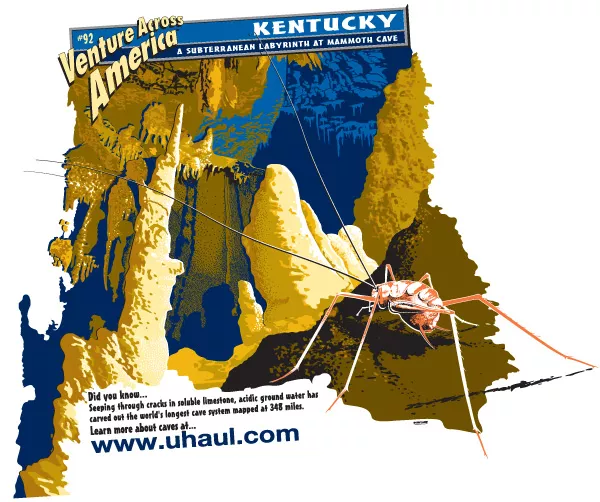
The cave cricket is one of the most visible troglophile that you will see in Mammoth Cave. They are different from regular crickets in that they don't chirp and their legs are very oversized. Many people mistake them for a spider.
Cave salamanders are hard to find because they like to hide under rocks. Salamanders near the surface have eyes and are colorful, but those deeper inside the cave are eyeless and colorless.
Troglobites "Cave Dwellers"
Troglobites, the group of cave animals most highly adapted to cave life, cannot survive outside caves. Many, including blindfish (eyeless fish) and crayfish, illustrate creative adaptations to their environment. With no need for camouflage or protection from the sun, many of these animals have lost pigmentation and are white. Some have no eyes. Most have developed other highly sensitive sensory organs to detect predators and prey. Because food in caves is scarce, full-time cave dwellers tend to be smaller, with lower metabolism and longer lifespans than their surface counterparts.
White crayfish and blindfish live in the lowest areas of Mammoth Cave, in the Echo River, and rely on their antennae and sensors to find food in the river.
The lifestyles of all cave animals highlight the fragility and interconnectedness of the surface and the cave environments. Ultimately, the energy that feeds cave animals comes from the surface. In addition, land use practices outside the Mammoth National Park area impact water quality and the life forms in the cave. Even visitors entering the cave impact the underground world. Lighting, trail construction, building unnatural entrances, and noise from cave tours, affect the inhabitants of this sensitive and fascinating place.