


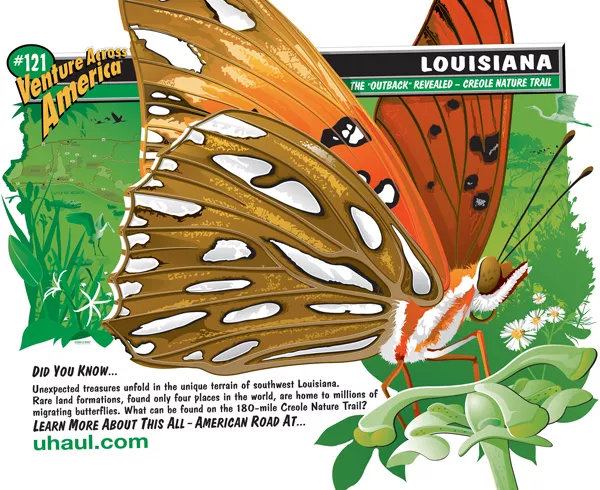
Get wild in the outback
Imagine visiting the Creole Nature Trail, gazing out across the land on a windless, warm day and seeing an alligator sunning itself. According to Monte Hurley, chairman of the Creole Nature Trail All-American Road District, there are more alligators than people in rural Cameron Parish, which is one of the two parishes that make up the outback. History tells us that those who visited Louisiana in the 19th century wrote that there were so many alligators that you could shine a lamp on a pond or a bayou at night and see alligator eyes so numerous they appeared like "stars in the heavens." With more than 3,000 alligator nests, Louisiana's Outback is one of the largest homes for alligators in the country. However, alligators are not the only allure. Those who visit the Creole Nature Trail will be sharing the beauty with many colorful butterflies, 30 species of mammals, 10 species of amphibians and reptiles, seven species of marine invertebrates, 132 species of fish, and believe it or not, 39 different species of mosquitoes. Along with the alligators, other animals, such as armadillo, coyote, mink, nutria, otter, rabbit, squirrel, raccoon, skunk and white-tailed deer, make their homes in the refuges on the Creole Nature Trail. Consisting of both salt and fresh water marshes and many prairies, the environment is constantly changing to support an abundance of plant, as well as various species of wildlife.
Louisiana's Outback also supports more than 250 species of birds. This amazing number represents a wide variety of bird species, which is why the Creole Nature Trail is considered to be one of the top 10 birding locations in the nation. The Creole Nature Trail is located on two major bird migration routes: the Central and Mississippi Flyways. Species of migratory waterfowl, such as ducks and geese, are the most common, along with water birds such as the laughing gull, royal tern, black skimmer and Louisiana's state bird - the brown pelican. The most common birds found in the marshes include marsh wren, seaside sparrow, redwinged blackbird and sandpipers, etc. At one time, a single refuge pool can host more than 800,000 ducks and geese.
Chenier Sanctuary
Louisiana lies in the very center of the transcontinental Gulf of Mexico migration path. During springtime, as many as 2 million birds and millions of butterflies migrate through the Peveto Woods Bird and Butterfly Sanctuary, which is a 41-acre island of chenier woodland in western Louisiana. Cheniers are wooded, sandy ridges believed to have formed thousands of years ago from shellfish and sand that rise in the middle of marshes and sprout stands of magnificent oak trees. Louisiana's Outback is one of only four locations worldwide where these unique cheniers exist. This is truly significant because these sandy beach ridges, topped with trees, are the first eating and resting stop for millions of butterflies and songbirds that cross the coast of Louisiana twice each year. Exclusive to western Louisiana, cheniers are known for supporting maritime forests dominated by live oaks (chenier is French for oak). The first Louisiana settlers named these coastal woods "cheniers" because what they saw looked like an "oak place." Cheniers have a higher relief than outlying barrier islands. They can be as many as three meters above sea level with the highest of the cheniers standing no more than 10 feet above sea level. Because of this, cheniers are one of the most important habitats for birds as well as mammals throughout coastal Louisiana. Research indicates that more migratory songbirds and butterflies pass over the Cameron Parish coast, Peveto Woods Bird and Butterfly Sanctuary than anywhere else. The Baton Rouge Audubon Society preserved this unique, beautiful habitat in order to establish the first chenier sanctuary for migratory birds.