



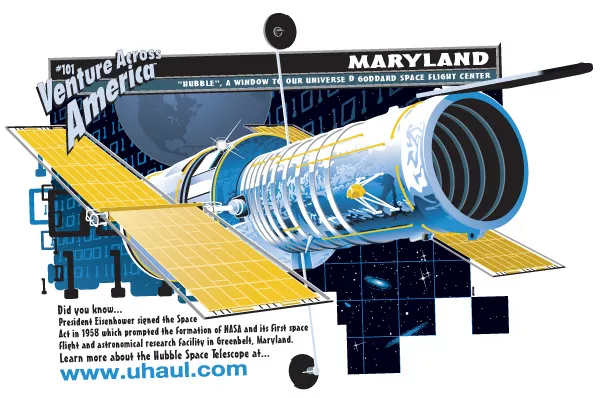
Fast facts
- Launched April 24, 1990
- Measures 14 feet wide and 43 feet long - about the size of a railroad boxcar
- Orbits Earth at a speed more than 17,000 miles per hour
- Primary mirror measures between seven and eight feet in diameter
- Took eight years to build
- Weighs 12.5 tons
- Originally launched with 400,000 parts and 26,000 miles of electrical wiring
- Delivers 10 to 15 gigabytes of data a day all over the world
- Two large solar panels that look like fins are attached to the side and convert sunlight into electricity. These panels provide power to Hubble's electrical system
In one decade, from 1990 to 2000, Hubble:
- Studied 13,670 objects.
- Made 271,000 individual observations.
- Probed 14,000 celestial objects.
- Returned 3.5 terabytes of data.
- Generated 330,000 exposures.
- Circled the Earth 58,400 times, or traveled approximately 1.5 billion miles.
Timeline
For centuries, the idea of a telescope in space was merely a gleam in a cosmologist's eye. This timeline is a list of significant people and events which helped make the unattainable a reality.
- 1570
- First telescope pointed at the sky
- 1923
- Rocket scientist Hermann Oberth publishes an article speculating about telescopes in orbit.
- 1957
- Russians launch the first artificial satellite, Sputnik.
- 1958
- President Eisenhower passes the Space Act, which prompts Congress to create the National Aeronautics and Space Administration (NASA).
- 1968
- NASA successfully launches a small observatory named OAO-II, designed to measure ultraviolet emissions of galaxies, stars, planets and comets. It orbited Earth for 4-1/2 years.
- 1975
- The European Space Agency (ESA) joins NASA in developing a space telescope.
- 1977
- Congress approves funds for development of a space telescope.
- 1983
- The telescope is named after renowned American astronomer Edwin P. Hubble.
- 1986
- Hubble's launch is delayed after the Challenger accident. The telescope is kept in storage.
- 1990
- Hubble is launched into orbit aboard the space shuttle Discovery.
People
- Frederich Bessel
- A German astronomer and mathematician who measured the distance to a star in 1838. From his calculations, we know that stars are trillions of miles away. For example, although Alpha Centauri is the closest star to the Earth (other than the sun), it is still four light-years or approximately 24 trillion miles away.
- Galileo Galilei
- Italian astronomer, mathematician and physic who made the first refracting telescope used for astronomical purposes. Using this invention, Galileo discovered the four brightest moons of Jupiter, lunar mountains, sunspots, the starry nature of the Milky Way and the rings of Saturn.
- Sir William Herschel
- Regarded as the founder of stellar astronomy. In the 1700s, he counted the stars that he could see in various directions in space and proposed a model of the universe. He believed it was an isolated system; the stars of the Milky Way arranged in the shape of a disk, with the sun at the center. He is credited with discovering Uranus.
- Edwin Hubble
- Hubble's namesake. An American astronomer who gave support to the Big Bang Theory with his observations that the universe was expanding.
- Hans Lippershey
- Credited with the invention of the telescope. A German-Dutch lens-grinder and spectacle-maker said to have accidentally aligned two lenses of opposite curvatures and different focal lengths.
- Charles Messier
- French astronomer who discovered 20 comets and numbered over 100 different objects in the sky, known as the Catalog of Nebulae and Star Clusters.
- Sir Isaac Newton
- Invented the first reflecting telescope in 1671. Newton used a curved mirror to reflect and focus the light inside the tube. Newton's telescope didn't become popular in the scientific community until 1730.
- Harlow Shapley
- Produced a new theory about the universe in 1918 that said interstellar dust obscured our view of the Milky Way Galaxy. He also thought the sun was not at the center of the galaxy, but toward its edge, and that it was a very small part of one very large galaxy. His theory contradicted that of another famous astronomer, Heber Curtis, who put the sun near the center of the galaxy and believed there were many galaxies in the universe.
- Dr. Lyman Spitzer
- An astrophysicist who proposed that a telescope in space would provide much clearer images than any ground telescope. His ideas were considered lofty, because no one had yet launched a rocket into space. He lobbied NASA and Congress to develop a space telescope. Eventually his vision was brought to life.