



Nuts and bolts
One scientist said: "Hubble itself is a large piece of glass. It's the instruments we put behind it that determine what it can do."
Indeed.
Without highly specialized instruments, Hubble would essentially be an orbiting vanity mirror. The instruments transform Hubble from an everyday telescope into a window to the universe.
Hubble instruments opened up the cosmos to the world and unlocked the key to the universal history book. Not to mention providing beautiful artwork for our walls! Hubble does this by interpreting the spectrum of light. Just as some animals see various forms of light - insects can see ultraviolet light - Hubble has the ability to read light that is invisible to the naked eye, called near-infrared light. But it takes a special "eye" to decipher this light.
- Wide Field/Planetary Camera 2 (WFPC2)
- Space Telescope Imaging Spectrograph (STIS)
- Near-Infrared Camera and Imaging Spectrograph (NICMOS)
- Corrective Optics Space Telescope Axial Replacement (COSTAR)
- Faint-Object Camera (FOC)
Wide Field/Planetary Camera 2 (WFPC2) is this "eye." It acts like the retina of your eye in that light passes through a lens, is bent or refracted, and comes to a point or focus. This is where the image is formed. The mirrors in the WFPC2 act as corrective lenses to the observatory's spherically aberrated primary mirror. Hubble's primary mirror is two microns too flat at the edge, so the corrective optics within the WFPC2 makes up the difference. Three cameras within WFPC2 deliver a broad perspective of the universe using a trio of L-shaped wide-field sensors; a fourth and smaller camera provides a higher resolution view.
Conversely, a faint-object camera (FOC) with a small field of view is sensitive to ultraviolet, visible and near-infrared light. The camera's high-resolution design allows it to magnify an image in three stages, increasing focus and clarity sevenfold within each step.
For example, when pointed toward Betelgeuse (a red star in the Orion constellation), the FOC can focus in on the surface of the star 500 light-years away. Our sun is the only other star surface to be imaged.
But what makes Hubble truly unique among the telescope family is its near-infrared camera and multi-object spectrometer (NICMOS). This specialized deep-space camera photographs celestial images and peers through galactic dust. Its sensors detect near-infrared wavelengths, which are slightly longer than those of visible light. Infrared light bores through the dust and gas of space just as our sun's red light penetrates our cloudy atmosphere.
Terrestrial telescopes are unable to penetrate dust, which makes Hubble particularly useful in capturing the delivery of newborn stars. Stars are often born in murky pillars, estimated to be 10 trillion kilometers high. Hubble recorded such an event in the Eagle Nebula 7,000 light-years away. Before NICMOS, scientists had difficulty seeing past the gas clouds that housed the birth of new star clusters. Hubble technology changed all that. When a ground-based telescope tries to see distant stars, its view is blocked by the Earth's atmosphere. Dust, currents of warm air and cold air mixing along with water vapor produce fuzzy images of stars.
Lights, camera, action
Imagine this scenario. A game show called "Name That Celestial Object" pits Hubble and a genius astronomer against one another. The guest host draws a category: Light. The genius astronomer says he can Name That Celestial Object in 100 wavelengths of light; Hubble says it needs only two. Who wins? Hubble, of course, because it specializes in identifying objects by their light - an impossible feat for human eyes.
How is it that Hubble identifies space objects by their light alone? Believe it or not, celestial objects actually have fingerprints. The light they give off is literally a chemical fingerprint Hubble uses to identify key features and properties of an object.
That brings us to another key component: the space telescope imaging spectrograph (STIS) - also known as the black-hole hunter.
Celestial objects are identified by their fingerprints, or light spectrum. Specific colors tell Hubble what elements are present in an object and how much. STIS breaks up these colors, or wavelengths of light, just as a prism does to make a rainbow.
The object's fingerprint can also be used to determine its temperature and motion. Knowing these elements is essential when searching for black holes. A black hole shows up as a disk of gas and stars accelerating into a galaxy's center. (Astronomers calculate that around 300 million solar masses must be present at a galaxy's center to create a black hole.) In fact, STIS has found black holes up to three billion times larger than the sun, lurking at the centers of over 30 galaxies.
When an object is headed toward Earth or away from Earth, its chemical fingerprint will appear either blue or red on the spectrum. If an object is accelerating away from Earth, its light appears red. The farther the object is from us, the redder it becomes on the light spectrum. Headed our way, the object becomes blue-shifted.
Originally, Hubble could see only at a redshift of about four or five. Astronomers believe this gave us a view of the universe at about one-third its age, or nine to 12 billion years ago. But after an instrument upgrade in 1997, STIS can now reach a redshift of 14. Objects giving off this light are so far away that, by the time their light reaches Hubble, it would have been traveling almost since the beginning of the universe!
Mirror, mirror
By definition, Hubble is a compound telescope, using a primary and secondary mirror to create an image out of light.
Also known as a catadioptric telescope, the compound telescope uses both mirrors and lenses to create an image. Its spherical shape does not point light to a single point, which results in a problem called spherical aberration. A corrective lens is placed in front of the mirror to make the light rays bounce off at the necessary angles. Incoming light passes through this lens to the primary mirror, reflects off the mirror onto an aluminized spot on the back of the lens, then passes through a hole in the primary mirror to the eyepiece where the image is viewed.
Hubble mirrors are made of glass and layered with an aluminum coating (only three-millionths of an inch thick) and magnesium fluoride (one-millionth of an inch thick). These elements make the mirrors light-savvy, reflecting visible, infrared and ultraviolet light.
The primary mirror, measuring between seven and eight feet in diameter, is crucial to the design of the telescope because it is the first instrument to receive light and reflect it onto other components. In order to get a clear image, the mirror must be ground and polished to perfection. Much like a pair of reading glasses, the prescription is as unique to the individual as it is to Hubble. The mirror must be the right prescription without even the tiniest scratch.
But it doesn't always work that way.
Repair and maintenance
Once in space, NASA scientists realized there was a tiny flaw in the Hubble primary mirror. Its vision was blurry. Scientists realized the mirror had been ground and polished incorrectly and suffered a spherical aberration. An edge of the mirror was one ten-thousandth of an inch too flat - a measurement slimmer than the width of a human hair. To correct this, the corrective optics space telescope axial replacement (COSTAR) was installed in 1993. COSTAR is a refrigerator-sized box containing 10 movable mirrors, each no longer than a thumbnail.
Perfection is required from all parts of Hubble, right down to its nuts and bolts. One loose screw or uneven mirror, even if it's off by only thousandths of an inch, can throw Hubble's controls off kilter. In that case, scientists are sometimes summoned to perform detailed surgery on Hubble. But it's no easy task, considering technicians must wear the equivalent of hockey gloves while in space. Not to mention, of course, that if a vital piece of equipment is dropped while performing the surgery, it falls only, well, a gazillion miles . leaving the balance of a multibillion-dollar program in their hands.
Hubble has undergone four major repair and servicing missions. NASA upgraded its technology in 1997 when its original, 70s-technology equipment was replaced with NICMOS and STIS. It was a daunting task, but the payoff was tremendous, considering the capabilities of the two scientific instruments. March 2002 was Hubble's final servicing mission, in which a new instrument called the Advanced Camera for Surveys (ACS) was installed, along with other equipment improvements. Hubble was scheduled to undergo another servicing mission planned for mid-2006. However, it was cancelled due to a NASA administrator decision that said the risk to Shuttle astronauts was too great in order to continue such missions.
Although Hubble is on duty 24 hours a day, not all of its time is spent observing. Each orbit lasts about 96 minutes, with time set aside for some "housekeeping," which means doing tasks such as turning the telescope to view a new target. Housekeeping can also mean switching communication antennas and data-transmission modes, or receiving commands and downlinking data.
Mission control
To the average look-at-the-sky-every-so-often citizen, the Hubble may seem simple. It points to its target du jour and automatically furnishes breathtaking universal landscapes.
Not quite.
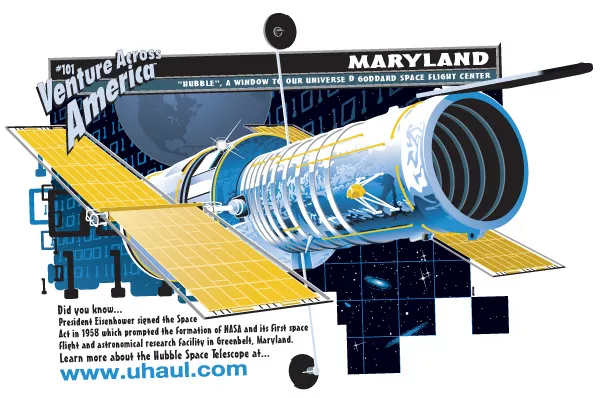
Hubble control and monitoring is provided by the Space Telescope Operations Control Center (STOCC) at NASA's Godard Space Flight Center (GSFC) in Greenbelt, Md. Hubble's keepers are a fiercely dedicated crew of astronomers, physicists and rocket scientists. Thousands work to send Hubble its daily commands, point it at the appropriate target and monitor its health to make sure all systems are functioning.
Not only is Hubble a specialized telescope, it is a spacecraft as well. Power, communications, steering, computing and structure all make up its spacecraft functions. These systems allow it to move around as needed and perform commands given by the GSFC.
All data collected by Hubble, including light, is stored digitally in onboard computers and then relayed to Earth.
Unlike traditional spacecraft, Hubble has no engines and can't plug into a power source from orbit. Therefore, scientists had to create a renewable power supply. That's where solar energy comes in. Two large solar panels flank the sides of Hubble, converting sunlight into electricity. The panels provide 2,400 watts of energy - the equivalent of 60 40-watt light bulbs. When Hubble is in the Earth's shadow, six nickel-hydrogen batteries provide the same power as 20 car batteries. These are recharged once they are in contact with sunlight again.