


Critters and Creatures
Sandpipers of Fundy
Life is abundant in the Bay of Fundy: in the water, above the water and on the shore. Just as the tides ebb and flow, the seasonal life cycles of hundreds of life forms are played out in nature’s orchestrated rhythms. The constancy of repeating cycles is present not only in the rise and fall of the tides, but also in the mating and feeding rituals of many species in and around the bay. Of all of the fascinating examples, the annual arrival every summer of millions of migrating semipalmated sandpipers ranks as one of the most amazing sights to see.
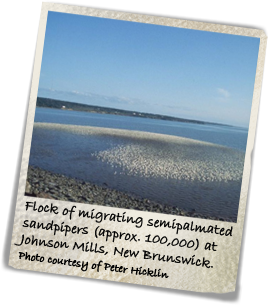
For centuries, shorebirds have entertained observers with their synchronized movements and precision acrobatics in which flocks of thousands perform in midair. In unison, they rise from the shore, soar, dive and bank together as if performing in a choreographed production. They fly through the air, skimming over ocean waves and beaches in celebrated maneuvers that are much admired among onlookers. Upon landing and settling down again, the sandpipers roost, or congregate to rest.
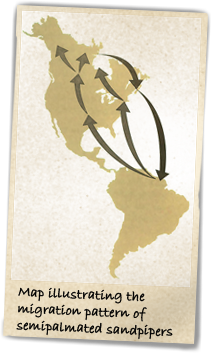
Why the sandpipers migrate to the Bay of Fundy has been explained only recently by scientists. Peter Hicklin, a wildlife biologist with the Canadian Wildlife Service, began over 30 years ago to immerse himself in the study of the sandpipers and other migrant shorebirds along the shores of the Bay of Fundy. Originally, his interest in piecing together the sandpiper story began, in part, with his interest in studying the annual migration pattern of the semipalmated sandpiper. Scientists have known that sandpipers and other shorebirds migrate from their subarctic spring nesting grounds, extending from Hudson Bay to Alaska, to spend the winter months along the warmer coasts of South America.
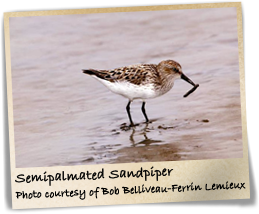
Every summer, in July and August, the sandpipers stop in the Bay of Fundy along their 4,000-kilometer (2,500 mile) trip over the Atlantic Ocean to the northeastern coast of South America. But 30 years ago, no one knew exactly why they grouped in such great numbers along the shores of Fundy nor to where they flew after their stopover. Thanks to the countless hours of observation of foraging shorebirds, sampling the mudflats for invertebrate life and the tagging (with leg bands) of more than 35,000 sandpipers for more than 16 years, scientists now have a very clear picture of why these birds congregate at the Bay of Fundy, where they come from and where they go when they leave.
To give you the clear picture of what Hicklin and other scientists have learned, we must first muddy the waters.
Clear As Mud
Each day, during low tide, the shores of the Bay of Fundy are lined with large expanses of rich, red-brown mud. The thousands of acres of mud appear at first glance to be a wasteland - and were once thought to have the same properties of quicksand. Thirty years ago, not much study was done on the mudflats around the Hopewell Cape area. Scientists once thought that perhaps the mudflats were unsafe and, if they explored them to the low tide line, they might sink in the mud - never to be seen again!
Scientists did take note, however, that huge flocks of sandpipers, on their layover from their migratory flights, stopped in Fundy to assemble in large flocks on the beaches at high tide, only to spread out over the mudflats once the tide receded. As the flats became exposed, the sandpipers spread widely over the flats, pecking at the surface without any apparent reason. Why? Fortunately, curiosity got the better of Peter Hicklin and other scientists who braved the unknown muck, to explore one of the most fascinating ecosystems and relationships between species in the natural world.
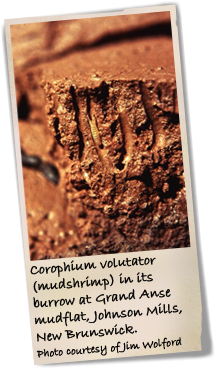
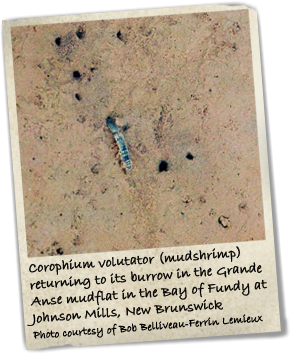
Like the scientists, if you are near the mudflats at low tide, you might hear an unfamiliar crackling sound. The crackling, crunching sound coming from the surface of the mud is the sound of thousands of tiny mud shrimp known by their Latin name Corophium volutator. These little crustaceans are about the size of a large grain of rice, or about five millimeters. Scientists estimate that, on some mudflats, between 5,000 to 10,000 mud shrimp occupy each square yard of mud, with the highest densities near the center of the mudflat. Over approximately 3,500 acres of mud in the upper Bay of Fundy during low tide, there could be as many as 7 billion of the mud shrimp.
An almost-unimaginable number of these small shrimp live just under the surface of the mud in 10-centimeter deep, u-shaped burrows that they construct in well-drained mudflats. As the tide recedes, they emerge and crawl about on the mud, looking for mates. They feast on diatoms (single-celled microscopic plants) that grow on the surface of the mud every summer.
Now we can clearly see why the sandpipers are on the mudflats. They are gorging on the fat-rich mud shrimp. These are the essential nutrients that the birds store to fuel the long, nonstop, four-day flight to their wintering grounds. Only Corophium can provide the special fats that are stored by the sandpipers like fuel in a gas tank. When the sandpipers arrive in Fundy from the arctic, they are famished from flying the first 1,600–1,900 kilometer (1,000-1,200 mile) leg of migration from James Bay. They need rest and plenty more food for the energy it will take to go the rest of the distance over the ocean. The sandpipers arrive weighing, on average, about 22 grams and will spend almost two weeks eating as many shrimp as they can to at least double their weight. Each sandpiper is thought to eat between 5,000 to 10,000 shrimp, depending on its weight, at every low tide.
Their consumption of this remarkable amount of food, every day for 10 to 20 days, fattens the sandpipers so they are energized for the second leg of their migration. By now they have doubled their weight, are rested and are prepared for the nonstop, 72-96 hour, long-distance journey to the northern coast of South America, most of which is over the Atlantic Ocean.
We must remember that when the birds gather in large flocks along the Fundy shore, they should not be disturbed. The one-to-two-hour period of high tide each day is an important rest period for the small birds, especially when we consider what lies ahead of them prior to reaching the warm beaches of Suriname and French Guiana. Respecting their need for rest should be a priority for all of us.
Nature's Perfect Balance
The North American home of the world's highest tides is also home to the tiny Corophium volutator. In all of the Western Hemisphere, this species is found only in the Bay of Fundy and the Gulf of Maine. The consistency of the mudflats, created by the sediments deposited by the tides, supports an environment that allows the mud shrimp to build their burrows and provides the diatoms on which they thrive. In turn, the mudflats and the mud shrimp host up to 75 percent of the world's entire semipalmated sandpiper population, approximately 3.5 million birds, throughout their southward migration cycle. The cycle repeats year after year in an exquisite balance that must be protected. Scientists continue to study and learn more about nature's balance and the work people can do to ensure that we do not upset that balance. Many areas of the Bay of Fundy are now protected through national and international efforts.Recently, the Bay of Fundy was designated a UNESCO Biosphere Reserve because of its natural productivity, importance to migrant shorebirds and great beauty. This designation reflects the need to protect a spectacular part of our natural world.