


Oklahoma: Weather Central
When the National Severe Storms Project began in the early 1960s, it was headquartered in Kansas City, Missouri. But researchers there quickly realized they had chosen the wrong state to make base.
"Most of the severe storm activity was coming out of our satellite office in Norman, Oklahoma," said Kelly Tarp, spokeswoman for the agency. "It became clear very quickly that our headquarters should be where the action is. And that's Oklahoma!"
The severe storms project moved to Norman in 1964 and has since changed its name to the National Severe Storms Laboratory. Since then, a flood of organizations, schools and other groups devoted to weather research and forecasting have also decided to call Oklahoma home. As we enter the 21st Century, Oklahoma is now known for weather research the same way Hollywood is known for movies.
So many weather-based groups have made Oklahoma their base that the state now has an umbrella organization call the Oklahoma Weather Center. This group combines organizations from the National Oceanic and Atmospheric Administration and departments within the University of Oklahoma. The center allows the different groups to work together in partnership to improve the understanding of events of Earth's atmosphere.
The following are a few members of the Oklahoma Weather Center. All are based in Oklahoma:
- National Severe Storms Laboratory - Internationally known for its investigation of all aspects of severe weather, especially thunderstorms, hail, lightning and tornadoes.
- National Weather Service - The starting point for official government weather forecasts, warnings, meteorological products for forecasting the weather, and information about meteorology.
- Storm Prediction Center - Has year-round responsibility of providing severe weather information to more than 100 National Weather Service offices.
- University of Oklahoma School of Meteorology - Recognized as one of the top five university meteorology programs in the United States.
- Center for Analysis and Prediction of Storms - Develops, tests and implements a complete regional forecast system for commercial and research applications.
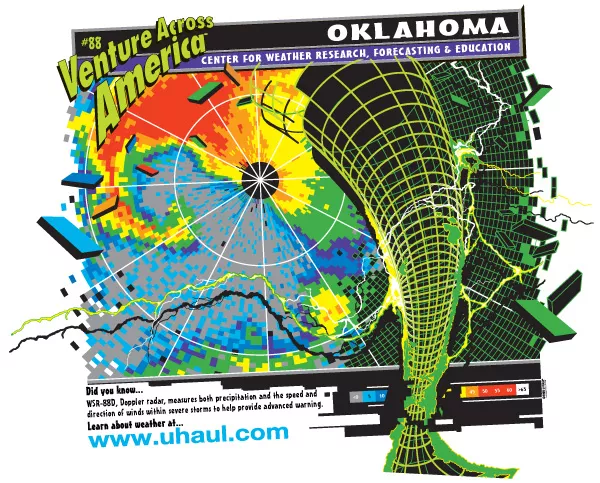
With the combined efforts of these organizations and others like them, the Oklahoma Weather Center has achieved some notable accomplishments. One of them was demonstrating that Doppler weather radar could be a useful tool in the detection of tornadoes, hail and other servere weather events.
The organizations employ more than 540 men and women and inject $45 million annually into Oklahoma's economy.
Weather Research Saves Lives
The tornadoes that ripped through Oklahoma City Monday May 3, 1999, killing scores of people and destroying hundreds of homes, is a tragic example of the importance of weather research, forecasting and education, a meteorologist at the National Severe Storms Laboratory said.
"If Monday's tornadoes had touched down in an area with similar population density 50 years ago, when there were no tornado warnings, I would guess that somewhere between 300 and 400 people would have lost their lives," said Harold Brooks, from his office in Norman.
Brooks said that the area that was ravaged by the tornadoes is an area well prepared for tornado warnings.
"Most people in that area have tornadoes on their mind during the month of May, and were ready to do the right thing when a warning came," Brooks said. "The problem was simply the force of the tornado. A lot of people did everything right and still died. Sometimes the only answer is to be nowhere near the tornado at all!"
Brooks said that research at the NSSL would continue to improve warning programs to alert citizens of severe storm warnings. "Historically, our warnings have simply been to let people know that severe weather is coming. Now, we are looking to let people know what kind of severe weather it is, such as hail, wind, tornado, etc."