


Giant beaver grinds soil into sand
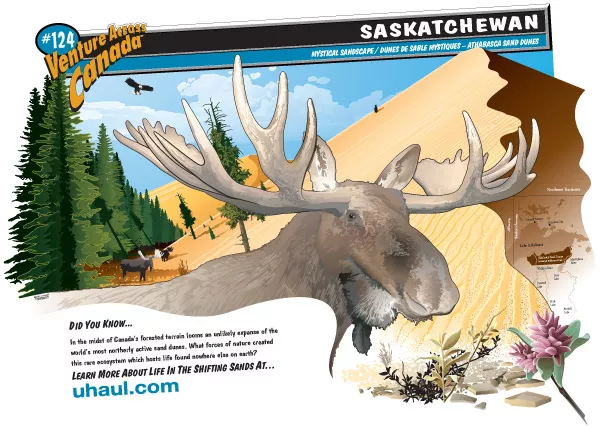
As soon as the pilot begins to tell an ancient myth, the passengers' attention quickly becomes focused on the Dene´ legend which is about the formation of the mystical Athabasca Sand Dunes. Legend has it that long, long ago, a giant went hunting beaver along the north shore of Lake Athabasca. The beavers had built a dam across the lake, which the giant broke open to lower the water level and find the beavers. When the giant spotted what he thought to be the perfect beaver, he went after it with a spear. Thinking that he had killed it, the giant tossed the enormous beaver onto the south shore of the lake. Lo and behold, the beaver was not yet dead and began frantically thrashing and grinding the earth with its tail kicking up sand from the ground and forming the large sand dunes of Athabasca. This legend is still told today by local aboriginal people of the Athabasca Denesuline (Dene´Nations). Experts indicate that archaeological digs along the south shore of Lake Athabasca prove that it was once used by prehistoric hunters who relied on animals that migrated here from the north. The giant-beaver myth is likely very old, since people have lived in this region for nearly 8,000 years. The descendants of the Dene´ Nations, the Denesuline of Fond du Lac, continue to follow the old ways of their ancient, traditional lifestyle, such as trapping and hunting, which are extremely important to the local economy.
Though the passengers really enjoy the myth, the pilot continues to explain that glaciers actually created the dunes during the last glacial period, and in order to understand where the dunes came from, we must go back thousands of years. The ancient dunes of Athabasca began to form more than 9,000 years ago, and the cycle of dune formation has continued ever since. Even though this formation began thousands of years ago, the dunes are actually a product of the Athabasca sandstone which was originally a delta that was formed more than one billion years ago. The delta, in a freshwater lake, was created out of materials carried down from ancient mountain ranges by glaciers and rivers. According to experts, water melting from retreating glaciers flowed through channels and spillways into the ancient glacial Lake Athabasca, depositing sand sediments. Two of the major, ancient spillways are now the MacFarlane and William Rivers. Over time, the glacial lakewater levels declined, causing the land to rebound after the weight of the glacial ice was gone. Sand sediments were exposed and eventually compressed into sandstone which later was eroded by strong wind, water and glaciers, ultimately forming the massive sand dunes that exist today.