


Moving winds make magic
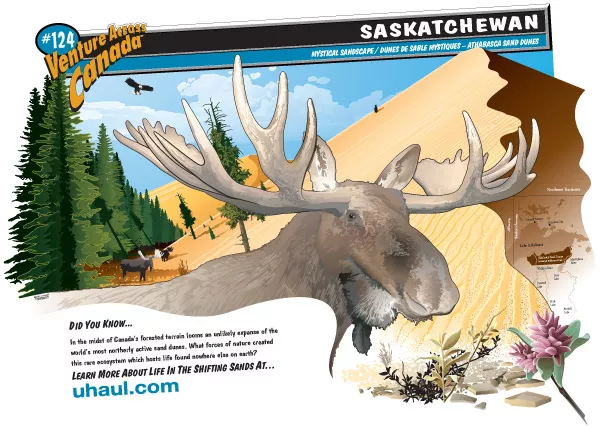
Slowly smothering the forest in certain areas, while revealing ghost-like stands of dried forest buried hundreds of years ago in others; the shifting sands of Athabasca keep the sand dunes mysterious. The pilot tells the passengers that if they like what they see during this visit, they should be sure to take a photograph because the ever-changing landscapes will never again be the same. Entire forests have emerged from the sand apparently, unlikely to ever again be covered and yet, within a few years, they submerge into the sand once again. As the dunes migrate southeast due to winds blowing in from the northwest, the sand constantly encroaches on the trees and, slowly but surely, buries the forest. The pilot indicates that it is common to see what experts refer to as “blowouts” throughout the sand dunes, and explains that blowouts are sandy depressions caused by the removal of sand sediments by wind. When sand has been blown away from trees in the dunes, it leaves their roots in a mound that protects the sand from further erosion. According to experts, tree roots that have been exposed by the constantly moving sand in the dunes of Athabasca can sometimes stand a meter in the air once the sand blows away.
Some of Athabasca's most intriguing features are found in the middle of the dune fields located just west of the William River. Over time, continuous winds have blown away all loose sand, creating thin layers of stones and pebbles on top of the sands, a process known as deflation, occurring in areas where there is limited vegetation. Experts refer to these large, flat areas as “desert pavement.” This desert pavement also referred to as gravel pavement or “gobi,” can be found in all of Athabasca's major dune fields. The stones that make up the thin carpet surface often are shiny because windblown sands polish the stones. The stones that make up the desert pavement range in various sizes from tiny pebbles to large stones. Some of the most extraordinary stones found in these dune fields are called ventifacts. Ventifacts found in desert pavement are actually the abrasion of larger objects by sand. And though ventifacts are found throughout the world, experts indicate that those found in Athabasca are not only abundant, but quite special as well. Desert pavements in Athabasca, consisting of different pebbles, stones and ventifacts are considered to be among the most fragile land forms found in the dunes. The pilot reminds his passengers that if they come across desert pavement, they should avoid walking over the top of it, as a single footprint can remain visible for years. Not understanding how a single footprint could remain visible for years when there are winds constantly blowing, several of the passengers ask the pilot to explain. He begins by describing a box of sand with stones dispersed throughout the sand. Imagine, as the wind blows over the box of sand and stones, the loose sand will blow away and only the stones will remain. Over a long period of time, the top layer is just stones. If the stones are stepped on and pushed deeper into the sand the footprint would remain until all the sand blows away to the depth of the individual footprint.