



Ecosystem
The ancient rain forests that lie within Olympic National Park are the largest and best-preserved virgin rain forests in the continental United States. The immense forests can be found along the peninsula's Pacific Coast and in the three western-facing river valleys: Hoh, Queets and Quinault Valleys. This area contains one of the most pristine ecosystems in the contiguous United States, with over 1,200 plants and over 300 species of mammals. Usually, the climate includes long, wet winters with 12 to 14 feet of rain annually, moderate temperatures and dry, foggy summers. The climate and conditions that exist make it clear that these forests are temperate rain forests.
The Olympic Rain Forests are classified as temperate rain forests because they meet all of the following criteria.
- Sitka spruce trees present.
- The presence of nurse logs, which are fallen trees (typically Sitka spruce) that seedlings land on and on which they begin to grow.
- The presence of colonnades, which are trees that grow in rows. This results from trees that begin growing on nurse logs.
- The presence of trees that appear to stand on stilts. This is a result of seedlings that sprouted on stumps which have since decayed, leaving the tree standing on its roots.
- An abundance of both mosses and lichens.
- The presence of big leaf maples with spike moss draperies. Since big leaf maples tend to be restricted to coarse, well-drained soil, they are not very common in the temperate rain forest.
As winding, moss-covered paths lead visitors under the forest canopy, sunlight illuminates the translucent tree leaves, giving the forest a majestic, emerald glow. Visitors will notice that the majority of trees found in temperate rain forests are coniferous, which are cone-bearing trees, commonly called evergreens. The four predominant conifers found in the Hoh Rain Forest are the Sitka spruce, western hemlock, western red cedar and Douglas-fir. Of these four, the most dominant in the temperate rain forest valleys is the Sitka spruce. Also common to the rain forest are deciduous, broad-leaf trees, including big leaf maple, vine maple, adler and black cottonwood.
It is quite common to find trees draped with ferns, mosses and club mosses. These plants that live on the surfaces of other plants are referred to as ephiphytes, and there are approximately 90 different species growing on plants in the Olympic Rain Forests. In many areas, vegetation is so lush that 500 tons of living matter (including plants and animals) live on one acre of land, making the temperate rain forest the world record-holder for sustaining the largest weight of living matter per acre.
While wandering through the Olympic Peninsula's natural wonderland, one may come across a variety of Plants & Animals populations. This area contains one of the most pristine ecosystems in the contiguous United States with over 3,000 plant species, more than 300 species of birds and over 70 mammals.
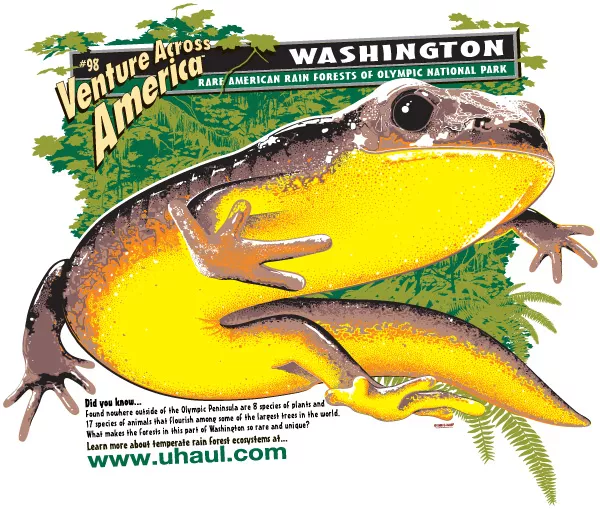
The forest community includes the black bear, black tailed deer, cougar, Douglas squirrel, jumping mouse, river otter, Roosevelt elk and shrew. Various birds, insects, reptiles and amphibians also dwell there, and the 12 major rivers provide rich habitats for fish and other aquatic creatures.
While researching Olympic National Park, U-Haul interviewed Barbara Maynes, public information officer at Olympic National Park. Here, she talks about the difference between temperate and tropical rain forests.
Text from audio clip:
U-Haul Representative: "Ok, you also mentioned earlier, temperate rain forest. I was wondering if you can explain briefly just what is a temperate rain forest as opposed to a tropical rain forest and how this temperate rain forest ecosystem works, just describe a little bit about it."
Barbara: "The biggest difference, of course, is whether it's in a temperate climate or a tropical climate. And the tropics basically are places down close the equator ... which we are not here. The temperate rain forest and ecosystem that actually extend from in North America from Northern California all the way up into the panhandle of coastal Alaska. There are several hallmarks, that for a biologist that set temperate rain forests aside form other types of forests in the northern U.S. One of them, of course, I mentioned before, was the presence of Sitka spruce that we think of as a type of tree. There are, in temperate rain forests, you also have something called nurse logs. Nurse logs are trees that have fallen over. And then, because there is so much plant life in a rain forest, one of the limiting factors for young plants and young trees to get started is just finding space to get growing. And so, nurse logs are basically when a tree falls down in the forest and creates more space for seeds to get a foothold and to start growing into a plant."