




Wildlife
The Olympic Peninsula is home to a unique ecosystem that includes plants and animals that exist only on the Olympic Peninsula (endemic). There are eight endemic plants and 15 endemic animals . These plants and animals do not live outside the Olympic Peninsula because the peninsula has been isolated from the rest of the United States for thousands of years.
Two thousand years ago, a vast continental sheet of glacial ice ran south from the Arctic covering western Canada. When it reached the Olympic Mountains, the sheet was split into two lobes, the Juan de Fuca and Puget ice lobes. During this time, a glacial outwash stream wrapped around the south side of the peninsula and extended to the Pacific Ocean. This cut the peninsula off from the nearby Cascade Mountains, as well as the rest of the continent. The end result is that not many animals were able to enter or exit the area.
Although the vast glacial ice sheet no longer spans portions of two countries, the Olympic Peninsula and Olympic National Park are still isolated by natural, geological features such as the Strait of Juan de Fuca to the north and the Pacific Ocean to the west. To the east are the Hood Canal and Puget Sound, and to the south is the wide valley of the Chehalis River. Urban development and other human activities, such as farming and logging, further isolate the unique Olympic National Park ecosystem.
While speaking with Barbara Maynes, public information officer at Olympic National Park, we asked her to identify some of the wildlife in the park.
Text from audio clip:
U-Haul Representative: "What other types of wildlife can be found in the park, apart from the endemic species? What other kinds of animals could people expect to see if they go to the park."
Barbara: "Well, there is a wide range of animals here. And I'll talk a little bit about what you can find in a rain forest. One of the other noticeable residents of the rain forest is the Roosevelt elk, and this is a type of elk that lives all around the Peninsula, but it's fairly commonly seen in the rain forest. This is a large elk and different, in some ways, from a Rocky Mountain elk, but they can be found in herds in any of the rain forest valleys. Other things that you can find, of course... There are many different kinds of salmon that live in the streams. There are black bears here that are not usually easy to see, but if you go to some of the high country areas of the park, such as Hurricane Ridge, in the early part of the summer, sometimes you can look down into the lush, subalpine meadows below Hurricane Ridge and pick out bears. Sometimes four or five of them at a time that you can see looking down into the valleys, feeding on the new spring grasses and other plants that are growing in the valleys. On the coast, you can find seals, seal lions. There are areas where you can find sea otters, if you are lucky. Sometimes in the spring, people are lucky enough to look out a little bit further off shore and see gray whales migrating. So there's a huge diversity of Plants & Animals in the park."
The following endemic plants are only found on the Olympic Peninsula.
(Endemic species information provided by Barbara Maynes, public information officer at Olympic National Park.)
Olympic Mountain fleabane (Erigeron flettii) - Found in open areas near or above treeline, the Olympic Mountain fleabane grows in tufted low clumps and has small, white daisy-like flowers.
Flett's violet (Viola flettii) - Blooming in June and July, this native of the Olympic high country has bright purple flowers with yellow centers and is commonly grows in rock cracks and crevices. Its leathery, kidney-shaped leaves are purplish on the bottom.
Olympic Mountain dandelion (Taraxacum olympicum) - Like most of the Olympic's endemic plants, this native yellow dandelion occurs in the high country of the Olympic Mountains.
Olympic Mountain groundsel (Senecio neowebsteri) - Found on open talus slopes above tree line, this relative of the aster has bright yellow flowers and thick, dark green leaves. It blooms in late summer, once the snow has finally melted from its high-country habitat.
Olympic Mountain milkvetch (Astragalus australis var. olympicus) - The rarest of the Olympic endemics, this small relative of the pea plant has hairy, gray-green leaves and pinkish white flowers. After the blooms fade, they are replaced by showy bright red seed pods. Found at high elevations only in the northeastern Olympic Mountains, the milkvetch grows on exposed talus and scree slopes.
Olympic rock mat (Petrophyllum hendersonii) - A native of the high country of the Olympics, the rock mat lives up to its name and is always found growing on bare, open rocks, often "painting" a line of white flowers as it grows up a crevice. Blooming in July and August, its white flowers grow in dense drooping spikes that complement its rosette of leaves.
Olympic Mountain synthyris (Synthyris pinnatifida var. lanuginosa) - Blooming in early spring (and sometimes as early as February) this plant lives on open wind-swept slopes and ridgetops of the park's alpine zone, where snow is frequently scoured away by winds. This diminutive plant is identified by its low-growing habit, fuzzy gray-green leaves and tiny spikes of deep purplish-blue flowers.
Piper's bellflower (Campanula piperi) - Found in rock cracks and crevices in the Olympic's alpine and subalpine areas, this diminutive plant has showy light blue to purplish flowers and small, spiny-edged leaves. It blooms July to August.
Thompson's wandering fleabane ( Erigeron peregrinus ssp. peregrinus var. thompsonii ) - Not found in Olympic National Park, this is the only endemic plant of the Olympic Peninsula that grows exclusively at lower elevations. Found in swamps and boggy areas on the southern fringe of the Olympic mountains, it has small, white daisy-like flowers.
The following endemic animals and insects are only found on the Olympic Peninsula.
(Endemic species information provided by Barbara Maynes, public information officer at Olympic National Park.)
Olympic marmot (Marmota olympus) - Like other marmots, the endemic marmot of the Olympics is often heard before seen. Living in colonies in high country meadows, the marmot has a high, shrill whistle that alerts other colony members to the presence of possible intruders. The Olympic marmot is similar in appearance to the closely related hoary marmot of the Cascade Mountains, but has different coloration on its back and more subtle markings on its feet and face.
Olympic yellow-pine chipmunk (Tamius amoenus caurinus) - The Olympic chipmunk lives at higher elevations than its larger, lowland relative, the Townsend's chipmunk.
Olympic snow mole (Scapanus townsendii olympicus) - A subspecies of the Townsend's mole, the Olympic snow mole is smaller, and is found at higher elevations. Though seldom seen, it is known to occupy the high country around Hurricane Ridge (5,200 feet in elevation). In contrast, the Townsend's mole is found only below 2,000 feet, with wet pasture being its preferred habitat.
Olympic Mazama pocket gopher (Thomomys mazama melanops) - The seldom seen pocket gopher spends most of its life underground. The endemic Olympic Mazama pocket gopher is approximately the same size (5 inches long) and cinnamon-brown color as other pocket gophers, but with larger ear spots.
Olympic ermine (Mustela erminea olympica) - A subspecies of the short tailed weasel, the Olympic ermine is the smallest of all the subspecies. Seldom seen by humans, the Olympic ermine is seven to eight inches long, with rich brown fur on its back, a creamy white belly and a black-tipped tail.
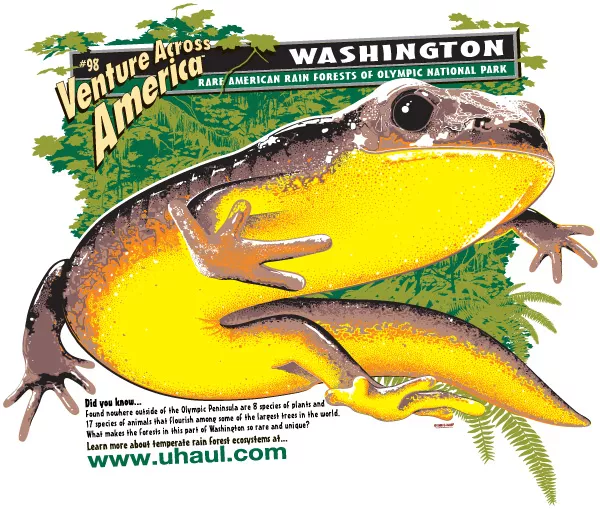
Olympic torrent salamander (Rhyacotriton olympicus) - Like the other torrent salamanders (the Cascade, Columbia and southern torrent salamanders), the Olympic torrent salamander has a bright yellow belly. Unlike the others, however, the belly has large dark spots, while the back and sides are green, brown or gray, without spots. Torrent salamanders need cold, clear water and are often found in the "splash zone", where a thin layer of water runs over or among rocks along waterfalls or creeks. The pristine forest and river habitats of Olympic National Park provide the Olympic torrent salamander with its ideal habitat.
"Beardslee" rainbow trout ( Onchorhyncus mykiss irideus, lacustrine form ) - The Beardslee is a highly adapted form of the rainbow trout. They grow to a very large size, often reaching at least 20 pounds by six years of age. The adults have distinctive blue backs with black spots, and large mouths, used to capture smaller fish, their primary prey. The adults spawn in the lake outlet in the winter months and, due to the lake's very clear water, their redds or nests are highly visible from shore.
"Crescenti" cutthroat trout ( Onchorhyncus clarki clarki, lacustrine form ) - The Crescenti is a highly adapted form of the coastal cutthroat trout and, in fact, looks very similar to the sea-going cutthroat, with a long jawbone and red slashes on the throat. Crescenti feed on insects and small fish and grow to 12 pounds in Lake Crescent. The Crescenti ascend the lake's principal tributary stream to spawn in the spring.
Hulbirt's skipper (Hesperia comma hulbirti) - This butterfly is a local subspecies of a widespread circumpolar species and in the field, is difficult to distinguish from its close relatives. About an inch in size, its thick body is covered with yellow green hair. Its orange or yellow wings are outlined in brown.
Olympic grasshopper (Nisquallia olympica) - This alpine grasshopper is a small (less than an inch in length) and wingless. With its medium brown color and scattered darker markings, it blends in with the grasses and rock of its high elevation habitat. Like most grasshoppers, it has a vegetarian diet.
Mann's gazelle beetle (Nebria danmanni) - A denizen of the Olympic's higher elevations, it has been collected on snowfields at night, preying on other insects that have been blown onto the snow during the day. The Mann's gazelle beetle is small and slender with a purplish sheen, and like other gazelle beetles, has long legs.
Quileute gazelle beetle (Nebria acuta quileute) - This gazelle beetles inhabits the banks of large, deeply shaded streams. It hides under rocks at the water's edge during the day and comes out to hunt at night. The Quileute gazelle beetle is about a half-inch long, has long slender legs and is faintly tinged with blue or green.
Tiger beetle (Cicindela bellissima frechini) - This endemic tiger beetle is found only on the northwest corner of the Olympic Peninsula. Like other tiger beetles, it has long legs and good eyesight. They are closely associated with water and are often found on sandy beaches of the coast or riverbanks. They are metallic blue-green on their undersides, with lightly patterned blue-green backs.
Arionid slug (Hemphillia dromedarius) and Arionid jumping slug (Hemphillia burringtoni) - Little information exists about these two endemic slugs, but they are relatively small (about three inches long) when compared to other native slugs of the Pacific Northwest. All slugs are related to snails; the arionid slugs show this relationship with a tiny remnant shell on their backs. The Arionid jumping slug has been found at only eight places on the Olympic Peninsula and appears to be associated with old growth forests near rivers or the ocean.
The "Missing" Species
The Olympic Peninsula's list of "missing" species is further testimony to the long-term isolation of these northwest mountains. Common mountain dwellers such as the lynx, pika and porcupine are found as close as the Cascade Range, just east of Puget Sound, but are not native to the Olympic Peninsula. A full listing of the "missing twelve" follows.Mammals
- Grizzly bear (Ursus arctos)
- Wolverine (Gulo gulo)
- Red fox (Vulpes vulpes)
- Lynx (Lynx canadensis)
- Water vole (Microtus richardsonii)
- Golden-mantled ground squirrel (Spermophilus borealis)
- North bog lemming (Synaptomys borealis)
- Porcupine (Erethizon dorsatum)
- Pika (Ochotona princeps)
- Mountain sheep (Ovis canadensis)
- Mountain goat (Oreamnos americanus)
Birds
- White-tailed ptarmigan (Lagopus leucurus)