
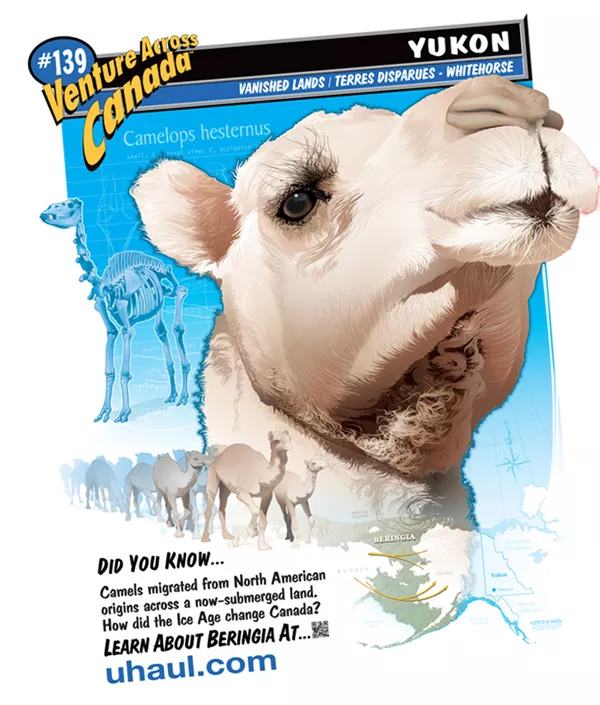
Lost Land Revealed in Yukon
The ice age forever changed Canada's landscape, but it's the glacial history of Yukon that proves to be unique. And though Beringia retreated below sea level 11,000 years ago, evidence for this lost land continues to be revealed throughout parts of Alaska and Yukon. This started during the great Klondike Gold Rush of 1896-1899, when more than 100,000 prospectors journeyed to the Klondike region of the Yukon in northwest Canada, rampantly searching for gold. As it turned out, more than just gold turned up, and it certainly didn't take long before word spread throughout the world that there was more than just gold to be found in the hills of the Yukon's Klondike region. During the gold rush, miners unearthed massive fossilized bones from beneath the Earth's frozen layers. Grant Zazula, Yukon government paleontologist, and Duane Froese, associate professor at the University of Alberta, co-authors of "Ice Age Klondike, Fossil Treasures from the Frozen Ground," noted that even though some bones were easily comparable to modern-day animals, such as elephants, buffalos and bears, other bones were those of extinct animals that lived during ancient times. Zazula and Froese also explain that during that time, people didn't know how old the unearthed bones were, where the bones came from, or why they were in the Klondike. They suspect that some of these earlier fossil discoveries were quite possibly just as awe-inspiring as a box full of gold would have been. Shortly after some of the very first discoveries, scientists from around the world started journeying to the Klondike in hope of unearthing ancient treasures and learning more about these unique fossils.
It was nearing the end of the 19th century when Canadian geologist R.G. McConnell made the earliest record of fossil collections in the Klondike. In 1904, the bones of many extinct species, as well as species that still exist today, were recorded by the first international fossil expedition in the Klondike, led by a team from the Natural History Museum in Paris. The American Museum of Natural History, the United States Biological Survey and the Smithsonian were among other expeditions into the Klondike to study the fossil bones. Zazula and Froese happily reported that a vivid picture of the ice age has emerged from the Klondike region. Today, gold miners are still unearthing fossils that continue to provide clues, just as they have done for more than a century, about Yukon's ice age history. Zazula and Froese talk about "Beringia's Big Three," referring to the steppe bison, horse and woolly mammoth, and explain that most of the fossil bones recovered from the Klondike and other places throughout Beringia are from those three species. However, in addition to Beringia's Big Three, other unique ice age fossils from western camels to Beringian lions and short-faced bears have been unearthed in the Klondike. Canadians can be proud of the fact that the Klondike is one of North America's leading sources of ice age fossils.