



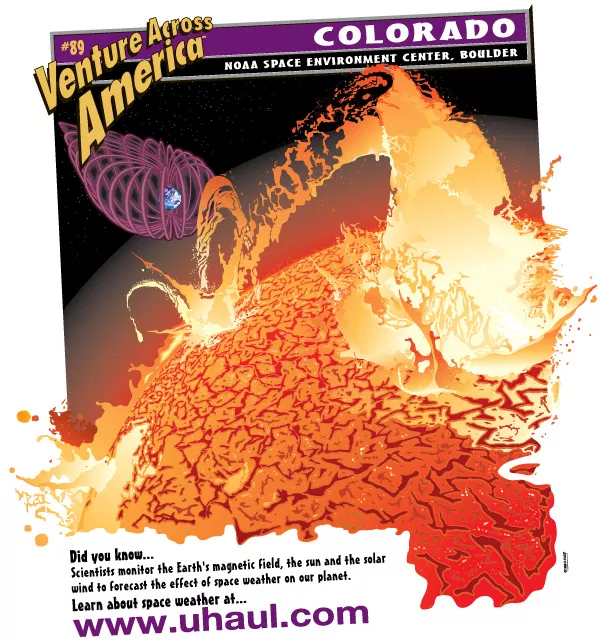
Forecasting Solar Weather
At the Space Environment Center (SEC), a research lab of the National Oceanic and Atmospheric Administration (NOAA), scientists monitor the effect of space weather on our planet. The SEC is on the alert for any disturbances that can affect astronauts and the many highly sensitive technological devices operating in space. Since the 1940s, the list of organizations and businesses relying on space weather information has grown as technology advances. Shortwave radio operators were some of the first to seek information from the Space Environment Center. Now, the SEC's reports are considered essential by telecommunications companies, utility providers, satellite operators and government agencies, which all have electronic systems that may be affected by severe space weather. The official space "weather room" for national and international warnings is the Space Weather Operations center, which is on alert 24 hours a day, 7 days a week. Aside from forecasting, SEC staff members are actively involved in developing new techniques to predict space weather, designing new equipment and researching the sun-Earth connection.
To predict space weather with accuracy, scientists use an array of sophisticated imaging systems and sensors on Earth and in space to help them scrutinize the sun's behavior. Solar flares generate energy equal to approximately 40 billion Hiroshima-size atomic bombs. Events such as coronal mass ejections and prominences are explosive bursts of gas released from the sun's corona, which send streaming particles of energy into space. By getting a close look at sunspots, comparing these regions to their past patterns and analyzing the sun as it rotates on its 27-day cycle, researchers can get a good idea of what weather conditions in space will be like. Recent sophisticated satellite improvements have helped them to improve their predictions' accuracy to almost 100 percent.
Scientists have information from hundreds of years of history on which to base predictions. They have long noted that examining sunspots is a way of keeping track of the sun's 11-year cycle of activity, but these dark areas on the sun are still not fully understood. They do know that these areas are associated with strong magnetic activity and are around 1,000 degrees cooler in comparison to the rest of the sun. Sunspots can be as wide as 150,000 km in diameter and usually develop in pairs. Scientists believe that while the sun's solar cycle has been pretty steady, there was a period during the 17th and 18th Centuries when few sunspots were noted, and Europe experienced a "little ice age."
Because of the strong magnetic field surrounding groups of sunspots, scientists believe they can give a pretty good indication of events that will occur. Flares that spurt out are classified by their X-ray intensity. Recently, the sun unleashed one of the largest recorded solar flares, estimated to be larger than the powerful March 1989 flare, but because this one was pointed away from Earth, it didn't cause millions of dollars of damage to sensitive electronic devices.