



Solar Basics
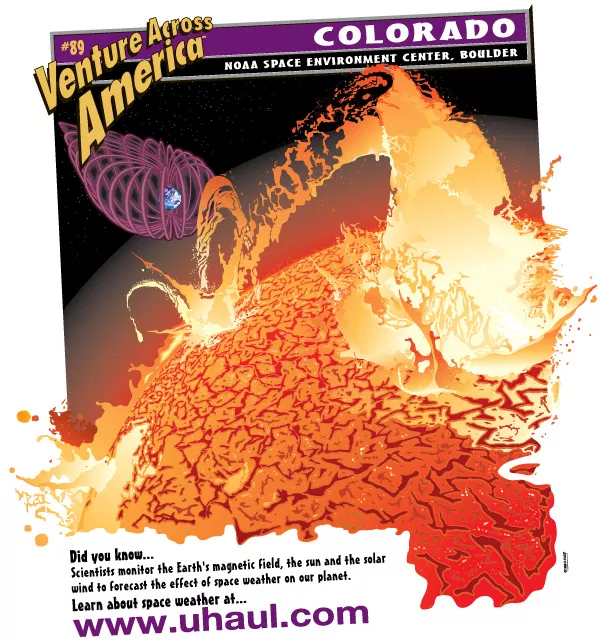
From a viewpoint on Earth, the sun is a placid fixture in the sky, a constant source of heat and light, and even a benevolent lifegiver. Closer inspection reveals a different reality. Our star is a dynamic ball of hydrogen and helium in continual turmoil, erupting and showering the solar system with highly charged particles. This solar activity is not consistent, but flows and ebbs, reaching a peak every 11 years. Scientists monitor this activity by observing the patterns of dark, blotchy sunspots that appear on the sun's surface.
A high concentration of sunspots indicates increased solar activity. One form this activity takes is the solar flare, bursts of high-energy particles, known as solar wind, that are released into space with enough force to reach speeds close to two million miles per hour. In contrast, the most powerful tornadoes are clocked at 300 miles per hour.
The sun is the star closest to Earth. Right now it is a bright yellow color, but once it gets older it will turn into a red giant, expanding in size by millions of miles. Eventually the sun will explode and the interstellar dust and gas will surround the dying star like a ring. Over time, the star will continue shrinking until it becomes a very small star called a white dwarf that produces no energy but will continue to glow from its leftover heat. Surrounding the core of the sun is a zone termed "radiative" because it acts like an insulator to keep up the temperature of the core. Surrounding that is a convective layer that helps transfer the energy outward to the photosphere. Then there are two more layers the chromosphere and the corona - which can be seen only during an eclipse. The chromosphere is a thin layer that appears as an outline, while the corona is similar to a halo extending outward like a crystal crown.
It's estimated the sun has been burning for five billion years and will continue to do so for billions of years more. Gamma rays are produced at the heart of the sun, where nuclear fusion is taking place. These rays take hundreds of thousands of years to get to the sun's surface. It is here, at an area called the photosphere, that the rays become visible to the naked eye and travel to Earth in approximately eight minutes. So even if the sun were to all of a sudden stop producing energy, it would still take eons before we no longer felt its effects.