

Interview with an expert
In an effort to learn more about the ghost orchid and the Fakahatchee Strand State Preserve, U-Haul contacted Biologist Mike Owen, at the Fakahatchee Strand State Preserve.
U-Haul: Where is the Fakahatchee Strand State Preserve located?
Mike Owen: The Fakahatchee Strand State Preserve is located within the Big Cypress Swamp region in southwest Florida. We're about 35 miles east of Naples and about 90 miles west of Miami. We're west of Everglades National Park.
U-Haul: How big is the preserve?
Mike Owen: The whole preserve covers about 84,000 acres.
U-Haul: What is the climate and environment like at the Fakahatchee Strand State Preserve?
Mike Owen: The Big Cypress Swamp is subtropical to tropical. We're just south of the 64° Fahrenheit winter isotherm, so it's really quite humid and warmer over the really deep sloughs, which can get two to three feet deep during the summer rainy season. And the canopy of large cypress trees holds in the humidity and keeps the dew point temperature above freezing. This gives the epiphytes frost and fire protection.
U-Haul: What is a cypress strand?
Mike Owen: The cypress strand is a linear swamp or an erosion channel. All of south Florida is limestone that was deposited under a shallow sea. Over the past few thousand years, naturally occurring carbonic acid in rainwater have dissolved channels in the limestone. The Fakahatchee is large. It's about three to five miles wide and 19 or 20 miles long. It's not real deep -- maybe two feet deeper than the surrounding prairies on both sides. The shallow channel allows water to stay there longer, allowing organic soils, or peat, to accumulate, which acts like a sponge. So, during the dry season - February to May - the soil is still moist, which is what cypress trees need. Cypress strands are dominated by bald cypress trees. They're related to redwood and sequoia trees, but don't get quite as big. They can get up to 130 feet tall and can live 1,500 to 2,000 years.
U-Haul: What is so special about this cypress strand? What makes it different from other strands?
Mike Owen: The Fakahatchee is the largest cypress strand within the big cypress swamp and within the state. It covers about 37,000 acres. There's another three miles of the Fakahatchee Strand north of I-75 within the Florida Panther National Wildlife Refuge, so the strand is actually about 19 miles long, and we have the bottom 16 miles of it.
U-Haul: What type of orchid is the Ghost Orchid?
Mike Owen: The scientific name is Polyrrhiza lindenii. Polyrrhiza meaning "many roots." The roots are slightly flattened. They're an emerald green when they're wet and a grayish-green when they're dry. And they're just roots; they have no leaves. There are little white dash marks on the tops of these slightly flattened emerald green roots. Radiating from the central point is a flower stalk, and the roots also emanate from that point. They can get up to… the longest one I've ever seen was probably a little over three feet long.
U-Haul: When these flowers are not in bloom, they're just made up of roots? No leaves or foliage?
Mike Owen: Right. No leaves at all. And, they're epiphytes, so they're leafless, epiphytic orchids.
U-Haul: An epiphyte is an air plant. In other words, it doesn't need to touch the soil to grow. Right?
Mike Owen: Right. An epiphyte is a plant that grows on another plant. It gains no nutrients from the host tree, unlike a parasite — like mistletoe — which truly does cause some harm to the host plant. Epiphytes can be an orchid, a bromeliad or a fern. Even mosses and lichens are epiphytic.
U-Haul: Do ghost orchids have a particular tree that they like to grow on?
Mike Owen: Most ghost orchids grow on either bald cypress trees, Pop Ash trees or Pond Apple trees, but they can also grow on the royal palm.
U-Haul: Can you describe what the ghost orchid looks like when it is in bloom? How do you know that what you're looking at is a ghost orchid?
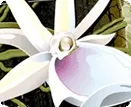
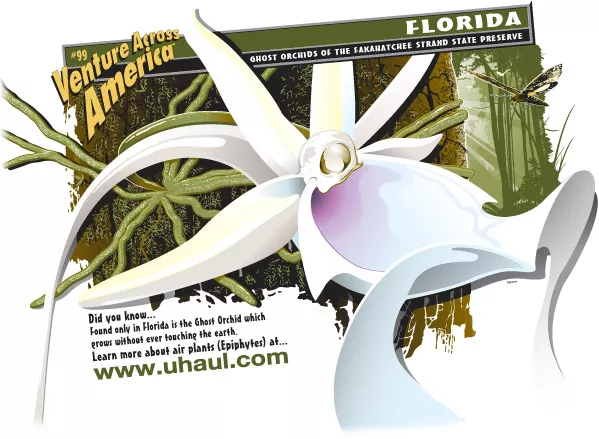
Mike Owen: The ghost orchid is unmistakable when it's in bloom. It's very large. It's three to five inches long and about two and a half to three and a half inches wide. They vary in size depending upon the health or the vigor of the plant. And, they're usually a ghostly white. They look like a leaping frog. They have the floral pattern of an orchid. Many orchids have highly modified floral parts, but on the ghost orchid they're wrinkled and folded. The bottom lip has two extensions that look like frog legs. Another common name besides ghost orchid is frog orchid.
U-Haul: How is the ghost orchid pollinated?
Mike Owen: We believe the pollinator is the giant sphinx moth. It's found in the American tropics and also in southern Florida. It has a very long proboscis, like the long tongue of a butterfly. Its proboscis is five to six inches long and the giant sphinx's wing span is five or six inches, too. The ghost orchid's bottom spur is about four to five inches long, and at the bottom of that spur is a little nectary where the sugar-rich nectar is located. We believe that only the giant sphinx moth has a proboscis long enough to reach the end of the four to five inch spur. So, that's how the ghost orchid gets pollinated. It is very important for plants to exchange genetic material this way. I don't believe the ghost orchid can be self-pollinated. It has to be cross-pollinated in order for it to produce seeds.
U-Haul: When does the ghost orchid bloom?
Mike Owen: It primarily blooms in the summer months: June, July and August...earliest I've seen it bloom was May 23rd. The latest I've seen was September 1st.
U-Haul: The ghost orchid is said to be a tropical rain forest orchid, but the Fakahatchee Strand State Preserve is not actually a rain forest. How did this end up in the Fakahatchee, and if the Fakahatchee is not a tropical rain forest, how does the ghost orchid survive?
Mike Owen: The range of the ghost orchid is primarily Cuba, throughout the western portion of the West Indies — primarily the Bahamas Islands — and extreme southern Florida. Everglades National Park, Big Cypress National Preserve and Fakahatchee Strand State Preserve would probably be its stronghold. Southern Florida is the limit of its distribution within the United States, but its largest range is Cuba. It does really well in the Fakahatchee because of the deep sloughs. The pop ash and pond apple trees have rough bark, which is a good place for the seeds to land. The seeds are very tiny and lightweight, so they're easily carried away by the wind from the seedpod, which opens up during, I believe, during May through August. Since we're in close proximity to the West Indies and Cuba, hurricane winds and even migrating birds could easily transfer ghost orchid seeds. Wherever an orchid seed lands, it has no food, so it relies on being infected by a fungus, which is a mycorrhizal fungus association that infects the seed and forms a symbiotic relationship between the fungus and the seed. This facilitates the nutrient uptake for the seedling. Without the fungus association, the seed cannot survive in the wild. They can be raised in the lab without the fungus if they are put on nutrient agars with sugars, but in the wild, the ghost orchid seed is dependent upon being infected by a fungus. Throughout its adult life, the orchid's roots are continuously infected by the mycorrhiza fungal hyphae. The little thread-like hyphae infects the roots, which helps the orchid gather nutrients from the surroundings. Since it grows on the bark of a tree, it gathers nutrients from rainfall and the air.
U-Haul: Does it feed off this fungus or does it work in conjunction with the fungus to gather food?
Mike Owen: There's a lot that's not known about mycorrhizal fungal associations within orchids. It seems that the fungus helps the orchid by facilitating the nutrient up-take, but the fungus probably benefits from the association as well — maybe a place to live within the roots of the orchid. In the wild, the orchid seed would not be able to survive into adulthood without being infected by a mycorrhizal fungus.
U-Haul: How does the Ghost Orchid photosynthesize?
Mike Owen: The Ghost Orchid gave up its leaves evolutionarily, and has just two tiny vestigial leaves when they're seedlings, maybe five or 10 millimeters long. They lose their vestigial leaves and grow larger roots because all the chlorophyll moves into the roots. They use their roots to photosynthesize their food. The seedling stage is a crucial time for epiphytic orchids to be infected by the fungus. It's my understanding that the seed cannot survive to adulthood without the fungus.
U-Haul: Is the Ghost Orchid endangered?
Mike Owen: The Ghost Orchid is listed as endangered on the Florida State list of threatened and endangered plants. So is the ribbon orchid and the Harrisella, which is listed, I believe, as threatened, so it's more common than the other two.
U-Haul: So, if you go to the Fakahatchee Strand State Preserve, do you have to search for the Ghost Orchids, since they are endangered and rare?
Mike Owen: Right. They were abundant locally 40 to 50 years ago, before the collecting of epiphytic plants began in the 1950's and 60's. And of course, the drainage of water in the swamp didn't help either. The water provides the humidity and frost and fire protection for the epiphytes.
U-Haul: Are there other types of epiphytes besides orchids? Are there any others within the Fakahatchee?
Mike Owen: Yes. We also have 14 different species of bromeliads, and we're up to 35 maybe 36 species of ferns. Plus, we have three species of pepperomias.
U-Haul: Not all orchids are epiphytes. Is that correct?
Mike Owen: That's right. About half of our orchids are epiphytic. We have about 44 species of native orchids here, and I believe 21 species, are epiphytic. The other half are terrestrial or semi-epiphytic. The terrestrial ones grow out of the ground, and the epiphytic ones grow usually on a host tree. Some are semi-epiphytic; they grow on stumps of Cypress trees or logs.
U-Haul: What kind of animals live in the Fakahatchee?
Mike Owen: We have the endangered Florida panther, which is a sub species of the cougar or mountain lion. We have the Florida black bear, which is listed as threatened on the Florida State list. And the Everglades mink, which is a threatened sub-species of the Southern mink. We also have the big cypress fox squirrel and the short-tailed hawk, which is a tropical hawk that breeds throughout the peninsula and south Florida. And, we have the southern bald eagle. We even have a couple bald eagle nesting areas within the Preserve. We also have bobcats, whitetail deer, river otters, red-shouldered hawks, as well as osprey and, of course, alligators. We also have snakes. The one that concerns most people is the Florida cottonmouth, or the water moccasin. We also have turtles, frogs and the American chameleon called the green anole. It's capable of turning from brown to green. It's not a true chameleon; we just call it the American chameleon. It's a native lizard that's beautiful when it turns green. They have bluish eyelids and can move their eyes independently, like the Old World chameleons from Africa and Madagascar.
U-Haul: Is the state preserve open to the public?
Mike Owen: Sure. We're open every day of the year from 8 a.m. to sunset. The only thing is...to see the tropical epiphytes, people have to be willing to wade in the water. Usually, it's a foot deep, and sometimes up to two or even two and a half feet deep in the sloughs.
U-Haul: If people don't want to get in the water, there are boardwalks where people can just enter the Fakahatchee?
Mike Owen: Sure. We have a boardwalk at Big Cypress Bend along the Tamiami Trail, and it has 215 acres of old-growth cypress trees. Some of the trees are three to four feet in diameter and a little over 100 feet tall. And there are royal palms out there, too. There's probably a few orchids up there, but many are too high to see. Each visit could be a little different when it comes to the animals you see.
U-Haul: Was there anything else you wanted to add that might be interesting or important for people to know about the Fakahatchee Strand State Preserve or the Ghost Orchid itself?
Mike Owen: The Fakahatchee is also the world's only bald cypress/Royal Palm forest, and it's a complex mosaic of habitats found within the matrix of the Fakahatchee Strand. Fakahatchee also has the largest population of royal palms in Florida. The other two populations are in Everglades National Park and in Collier-Seminole State Park. And, our population of royal palms is estimated at 5,000 to 7,000 trees. So it's a very healthy population of native royal palms.