

The Fakahatchee Strand
Tourists and scientists alike enjoy exploring southwestern Florida's diversity and unique scenic views. Approximately 25 miles southeast of Naples, Florida, in Collier County, lies a remote, 84,000-acre swampland forest called the Fakahatchee Strand State Preserve. "Fakahatchee" is a Seminole word meaning "forked river." "Strand" is local slang for any long, narrow swamp forest.
The Fakahatchee Strand, which was formed by erosion, is an elongated channel in limestone bedrock that has accumulated deep organic soils, or peat, over hundreds of years. The sloughs are deeper channels cut within the strands. A slough can be compared to a small river or stream; a strand is like a little valley. The strand is about two feet deeper than the surrounding prairies, and the sloughs are about a foot or foot and a half deeper than the strand.
The sloughs of the Fakahatchee have been colonized by Bald Cypress and other trees, creating a swamp forest. The Fakahatchee Strand is the major drainage slough of southwestern Florida's Big Cypress Swamp and is about three to five miles wide, 19 to 20 miles long and two feet deep.
The Fakahatchee Strand State Preserve's central slough is the world's largest Cypress Strand/Mixed hardwood swamp and chain of sinkhole lakes connected by channels. The Fakahatchee's swamp lakes are about 5 to 10 feet deep, and some of the sinkhole lakes are nearly 100 feet deep. Big Cypress National Preserve only has one sinkhole that is 95 feet deep.
The Fakahatchee Strand is truly a unique environment, unlike anything most people have ever experienced. North America's largest concentration of tropical, epiphytic orchids and the largest strand population of native royal palms are found here. In addition, bromeliads, ferns, pop ash trees and pond apple trees are thick within the slough. The central slough is formed by the chain of sinkhole lakes within this Cypress strand.
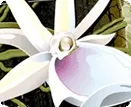
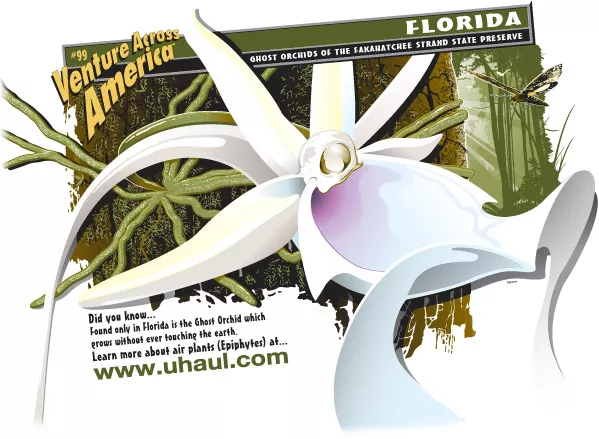
Managed by the Florida Department of Environmental Protection, the Fakahatchee Strand is one of the most significant subtropical swamps of south Florida. Home to several rare and endangered plant species, such as the ghost orchid, the Fakahatchee has been designated an "area of critical concern" by the State of Florida in order to preserve its natural resources.
The Fakahatchee Strand was first explored by naturalists between 1860 and the early 1900s. In the 1940s, the Fakahatchee's topography was altered forever. Logging of the old-growth Bald Cypress trees was conducted for PT boats, decks of aircraft carriers, and hulls of minesweepers during World War II. The exquisite habitat was invaded as more than 130 lime-rock trams were built (most were a mile long). While the Fakahatchee Strand has never been the same since that time, the logging project took 10 years, and those who study the area agree that the change was most likely too slow to wipe out any rare plants. It was the high demand for rare orchids in the 1950s and '60s that caused the real damage. Truckloads of specimens were taken out of the Strand by orchid collectors.
In 1974, the Fakahatchee became a state preserve and continues to be a source of botanical surprises. To date, 484 plant species have been identified within the preserve, and 71 of these plant species are listed as Threatened or Endangered. Although logging, drainage, fire and other human actions have had a serious impact on the Fakahatchee, the main reason for the high number of endangered flora is due to the abundance of tropical plants living in this sub-tropical forest. Sixty-nine percent of the Fakahatchee's trees, 86 percent of the ferns and 88 percent of the orchids are of tropical origin. When temperatures in the Fakahatchee dip below freezing for just a few minutes, these vulnerable, tropical populations are reduced.
While the Fakahatchee Strand is essentially a temperate forest, the tropical plants are able to flourish because bald cypress trees form a large canopy over the Strand and sloughs of Popash and Pond apple trees. This creates a tropical environment by keeping the wind out, holding in the humidity and keeping the dew point above freezing most of the time. In fact, over the deep water sloughs, the temperature rarely falls below 32 degrees Fahrenheit.
Fakahatchee Strand State Preserve is home to 44 native North American orchid species, 11 of which cannot be found anywhere else on the continent. In addition, 14 native bromeliads and 32 native ferns live in the Fakahatchee.
Some of the Fakahatchee's trees, such as the Gumbo limbo, Laurel oak and royal palm, cannot tolerate being flooded for long periods of time, so they grow on small hills called hammocks. The central royal palm hammock in the Fakahatchee has 3,000 trees and is known as the world's biggest and healthiest hammock. Pop ash and pond apple trees, on the other hand, grow in the sloughs. The bark on these trees is rather rough, which makes it ideal for bromeliads, fern spores and orchid seeds to germinate over the deep water, which offers both frost and fire protection. Wildlife found in the Fakahatchee Strand includes the Florida black bear, the Florida panther, bobcats, raccoons, otters, deer, mink, alligators, snakes, lizards, hawks and various wading birds.