



Carnivorous Plants
Throughout the world, more than 450 species of carnivorous plants have been identified. The following list, compiled by the Nature Conservancy, details the specific carnivorous plants which have been identified growing naturally in North Carolina's Green Swamp Preserve.
While many carnivorous plants are commonly referred to by easy-to-remember names, such as Venus Flytrap or pitcher plant, each one has a scientific, Latin name as well. In this list, each Latin name represents the specific plant found in the Green Swamp Preserve. Some of the descriptions of these plants were taken from Peter D'Amato's book, The Savage Garden, with permission.
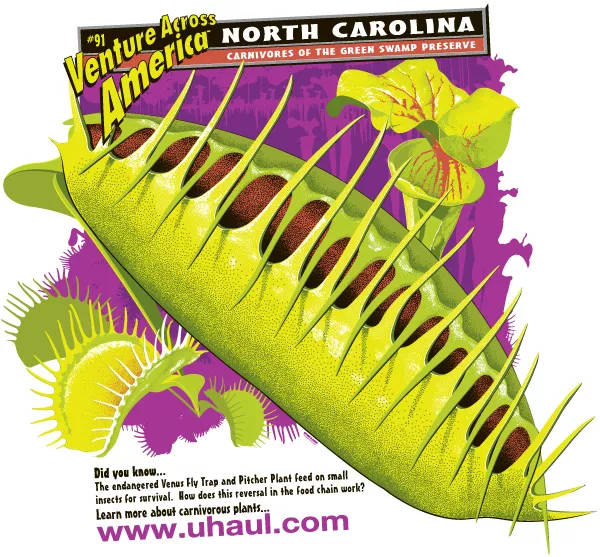
Venus Flytrap- Dionea muscipula .
Charles Darwin, who studied carnivorous plants and wrote a book called Insectivorous Plants in the late 1800s, called the Venus Flytrap "one of the most wonderful [plants] in the world."
This plant is grown from seed and it usually takes about five years to reach maturity. It's mostly a green plant, but the leaves, which average two to four inches in length, are sometimes red. The leaf traps are about one inch long.
A glistening nectar-like secretion inside the trap attracts insects to it. To trigger the trap, tiny hairs inside on the leaves must be touched by the insect. If one trigger hair is touched, the trap prepares to close. Then if another hair is touched within a few seconds, the flytrap knows the insect is big enough for a full meal and the trap snaps shut in less than one second. When an insect tries to free itself, it often touches more trigger hairs, which causes the trap to squeeze even tighter, making any chances of escape impossible. The long finger-like hairs on the margins of the trap help keep even quick insects from escaping once the traps begins to close. After closing, digestive juices, similar to stomach acid, are secreted. The soft nsect body is dissolved, and the nutrients are absorbed. The indigestible outer skin of the insect remains in the trap. The trap will open a few days later, and may be able to catch another meal. The act of closing and digesting, however, "wears" out the trap; and new ones are always growing to replace older ones.
Trumpet pitcher plant-Sarracenia flava
This plant grows tall, erect pitchers that vary in size from 10 inches to 36 inches. A well-formed lid is located on the top of the pitcher, which keeps out rain and acts as a landing platform for insects.
Similar to the flytrap, insects are attracted to the Trumpet pitcher plant by the smell of sweet nectar. Studies have shown, however, that the various color patterns of the pitcher also play a role in attracting prey. Some prey, such as carrion flies and beetles, may be attracted by the odor of decaying insects inside the pitcher.
And while the flytrap catches insects by snapping shut on them, the Trumpet pitcher plant uses a drug called coniine, found in the plants nectar to make the insects "drunk" enough to fall into the tube from which they cannot escape.
According to D'Amato, the Trumpet pitcher plant sometimes catch such enormous amounts of flies, ants, wasps, beetles and moths that the pitchers topple from the weight.
Prime lots of this plant are rapidly disappearing, especially in the Carolinas, due to attacks on its habitat.
Red pitcher plant- Sarracenia rubra
These pitcher plants, with their red to dark-red flowers, are generally smaller than other pitchers. They have a scent that smells like roses, or, as some experts have noted, Cherry Kool-Aid. In general, they lure prey the same way as the Trumpet pitcher plant, with nectar and color.
Purple pitcher plant- Sarracenia purpurea
This pitcher plant varies in size from a few inches to over a foot in height. Unlike other pitcher plants, which have lids to keep rainwater out of the tube, the Purple pitcher plant has only a "collar" around the tube. This collar is covered with bristly, downward-pointing hairs. Insects try to cling to these hairs, but often slip, where they tumble into the rainwater below and drown.
This plant, according to D'Amato, is often the first plant a hobbyist encounters. Although it is not as good at catching insects as other pitcher plants, the Purple pitcher plant is popular at plant nurseries because of its beauty and compact size.
Hooded pitcher plant-S. minor
These pitcher plants are generally green with a coppery red cast to the upper pitcher when it is growing in bright sun. An interesting characteristic of these pitchers is the presence of white spots on the back of the pitcher. Scientists believe these white spots, which they call "light windows," are there to allow more sun into the inner tube of the pitcher. The reasoning is that insects are more likely to crawl into a bright tube than a dark one. It is also believed that flying insects may think they are actually exit holes out of the tube. The insects only discover that is not the case when they strike the pitcher's back wall and fall in. The most common prey for the Hooded pitcher plant is ants.
Bladderwort- Utricularia cornuta
–U. juncea
–U. inflata
–U. purpurea
–U. subulata
Bladderworts make up the largest genus of carnivorous plants and they are the most widespread. They are mostly aquatic in nature, floating in ponds or growing in very moist soil. They can be found on every continent in the world because they are highly adaptable. They live everywhere from arctic lakes that are frozen half the year to quiet, acidic ponds in the sunny and warm southeastern United States.
These plants are completely rootless. When in bloom, the plants produce beautiful yellow or purple flowers. ( In the opinion of Peter D'Amato, these particular species are NOT cultivatable the tropical ones are.)
The name Bladderwort comes from the device they use to capture their prey, a bladder-type capsule the size of a pinhead. Tiny aquatic insects and other animals are sucked into the bladder after touching whisker-like trigger hairs as if by a vacuum. Because the bladders are so small, the bladderworts prey are usually microscopic organisms such as daphnia and cyclops.
Tiny triggers sit at the door's entrance. By touching the hair, the door to the bladder swings open and the prey is sucked inside, with the door slamming shut behind it.
Butterwort– Pinguicula caerulea
–Pinguicula lutea
Sometimes called "pings" after their Latin name, there are some 70 species known, and they grow throughout the Northern Hemisphere. They are typically small plants with a diameter of just a few inches.
As the names suggests, their leaves have a greasy, buttery feel to them. The leaves generally sit flat on the ground and are slimy, like flypaper. The leaves, which glisten in the sunlight to attract prey, contain thousands of tiny hairs. When insects such as gnats, ants, springtails and fruit flies land on these leaves, they become stuck in the tiny hairs, which are covered in strong glue. Once the insect is trapped, the Butterwort almost immediately begins digesting its meal.
Sundews- Drosea capillaris
–D. intermedia
–D. filiformis
–D. brevifolia
As plant expert D'Amato explains, "If an insect ever evolved the brains enough to write a horror novel, the monster in that novel would probably be a Sundew."
That's because the Sundew, though one of the more pleasant, innocent-looking carnivorous plants to be found, condemns its prey to a horrible death that can last anywhere from a few minutes to a few hours.
These plants are probably the most diverse genus of carnivorous plants in the world. There are somewhere around 130 species and they are found on almost every continent.
Sundews can be as small as a penny or as large as a small bush. Their leaves are covered with tentacles. At the end of these tentacles is a droplet that insect mistakenly believe is nectar, when it's actually glue!
When an insect touches this glue, it becomes entangled. While trying to free itself, it inevitably touches more droplets, becoming more entangled and helpless. Then, to make matters worse, the tentacles, sensing a victory, begin moving, increasing the plant's stranglehold on its prey. The short glue-tipped tentacles actually press the insect prey against the leaf surface, where digestive juices can work.