

Interview
It was the 1960s and Larry Mellichamp, then a young student at the University of North Carolina at Charlotte, was on a field trip with his botany class to North Carolina's Green Swamp. At the beginning of the day, while the rest of the class was sent off in one direction, the professor asked Mellichamp to go look for carnivorous plants.
"I searched and searched for one, which I had never seen before, but was having no luck," recalled Mellichamp. "Well, by the end of the warm, humid day, I hadn't found a thing. Then, just as it was getting almost too dark to see, I spotted a few pitcher plants on the side of the road. I was so excited that I dug it up (in those days, it was legal to collect carnivorous plants) and I brought it back to the school's greenhouse. That was the beginning of my fascination with carnivorous plants. I guess it kind of 'sealed my fate,' and I've been hooked ever since."
Today, Mellichamp is one of the nation's leading experts on carniovorous plants. He has a Ph.D in botany from the University of Michigan and has had several scholarly works published regarding these meat-eating plants. U-Haul sat down with Mellichamp recently to discuss carnivorous plants and the Green Swamp. Here are some excerpts from that interview.
U-Haul: What is the Green Swamp and where is it located?
Mellichamp: The Green Swamp is a huge sweep of marsh, swampland and lush wet meadows located in southeastern North Carolina. It's not like a rain forest because there are no huge trees. But, it's an impenetrable growth of shrubs, some up to 20 feet high. If you tried to walk through the Green Swamp without the use of a machete, you could die from getting entangled in the prickly vines, shrubs and muck. It's probably the most impenetrable vegetation on this continent. There are vines the size of broom handles with half-inch thorns.
Today, the Green Swamp Preserve represents 15,762 acres of land that was given to the Nature Conservancy in 1977. It is made up of huge meadows, called savannas, shrub thickets, called pocosins, and swampland. Living in the Green Swamp are all kinds of animal life, in addition to the heavy vegetation. There are alligators, black bears, coral snakes, rattlesnakes, water moccasins, copperheads and more. However, I have personally never encountered face-to-face any of these animals in over thirty years of field work there.
U-Haul: What is it about the Green Swamp that makes it the so-called "mecca" for carnivorous-plant enthusiasts?
Mellichamp: The Green Swamp hosts the largest diversity of carnivorous plants in the world. It also holds the most carnivorous plants in terms of sheer numbers of plants. There are probably a million of them throughout the region.
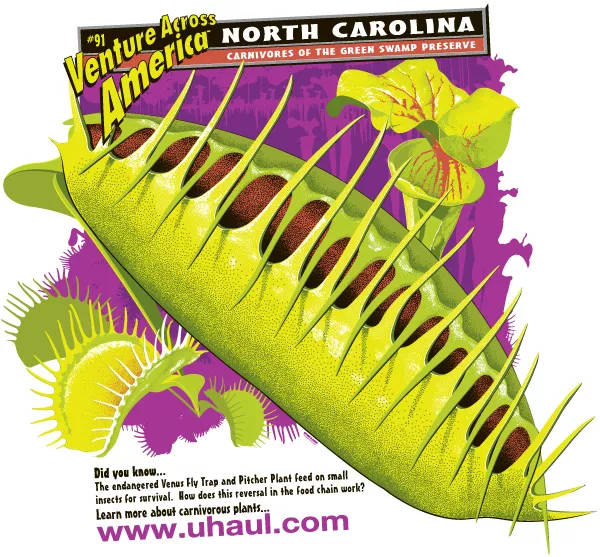
Perhaps most noteworthy, however, is that the Venus Flytrap, the most famous carnivorous plant, can be found only within a 60-mile radius of the Green Swamp, just south of Wilmington, N.C. This is the only place in the world that the Flytrap grows naturally in the wild!
There are also more than a dozen other species of carnivorous plants to be found there. For example, there are four different kinds of pitcher plants, four types of Sundews, three types of Butterworts and eight species of Bladderworts. There are literally thousands and thousands of these plants growing wild throughout the savannas, ponds, and wet ditches.
U-Haul: Where, specifically, do these carnivorous plants grow in the Green Swamp?
Mellichamp: They grow in the open, sunny, wet meadows with grasses and an occasional longleaf pine. It's a common myth that they grow in deep, shaded regions, when, in fact, it's just the opposite. These plants need direct sunlight to grow.
U-Haul: How long have carnivorous plants inhabited the Carolinas region?
Mellichamp: There are no fossil records of carnivorous plants with which we could use to measure, but generally speaking our theory is that they're pretty ancient. Some probably evolved in the uplands of the southern Appalachian mountains. We think that they began evolving tens of millions of years ago.
There is one theory that Venus Flytrap come from outer space, because there are these large, oval lakes in the area, called Carolina Bays, and people say these lakes were formed from the tail of a comet that hit the earth. Others say it was a meteor shower. Anyhow, there are a lot of unusual plants that grow in the vicinity, including the Venus Flytrap. For that reason, people wonder if Venus Flytrap may be a plant that originated in outer space and arrived here when these lakes were formed. But this is a far-fetched theory, because the Venus Flytrap is very normal in its physiology and it has normal flowers. Only the leaves are different in the sense that they move.
U-Haul: Is the Venus Flytrap in danger of becoming extinct?
Mellichamp: The Flytrap is not officially listed as endangered. Rather, it is what we call a plant of "special concern." So, you cannot collect this plant in the wild without a permit because it is a plant that is exploited commercially. But there really are a lot of them growing in the wild.
Still, there is a great deal of concern. Despite the large populations, there used to be a lot more. I'd say that probably up to 90 percent of their former range has been destroyed by agriculture, development, timber industry, road building, and herbicides.
The 1970s were kind of the heyday for carnivorous plants here in North Carolina, because the Green Swamp was almost all dirt roads with ditches on the sides, which these plants love. Now, these dirt roads are being paved over, and work crews often mow the roadside ditches, killing the carnivorous plants there.
U-Haul: Are there any special uses for carnivorous plants?
Mellichamp: There are some pitcher plants being studied right now as a possible anti-cancer drug, so we'll have to see how that turns out. Besides that, over in Europe, Butterworts have been used for centuries to coagulate milk. There are not a whole lot of economic uses, but those two are a few that come to mind.
U-Haul: What is the future of carnivorous plants?
Mellichamp: Loss of habitat is the biggest worry for carnivorous plants. City sprawl is a big problem. The counties in North Carolina where these plants grow are some of the fastest growing counties in the nation. Road construction is also killing many of them. The land where carnivorous plants grow is viewed as pure wasteland, in general. It's almost like we need to discover some amazing use or economic advantage that these plants offer before anyone will stand up, take notice, and start to truly preserve their habitats. Ironically, the carnivorous plant habitats (savannas) in the Green Swamp contain the greatest diversity of higher plant species of anywhere in the temperate zone in the world.
Because of this habitat loss, and because there has been a tendency in the past to collect carnivorous plants from the wild, I have been breeding hybrid pitcher plants for the past 15 years to make them available to hobbyists who want to grow them. These hybrids grow better than the wild species, and so they remove the need to collect from the wild. They also help attract interest to carnivorous plants and bring attention to the plight of carnivorous plants worldwide.
I am very impressed that U-Haul has decided to feature carnivorous plants on its trucks, as this also calls attention to these most remarkable plants that are so famous from North Carolina.
IF YOU GO - GREEN SWAMP
Some call the Green Swamp the mecca of carnivorous plants. Covering 15,672 acres of swamp, pocosin and extensive tracts of longleaf-pine savanna, the area contains more than a dozen species of carnivorous plants, including the Venus flytrap. There are areas in the Green Swamp where you can stand and be literally surrounded by hundreds of meat-eating plants.
A trip to the green swamp could be a wonderful excursion for the newcomer to the world of carnivorous plants or the seasoned veteran. Here's some general information to help you plan your trip. For further information, visit the Nature Conservancy's North Carolina chapter on the Web at www.tnc.org/northcarolina or call the Wilmington office at 1-919-403-8558.
Getting there:
A parking area for the Green Swamp is located five miles north of the town of Supply on North Carolina's Highway 211 in the southeastern part of the state.
When to go there:
The Nature Conservancy recommends the spring or fall as the best time, temperature-wise, to visit the Green Swamp. For viewing carnivorous plants, the winter isn't a good time because many of the plants are shriveled up as they hibernate. If you can handle the muggy, warm weather, the summer is a great time to view carnivorous plants.
Before making the trip, the Nature Conservancy urges you to call the Southeast Coastal Plain Office at 1-910-762-6277. That office can inform you of weather conditions and other issues that may affect your travel plans. If there has been a lot of rain, for example, the Nature Conservancy recommends hikers stay off the trails, because more damage is done to the fragile ecosystem. The Nature Conservancy also conducts prescribed burns of certain parts of the preserve throughout the year, so it's important that you call them anytime before going visiting.
What to do there:
The Nature Conservancy periodically schedules field trips to the Green Swamp, led by local volunteers. Call 1-919-403-8558 for more information.
If you prefer to go it alone, the preserve is open to the public free of charge. Simply park your car on the side of the road and venture through the many trails.
It's illegal to collect carnivorous plants from the wild, but it's a lot of fun just searching for the many species that exist there. If you see a Venus flytrap, it is recommended that you don't trigger the traps because most leaves can snap only about three times before they die.
What to wear:
Workers at the Nature Conservancy recommended wearing rubber boots or sneakers that you really don't care about, because your footwear is probably going to get quite muddy and wet. Also, some type of bug spray is suggested to keep away the myriad ticks and chiggers that inhabit the region.
What else to do:
The Green Swamp lies in the coastal region of North Carolina, so in addition to looking at carnivorous plants, vacationers can also visit some beautiful beaches, including Holden Beach, Ocean Isle and Long Beach, all a short drive from the preserve.
The city of Wilmington, about 20 miles northeast of the Green Swamp is the cultural, medical, educational and economic center of this region. The city is known for historic preservation, its close proximity to area beaches and annual events such as the Azalea Festival and Riverfest.
The Green Swamp is also open to hunting through the North Carolina Wildlife Resources Commission's Game Land Program.
Call 1-800-VISIT-NC for more tourist information.
Cost:
There is no cost to enter the Green Swamp.