


Growing Your Own
Growing your own carnivorous plants can be lots of fun and a great way to learn more about these fascinating plants. Of course, growing them can also be very frustrating because of the special care they need. Talk to nearly any carnivorous plant expert and they'll tell you that their first memory of carnivorous plants was taking one home and watching it die.
But if you take the time to learn about the correct way to grow them, having a carnivorous plant can be a snap! You just have to realize that they are not as easy to maintain as the rest of your beloved house plants. As carnivorous plant guru Barry Meyers-Rice notes, no amount of love will make up for education when it comes to these plants.
Experts disagree on whether or not it is necessary to build a terrarium in order to successfully grow carnivorous plants. Some say you have to be lucky to successfully grow these plants on your window sill, while others say it's quite easy if you just stick to the rules.
Since building a terrarium will cost you about $300 or more, the following tips are for those who want to try their luck at growing carnivorous plants the less complicated and less expensive way – on a windowsill.
For further tips on growing your own carnivorous plant, check out the Web sites of these carnivorous plant-growing experts:
- Barry Meyers-Rice: www.sarracenia.com
- Peter D'Amato:
Buy it
Buying a carnivorous plant is the easiest part. You can find the Venus Flytrap at almost any nursery, where they are usually sold in small pots for about $5. Some of these nurseries may also carry a few other carnivorous plants, such as sundews and pitcher plants, but for the best selection, try the Internet. Here you'll find dozens of mail-order companies that specialize in carnivorous plants and provide all kinds of important tips on how to grow them. Most have minimum purchase orders of about $20, plus shipping. Two of the more reputable Web sites on the Net are californiacarnivores.com and sarracenia.com.
Pot it
Plastic pots are the safest way to go for housing carnivorous plants. Terra-cotta clay pots look nice, but the porous material of these pots can mean high evaporation, which will dry out your plant. Also, mineral salts in the clay pots may be absorbed into the soil and then into the plant, killing them. But, if you really want to use a clay pot, just make sure it's been glazed first.
Whether you use a clay or plastic pot, it should be the kind with drainage holes at the bottom. Most carnivorous plants, including the Venus flytrap and many pitcher plants, hate undrained containers unless they are really deep.
Soil it
Depending on where you buy your carnivorous plant, it may be a good idea to repot it to ensure that the soil is correct. What you want is a 50-50 mix of sphagnum peat moss and sand, preferably sharp or silica sand. The peat moss is very acidic, a quality carnivorous plants love. Carnivorous plants also love the moisture that peat moss retains.
As for the sand, be sure NOT to use sand that you collect from the beach or lake. "Put a carnivorous plant in sand that you collected from a beach or lake and it will die, guaranteed!" exclaimed carnivorous plant expert Meyers-Rice. That's because this sand has salts in it, and salt is a nutrient that carnivorous plants have gotten used to living without. They get their nutrients from the bugs, not the sand.
Water it
Another surefire way to kill your carnivorous plant is to water it with tap water, which also has nutrients the plants cannot handle. Instead, you must use purified water. But it can't be just any bottled water. Salt is often added to bottled water to make it taste better. Do not use mineral water, mountain water or spring water, unless the label states it has been purified or is low in sodium. Just remember to look for water that is low in dissolved mineral salts.
Also, some folks mistakenly believe that boiling water will allow the minerals to disappear, making it safe for carnivorous plants. "This is not true," explains Savage Garden author Peter D'Amato. "The only thing that will vanish from the water with such treatment is the dissolved chlorine gas that is added to water to kill bacteria. The minerals, unfortunately, are left behind.
The soil that a carnivorous plant sits in should remain permanently wet. At any moment, you should be able to grab a handful of the soil, squeeze it, and have water drip from your hand, according to the experts.
The best way to keep the soil wet is to set your pot (with drainage holes in the bottom) in a saucer or tray that always has some water in it. Generally speaking, most carnivorous plants do well when about one inch of water is kept in the saucer at all times.
Light it
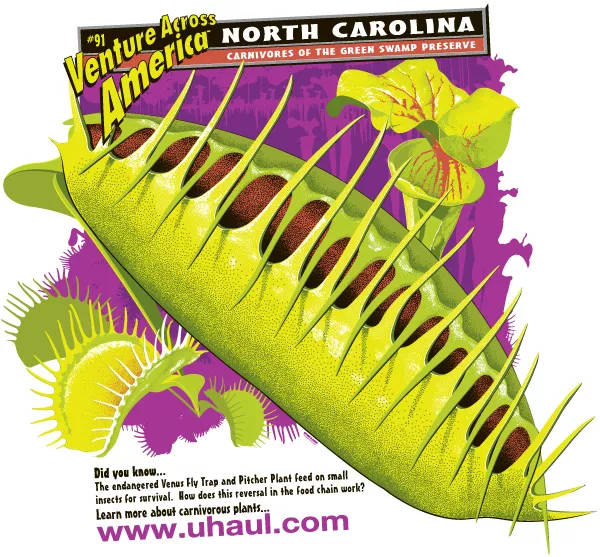
If you ever visit the Green Swamp in North Carolina to see the dozens of carnivorous plant species growing wild, you'll see for yourself that these plants thrive on direct sunlight. While some may be partially shaded at times by a pine tree or tall grass, generally speaking sunlight is as important to carnivorous plants as wet, acidic soil. If you put it on a windowsill, choose a window that gets direct sunlight for at least a few hours. How much sun your plants get also depends on where you live. In California, for example, you may have healthier plants when they're exposed to sun only in the morning, or protected by a canopy of shade cloth in the afternoon.
Feed it
If your carnivorous plant is outside in your backyard or patio, there is no need to feed! It will lure, catch and devour insects all by itself. If, however, you are keeping the plant inside, you will need to feed it bugs. Experts recommend caterpillars, flies, spiders, crickets and slugs. But remember, during the winter, most carnivorous plants go into dormancy and should not be fed. And whatever you do, don't ever feed carnivorous plants hamburger meat. They will die for certain. Hamburger meat is too much concentrated protein, and it wil stimulate the plant to over-produce digestive fluid. This may kill the plant.
Let it rest
Keep in mind that most carnivorous plants go through a dormancy period, during which their leaves may fall off and the plant stops growing. Most carnivorous plants need this so-called hibernation, so do not force them into a growth period with artificial warm temperatures when they should be resting. The dormancy period usually occurs in temperatures between 30 degrees and 60 degrees Fahrenheit, between December and January. If you live in a tropical environment, where temperatures do not go that low, it may be necessary to place the plants in a refrigerator for a while during these months. However, for most regions, simply putting the plants near a chilly basement windowsill will be sufficient.