




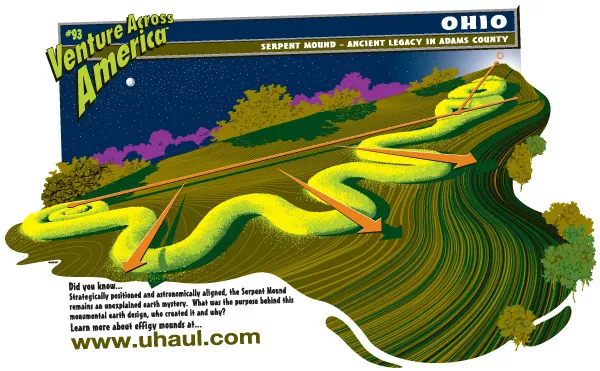
Interview With An Expert
Brad Lepper is one of the leading authorities on Serpent Mound. He's been actively studying the ancient site since 1990, but as a student of Ohio archaeology and a native of the state, he's visited and done research on the Mound since the 1970s.
Currently, he is a curator of archaeology at the Ohio Historical Society and a part-time professor at Denison University in Granville, Ohio. He has a master's degree and Ph.D. from Ohio State University in anthropology, where his specialty was archaeology.
Brad was one of three professional archaeologists (along with Dee Anne Wymer and William Pickard) and two avocational archaeologists (Robert Fletcher and Terry Cameron) who re-excavated the Serpent Mound in 1992. It was the first time the mound had been excavated in more than 100 years.
Brad spoke to U-Haul recently about Serpent Mound. The following includes excerpts from that interview.
U-Haul: There are some questions regarding who exactly built the Serpent Mound, and when. Do we now know with any sort of certainty who built it and when it was built?
Brad: There is still some controversy regarding when Serpent Mound was built and there's still room for disagreement. But I think that the strongest data support the interpretation that it was built by the Fort Ancient people about A.D. 1070. And I come to that conclusion for a number of reasons. A number of lines of evidence point me in that direction.
First, we have two radiocarbon dates from particulate charcoal from different parts of the Mound itself. Both dates came back identical at the corrected date of A.D. 1070. Second, the Serpent is not a very important image in Native American art until the Fort Ancient period (which is around 900 A,D up until the 1600's), but it does figure prominently in Fort Ancient period art and symbolism.
Traditionally, archaeologists have interpreted Serpent Mound as having been built by the Adena people around 2,500-2,300 years ago. The reason they think that is not because of anything that was found in the Mound (nothing was) but because two, clearly Adena, burial mounds and a small Adena village site are located nearby.
However, there is also a Fort Ancient burial mound located nearby, and even closer there is a Fort Ancient village site within one hundred yards of the tail of the Serpent. So, you could use that same argument by association to say, "Well, look, we've got a Fort Ancient village and a Fort Ancient Mound nearby, so the mound may just as easily have been built by the Fort Ancient people."
U-Haul: In terms of the Serpent Mound, the mound itself, what is it? Is it just dirt? Is there stone underneath? And how did they build it?
Brad: That's a real good question. When Archaeologist Frederick Putnam excavated it in the 1880's, he did find, at least in certain places, a layer of stone and ashes near the bottom, and perhaps some stones in it as well. But the structure is predominantly earth. And in the trench that we re-excavated and looked at, we didn't find very much stone at all, and certainly no stone layer. We only found earth.
U-Haul: So, more or less, the Serpent Mound is a dirt mound that has endured for years and years.
Brad: Yes. Once vegetation becomes established on an earthwork, it's very permanent. The National Park Service has done some studies with Revolutionary War earthworks as well as Civil War earthworks, and they've found that as long as grass or other vegetation is growing on it, that those roots hold the form very well, and it does not erode much.
U-Haul: What term did you use for it? Earthworks?
Brad: Yes. An earthwork is just a broad classification that includes mounds and enclosures like the giant circles, squares and octagons built by the Hopewell, as well as effigy mounds, like Serpent Mound. They're just earthworks ... works of earth.
U-Haul: Gotcha. Now, you mentioned the excavation that you and your colleagues did. When did this take place?
Brad: 1992.
U-Haul: 1992. So before that, it was pretty much assumed the Adena culture had built the Serpent Mound?
Brad: Yes. All the textbooks that talked about it labeled it as an Adena mound.
U-Haul: What brought about it? Why did you and your team decide to study it?
Brad: Well, intense interest, mostly. There were two avocational archaeologists, Robert Fletcher and Terry Cameron, who were very interested, and they had done a map and had done a tremendous amount of research on Serpent Mound. They were interested in determining the age, scientifically, and they approached me and some of my colleagues and we joined with them to provide some of the professional expertise of the team. But really, it was initiated by Fletcher and Cameron.
U-Haul: It's incredible that, in the 1990s, the work of two amateurs could change forever the way we look at the history of Serpent Mound. Do you think there are other important archaeological finds around the world that amateurs could study and, in doing so, possibly change the history books?
Brad: Oh absolutely! In a number of fields, amateurs make some of the most important discoveries that are then followed up on by professionals. Or sometimes the professionals can then work with them to clarify the interpretations and do some work. But, yeah, amateurs make an enormous contribution to modern archeology!
U-Haul: What makes the Serpent Mound the most famous mound?
Brad: Well, it is the largest Serpent effigy built in prehistoric times and certainly in Ohio where you have an abundance of wonderful, magnificent mounds and earthworks, it stands out in Ohio because people can at least think they understand it. In other words, if you look at the Hopewell circles and octagons, which are MUCH bigger than Serpent Mound, you're overwhelmed by the scale as well as by the arcane geometry. Like, what the heck does a circle mean, what's this giant octagon mean? But when you go to Serpent Mound, you feel a much stronger connection with the people who built it, because you have an idea of what they had in mind.
U-Haul: Yeah, it's pretty simple. It's a snake.
Brad: Yeah. That has, unfortunately, though, led to people assuming they know more than they do. And one of the classic examples of that was the Reverend Landon West at the turn of the century, who interpreted it, not just as any serpent but as THE serpent of the Garden of Eden. He thought that it was Satan with the apple in his mouth, and believed, therefore, that it marked the location of the Garden of Eden.
U-Haul: Oh, wow. And he claimed that? Was that believed by a lot of people?
Brad: I don't think so, but it was published in the Ohio Archeological and Historical Society quarterly. So some people, at least, regarded it as interesting.
U-Haul: So since then, you and your team have done studies and found that it had nothing to do with the Garden of Eden.
Brad: Right. And I don't think anybody has seriously entertained that theory in the past 100 years or more.
U-Haul: Is there any chance of there being something really interesting buried down there. Maybe a mummy or gold or anything like that buried down there?
Brad: No. No. In fact, mounds were dug into all over the place during the 1800s by people looking for gold or jewels or treasures, and they certainly found treasure, but it was a treasure of a very different sort. It was treasure that informs us about the lives ... the life and death of these ancient cultures. They didn't find any gold or jewels.
Based on Putnam's excavations and the very limited excavations that I was involved with when we reopened one of Putnam's trenches, I don't think there's any reason to believe it's anything other than a sculpture made out of earth.
U-Haul: How important do you think this sculpture was for an ancient culture? What role did it play in their daily lives?
Brad: I'm not sure it would have played any serious role in their daily lives. Well, let me rephrase that: The role of a sacred place, like a temple or a cathedral doesn't, I guess, play a very important role in many daily lives, but on Sunday, on the Sabbath, it becomes a very important day, and a very important focus. Those kinds of centers can also be an important focus for a community, more than just on one day. Given the fact that there was a Fort Ancient village nearby, I think it could well have been an important focus of their lives, but you have to remember there's only one of these in all of Ohio, in all of eastern North America, for that matter. There are more effigy mounds in the Upper Mississippi. In fact, Effigy Mounds National Monument is in Iowa right along the Mississippi River. And actually, another argument in favor of the effigy mounds in Ohio being later is the fact that all those effigy mounds in the Upper Mississippi are built much later than the Adena. They're built in the period called the Late Woodland, which is right before the Fort Ancient period in Ohio. But anyway, I think the Serpent could have been and must have been, based on the effort put into building it, an important focus for the lives of the people, at least in the local area.
U-Haul: Are there any other serpent-like mounds in Ohio, actual serpents?
Brad: None confirmed. There were stories that there was another serpent mound in Warren County, but based on the earliest documentation, I don't think it was intended to be a serpent mound, it was just an earthwork that later people interpreted based on the general shape that it looks vaguely serpentine. And there's those two stone effigies that I alluded to earlier in the valley below the Fort Ancient site in Warren County, that the excavator believes to have been stone serpent effigies. I've seen them and I think I agree, but they don't wind around like the coils of the Serpent Mound that we know and love. Instead, they are sort of just curving lines of stone, but one of them in particular has several limestone slabs at one end that very strongly, to me, suggest a rattlesnake's tail.
U-Haul: How about the Serpent Mound itself? Could you describe it? I read somewhere about the theory that the serpent is possibly eating a frog, or something like that.
Brad: Oh, yes. I think that's a silly interpretation, but there really are a complicated set of features at the head of the serpent that have confused a lot of people. Some people think the serpent has a gaping mouth and it has some kind of egg in its mouth, and that there are some mounds on the other side of its so-called egg that beg to be interpreted. And some people trying to find some interpretation have suggested that it might be a frog. And they made up a story, in fact, that the serpent was striking at the frog, and the frog was jumping away and she laid an egg behind her. But the egg is about four times bigger than the frog, so it must have been a difficult labor.
But, Robert Fletcher has come up with, I think, the best interpretation of those features at the head, and I am in complete agreement. Fletcher says that the so-called egg is actually the serpent's eye, and it's highly stylized and exaggerated, but it's stylized and exaggerated in just the way that Fort Ancient art exaggerates and stylizes serpent eyes and other depictions of serpents. And the features on the other side of the eye are the snout, the serpent's nose. So, the so-called mouth goes all the way around the egg, or the eye, continues on to the other side, and it's just the rest of the serpent's head. But the eye is shown in a very exaggerated form, because, and I don't know this for sure, but historically the American Indians in that area (when they were interviewed and talked to by pioneers) believed that serpents had magical powers and could hypnotize their prey with their gaze. Also, it's a known feature that serpents don't have eyelids, so they never blink, they never close their eyes when they sleep, which also probably contributed to interpreting mystical significance to those eyes. And I think the oval is a representation of the serpent's eye.
U-Haul: And then at the tail of it, what is at the tail?
Brad: It's just a tightly coiled tail. It's as if the serpent were in the process of uncoiling and extending itself down across this magnificent, jutting, rocky cliff that sticks out into the Brush Creek Valley.
U-Haul: And there's never any danger of mudslides or anything destroying this?
Brad: Well, there has been in the past, a serious problem with erosion at the ends, both at the tail and at the head, where it dips near the bluff edge. But, the Ohio Historical Society, in recent years, has taken steps to stabilize those slopes to prevent further erosion. Certainly, something catastrophic could happen, but no, it's pretty well protected now.
U-Haul: Are there any groups that want to just buy it and get rid of it and build condominiums on top of it, or something like that?
Brad: It is owned by the Ohio Historical Society. It's protected so that will never happen. In recent years, though, the surrounding area was threatened. A developer wanted to buy a bunch of the property surrounding it, dam up Brush Creek and turn it into a lake, such that Serpent Mound wouldn't be overlooking a pleasant valley anymore, it would be a peninsula extending into a recreational lake. And there were going to be houses and condos and recreational facilities around there, which would have really devastated the visual environment and destroyed evidence of whatever archeological sites are down in the valleys. But fortunately, that didn't pan out.
U-Haul: Thanks.