




What is it?
Serpent Mound - what is it?
In a nutshell, the Great Serpent Mound is a really old, really big earthwork constructed of dirt, shaped like a snake and located on a grassy hilltop about 50 miles east of Cincinnati.
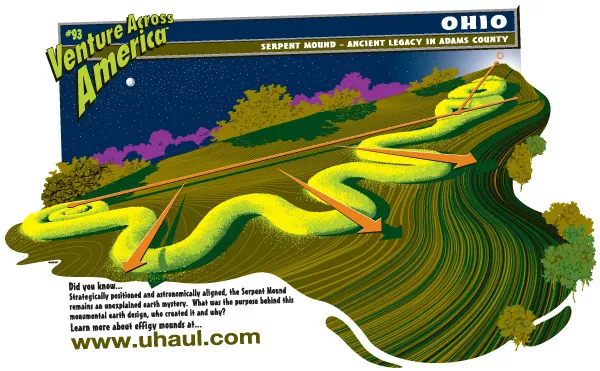
But this simplistic definition does not even begin to describe the significance of this marvelous, magical creation that continues to amaze visitors some 1,000 years after it was built. The mound is by far the most unique of more than 10,000 ancient mounds and earthworks that used to exist in southern Ohio. The snake extends approximately 20 feet wide, 4 feet high and nearly 1/4 mile long. At the head of the snake is a very curious structure stretched around a large oval containing the remains of a stone pile. This has been interpreted in various ways as a snake swallowing an egg (or even a frog), but new information suggests that it is a stylized eye.
Scientists now believe that the Serpent Mound served not only as a religious symbol, but also as an astronomically aligned calendar.
HOW OLD IS IT?
For nearly as long as archaeologists have been studying the Serpent Mound, it was believed that the mound was built some 2,000 years ago by an Indian society we call the Adena. What they called themselves will never be known.
But that theory was based purely on circumstantial evidence. Two Adena burial mounds and a small village site were found within a few hundred feet of the mound and so archaeologists interpreted that to mean the Serpent Mound was also Adena. No artifacts were found inside the effigy itself, however, so the early association with Adena could not be considered conclusive.
Despite the lack of hard evidence, the belief that the Adena mound was built by the Adena people continued until 1991. That’s when two amateur archaeologists led an excavation whereby several charcoal samples were taken from a section of the mound. Two of these, from a level of the mound that was most likely to have been deposited during construction, were then tested by radiocarbon dating.
The results of these tests indicate that the mound was possibly not built by the Adena culture after all, but rather by a later people we call the Fort Ancient at some time around A.D. 1100.
FURTHER EVIDENCE
Beyond the Radiocarbon dating evidence, further data supports the theory that the people of the Fort Ancient culture were the builders of the Serpent Mound.
First, a large Fort Ancient village once occupied the ground just south of the serpent’s tail. Also, about 900 feet south of the Serpent Mound, there is a small mound that may have been a Fort Ancient burial mound. Archeologists excavating this small mound found artifacts that seem to be from the Fort Ancient people. The burials were found to be covered with limestone slabs, a feature of some Fort Ancient graves. Also, archaeologists found a knife blade and a small arrowhead that matched tool types used during the Fort Ancient era. Furthermore, the Serpent Mound appears to be astronomically aligned to several important yearly solar events; the summer and winter solstices, and the equinoxes.
All of these facts lead most of today’s archaeologists to believe that the Serpent Mound was built by the Fort Ancient people. "A preponderance of the evidence indicates that Fort Ancient people built Serpent Mound about 900 years ago," wrote Archaeologist Brad Lepper in the September 1998 issue of Timeline magazine.
RADIOCARBON DATNG. HOW DOES IT WORK?
Modern Archaeologists use ash and charcoal found in the earth to determine how long ago the ancient fires that burned them were kindled. Living things contain two isotopes of carbon – a stable and an unstable form. When the plant or animal dies, the unstable form begins to decay. By comparing the relative proportions of the stable and unstable forms of carbon in organic remains, scientists can determine how long ago the organism died. This is Radiocarbon dating.
Source: Timeline, September 1998
WHAT DO ALL THE SHAPES AND CURVES MEAN?
Robert Fletcher, one of the two amateur archaeologists who led the 1992 excavation of the Serpent Mound, has compared the design of the mound with the physiology of snakes, and from that has made several observations about what the shapes signified. The following are a few of the observations Fletcher made.
- The oval embankment at the mouth of the snake is most likely the eye of the serpent.
- The triangular hollow east of the eye might represent the poison glands of a pit-viper, or rattlesnake.
- The mound west of the eye may represent the pit-viper’s heat sensitive depression (the loreal pit), which is located between the eye and the nostril. (The rattlesnake’s ability to sense warm-blooded prey, even in the dark, would have been noted by Native Americans, who were keen observers of nature, and might have been seen as a magical property, inspiring awe and reverence.)
Furthermore, Fletcher and his partner, Terry Cameron, diagrammed several astronomical alignments that may have been used by the ancients at Serpent Mound. They found that the head of the Serpent Mound is aligned to the setting sun on the summer solstice (In the Northern Hemisphere, summer solstice is on June 21 or June 22.). They also discovered that the coils of the Serpent Mound are variously aligned to the summer solstice sunrise, the sunrise on the equinox and the winter solstice sunrise. If this is true, the Serpent could have functioned as a giant calendar, which enabled those who built it to track the changing seasons by tracking the yearly cycle of the sun.