




Question the facts
Don't Believe Everything You Read
How two guys on vacation forever changed the history of Serpent Mound by questioning the "facts"
If you are familiar with U-Haul SuperGraphics, you know that many of them feature places that date back hundreds, thousands, even millions of years.
For example, the Iowa graphic of the Manson Impact Structure depicts a meteor that scientists say smashed into the Iowa countryside about 74 million years ago. The Utah graphic, meanwhile, shows the beautiful Escalante Canyons, which geologists say have been formed and reformed during the past 180 million years. And the Nebraska graphic re-creates pre-historic Rhinoceroses that paleontologists say roamed middle America some 10 million years ago.
People who either visit these areas or read about them in books generally accept these dates as indisputable fact. They say to themselves, "Hey, scientists have been intensely studying these places for hundreds of years. They must have all the facts straight!"
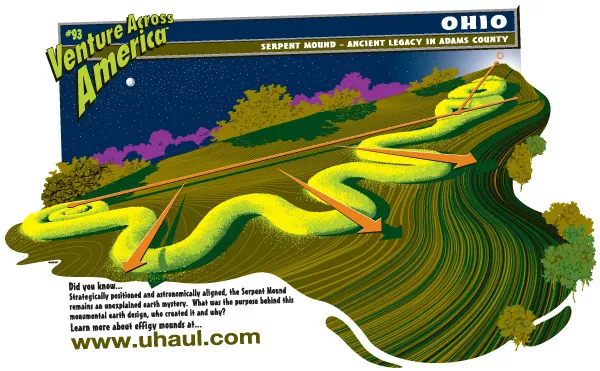
That's how most people look at the dates and facts in history books. But Robert Fletcher and Terry Cameron are not like most people. The two friends (Bob was originally from California, Terry from Ohio) from were taking a tour of the prehistoric earthworks in southern Ohio in the late 1980s when they stopped for a visit at the Serpent Mound in Ohio. While neither one of them were scientists (Robert was a computer engineer and Terry, an electrical engineer), they both took a closer-than-normal look at the world-famous historic site. Bob's father had requested a map of Serpent Mound, but after talking with William Gustin, the site manager at Serpent Mound, they were surprised to find that none were still in print, and there were some problems with the maps that did exist.
"Quite honestly, the maps weren't very good. None of them agreed with each other in detail." Robert recalled during an interview recently with U-Haul.
One thing led to another, and before Robert and Terry knew it, they were spending all of their free time studying the Serpent Mound, making detailed maps of the area and researching the history of the famous earthwork.
What they learned was that very little hard evidence existed to support the long-held belief that the Adena culture had constructed the mound around 2,000 years ago. In fact, the effigy mound had only been excavated one time, in 1889 by archaeologist Frederick Putnam. And although Putnam was a skilled archaeologist for his time, he did not have the benefit of technological innovations such as radiocarbon dating. He wasn't able to securely date the construction period, or determine which prehistoric culture in Ohio had built it.
"Back in those days, archaeologists mostly were looking for museum quality artifacts, such as whole pots or stone projectile points, and discarded broken fragments and other 'useless' items they found. Of course, many of these items, such as charcoal or broken pieces of pottery, would be considered precious to archaeologists today," Robert said.
Considering the fact that very little hands-on research at the Serpent Mound had been conducted during the past 100 years, Robert and Terry decided to undertake the challenge of excavating the Serpent Mound on their own. With the help of a few volunteer archaeologists (federal law prohibits excavations of historical sites without the presence of professional archaeologists), the two men spent a great deal of their savings and free time in an attempt to unearth the mystery of the Serpent Mound. Incidentally, one of the archaeologists who helped in the dig was Bradley Lepper.
Though the pair received a small grant from the Ohio Historical Society, Robert and Terry had to pay for most of the dig themselves. They continued to work at their jobs as engineers in northern Ohio, so a major cost was travelling back and forth between northern and southern Ohio weekends and holidays.
The official dig finally took place in 1991, and the team recovered several charcoal samples from beneath the mound. Robert and Terry then had three of the samples lab-tested using radiocarbon dating (another $500 per sample expense for the pair).
The results from those tests, and other evidence, suggested that he Adena people may not have built the Serpent Mound after all. Instead, the evidence suggests, the Fort Ancient people more likely built the mound about 900 years ago. This new information may effectively rewrite the history books on the Serpent Mound.
However, the radiocarbon dates do not prove beyond a shadow of a doubt that the Fort Ancient people built the mound. Fletcher and Cameron also provided other evidence to back up the radiocarbon tests.
For example, their research showed clearly that snakes as cultural symbols are much more common among farming groups, such as the Fort Ancient people were, than in the Adena culture. "Serpents, in general, were more revered in planning cultures (Fort Ancient) than in hunting and gathering societies (Adena)," Robert explained. "A planning culture is usually more oriented to things that stay on the ground, or come out of the ground because they are constantly disturbing the earth on a larger scale while farming."
Fletcher also pointed out that the serpent played an important role specifically in the Fort Ancient culture, which thrived between A.D. 1000 and 1550. Additionally, Fletcher interprets the Serpent Mound's large oval embankment as a stylized eye, which matches the way in which a serpent's eye was depicted in other Fort Ancient-era art.
While it still can't be said with complete certainty when and who built the Serpent Mound, Robert Fletcher and Terry Cameron have brought us much closer to the truth. They have forever changed the course of history with their discovery.
Fletcher explained that, while many dates and facts regarding archaeology are usually correct, it's always a good idea to have a healthy skepticism about what you see and read. Archaeologists are always working with an incomplete prehistoric record. They are like detectives at a crime scene, sifting often-contradictory clues, and trying to explain what they find. Sometimes, later investigators come along with new ideas and technologies, and the explanation changes.
"Only the archaeologist himself or herself knows how incomplete or sparse the data is that they use to arrive at their conclusions," Robert explained. "In the case of the Serpent Mound, the information Putnam gathered became the rock by which all subsequent studies were based. His information was very good for the time (1889). But it is incomplete in today's archaeological world and it affected everything down the line."
Robert and Terry weren't scientists (although Robert has since returned to school, where he is getting his Master's degree in Archaeology at the University of Pittsburgh). They were just two guys who didn't - and still don't - believe everything people tell them. They combined that attitude with a little money and a lot of hard work to help the world understand itself a little better. They proved that one person (in this case, two) really can make a difference.