



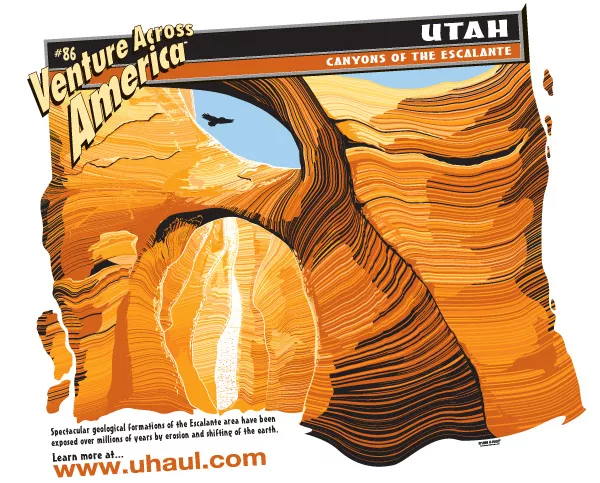
How The Canyons Were Formed
Millions of years ago in southeastern Utah, an intricate network of deep canyons began forming due to the erosion activity of water and wind on layers of sandstone. Over immense periods of time, amazing geological displays were created. This region, known as the Canyons of the Escalante, is part of a natural basin surrounded by the Colorado Plateau.
Hundreds of magnificent sandstone canyons displaying red rock arches, vaults, natural bridges, uplifted plateaus, sheer cliffs and waterfalls can be seen throughout the Canyons of the Escalante. Geologists believe the geological formations, carved in brilliantly colored sandstone , were deposited millions of years ago as the region alternated between sea, lake and desert. The intense geological activities and erosion forces that created the remarkable landscape include shifting of continents, global rising, falling of sea levels, wind, rain and the formation of seas and rivers.
Geological formations found throughout the Canyons of the Escalante consist of sedimentary layers of stone deposited during the Triassic and Jurassic periods. The predominant rock layers found in the Canyons of the Escalante are listed below, as described by the National Park Service's Canyons of the Escalante Information & Hiking Guide.
Please note that formations are listed in order from lower to upper layers.
- Chinle Formation: Laid down by meandering streams and shallow lakes, this multi-colored formation is seen in the upper reaches of east side tributaries. It erodes fairly easily, undercutting the Wingate sandstone above, resulting in boulder-strewn slopes. This formation is found predominantly in the Circle Cliffs area.
- Wingate Sandstone: Deposited as sand dunes when a huge desert covered the region. This formation, when undercut by the Chinle below, forms angular, vertical-walled cliffs.
- Kayenta Sandstone: This formation has alternating hard and soft layers laid down by sluggish streams. Where exposed, the Kayenta forms ledges and terraces.
- Navajo Sandstone: This sandstone was also deposited as desert dunes and varies in color from white to yellowish and light orange. Lying above the erosion-resistant Kayenta, it forms domes and rounded surfaces. The Navajo is the primary formation found in those canyons, which flow to the river from the west. Most arches and natural bridges in the area are found in this formation.
- Carmel Formation: Deposited by shallow seas, this siltstone-like formation was formed during the Jurassic Period. Its color varies from maroon and purple to gray and brown. Found west of the river in the Harris Wash, Egypt and Early Weed Bench trailhead areas.
Many geological formations are streaked with desert varnish, creating stunning, natural masterpieces. Desert varnish is a mix of airborne dust and clay particles left by water dripping down rock faces. These particles are cemented to sandstone walls by bacteria and microfungi. Varnishes rich in iron appear dark red or rust colored, while those rich in manganese create streaks of black or iridescent blue-black.