

Flight to freedom
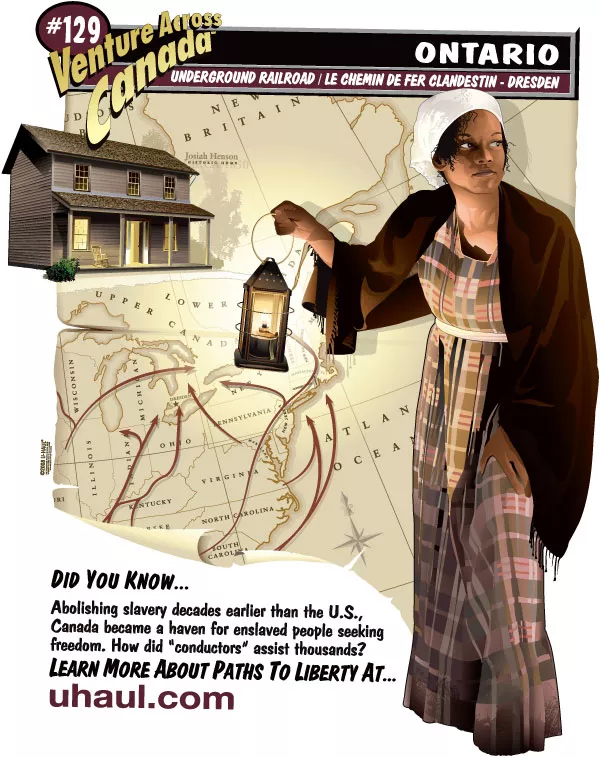
If the Underground Railroad was not a real railroad with tracks running below ground, then what was it and why did southern slave owners actually believe that their enslaved sought freedom along its tracks? The Underground Railroad, recognized today in history as one of the first civil rights movements, was a top-secret operation without any formal organization, and offered freedom-seeking African-American slaves assistance in escaping from their owners. With vast networks of various paths through forests, swamps, rivers and even over mountaintops, the Underground Railroad was considered to be any route taken to freedom. Reaching its peak between 1830 and 1865, it is estimated that the Underground Railroad, with its loose association of people, places and things, assisted more than 100,000 escaped fugitives during their flight to freedom.
The Underground Railroad was an extremely dangerous, illegal life- threatening operation. Escaping fugitives and those that assisted them were at constant risk of being caught and punished. In order to help keep people and places along the Underground Railroad safe, those who were involved often spoke and wrote using codes and railroading terms that were directly associated with current train travel. Freedom lines, routes, safe houses, stations and other havens had to be top secret because those seeking freedom often were tricked and captured along the way by people pretending to be operators supporting the Underground Railroad. Small independent groups that assisted escaping slaves would provide safe houses, freedom lines and various routes to connecting stations in their immediate surroundings, but beyond their safe house they knew few details of the next connecting station. Conductors traveling with cargo would often zigzag in order to ensure that they would not be followed. To learn the code words used on the Underground Railroad, please click on the link below.
The Underground Railroad Code Word Dictionary from The Underground Railroad for Kids: From Slavery to Freedom
- Agent:
- A person who plots the course and makes arrangements for fugitive slaves
- Baggage:
- Escaping slaves.
- Cargo:
- One or more fugitive runaway slaves
- Conductor:
- A person who guides slaves along their journey to freedom
- Drinking Gourd:
- The Big Dipper star grouping, which points to the North Star
- Forwarding:
- Transporting fugitive slaves from station to station
- Freedom Line:
- An escaped slave's route of travel
- Freedom Train:
- The Underground Railroad
- Heaven:
- Canada
- Hope:
- Sandusky, Ohio
- Judgment Day:
- The day or time of escape
- Load of Potatoes:
- A wagon full of fugitive slaves who were hidden under farm produce such as hay or potatoes
- Moses:
- Harriet Tubman
- Operator:
- An operator on the Underground Railroad
- Parcel or Package:
- A runaway slave who was traveling along the Underground Railroad
- Passenger:
- A fugitive runaway slave who is traveling along the Underground Railroad
- Promise Land:
- Canada or some place in the North
- Routes:
- The escape routes used by one or more fugitives
- Shepherd:
- A person who escorts escaping slaves
- Shipment:
- Arriving fugitive slaves
- Station:
- A place where fugitives are sheltered
- Stationmaster:
- A person who runs a safe house
- Stockholder:
- A person who donates money, clothing or food to the Underground Railroad
- Terminal:
- A stop, such as a town or city, along the Underground Railroad.
- Traveler:
- An escaping slave.
- Brakeman:
- The men and women who helped newly arrived former slaves settle into a life of freedom in a new location
Dictionary From:
Carson, Mary K. (2005). The Underground Railroad for Kids: From Slavery to Freedom. Chicago Review Press Incorporated