

Château Frontenac and Dufferin Terrace
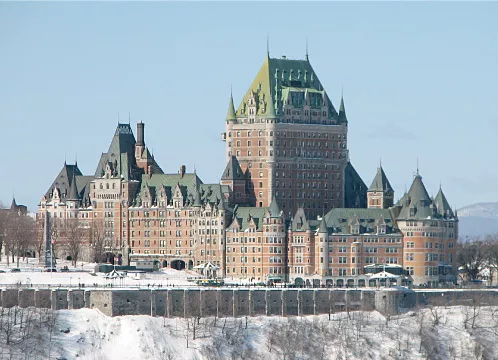
© March 2, 2008
Now that we have looked at most sections of Old Québec's Fortified Wall in the 21st Century, let's look at its final section: the majestic Château Frontenac with its spectacular Dufferin Terrace, a boardwalk covering a distance of 0.27 mile (1,425 feet or 434 meters). Both of them overlook the St. Lawrence River, with a view that extends for many miles (or many kilometers) and includes part of Old Québec's Lower Town.
Château Frontenac is by far the most prominent feature of Québec City's skyline and has also become the main symbol of that city, recognized throughout the world. Both that magnificent hotel and the Dufferin Terrace, right in front of Château Frontenac on the St. Lawrence River side, astonishingly complement the high cliffs upon which they are perched.
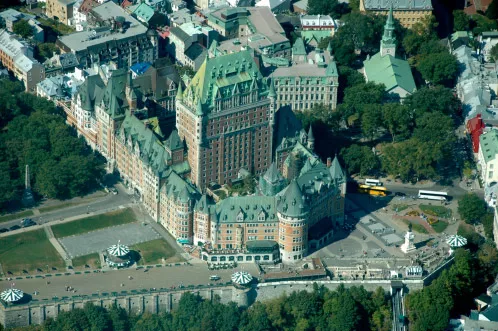
© September 12, 2009
Both Château Frontenac and Dufferin Terrace were designed and built at the end of the 19th Century, at a time when Old Québec's Fortified Wall had become practically obsolete as a key element of the defensive system for Québec City and Canada, because of the evolution of military technology. So, the main concern at that time was urban embellishment, not the improvement of Québec City's defensive system. This nuance also explains why Château Frontenac was built as a grandiose hotel and Dufferin Terrace as a spectacular boardwalk.
But that was not always the case. As far back as 1620 for the Forts St. Louis and 1648 for the Châteaux St. Louis, the Forts St. Louis and Châteaux St. Louis stood pretty much at the same place where Château Frontenac and Dufferin Terrace stand today. They were considered an integral part of the Fortified Wall as well as key elements of the defensive system for Québec City (when it stood essentially where Old Québec stands today). The four different Forts St. Louis were the direct "ancestors" of the Fortified Wall. The two different Châteaux St. Louis were the seat of the colony's executive power for almost 200 years, serving for 32 of 40 French and British Governors or Governors General as their official residence.
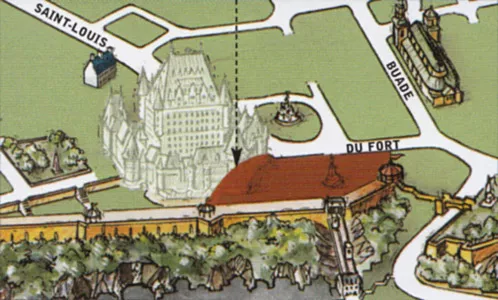
© 2005 Parks Canada
The choice of the term "Château" in the name of the prestigious hotel "Château Frontenac" helped to maintain the memory of the lost Châteaux St. Louis, after a fire destroyed the last one of them in 1834. In 1838, its ruins were finally demolished and it was replaced by the Durham Terrace ... which was later expanded and eventually became the Dufferin Terrace in 1879. The choice of the term "Frontenac" in its name was in honor of Louis de Buade, Comte de Frontenac et de Palluau, who had been Governor of New France from 1672 to 1682 and again from 1689 to 1698. He was Governor of New France when the French won the Battle of Québec against the British in 1690, after he had given this famous message to an envoy sent by Sir William Phips, the British Admiral who was summoning him to surrender: "No! I have no reply for your general, but by the mouths of my cannons and guns!"