


The star-shaped Citadel
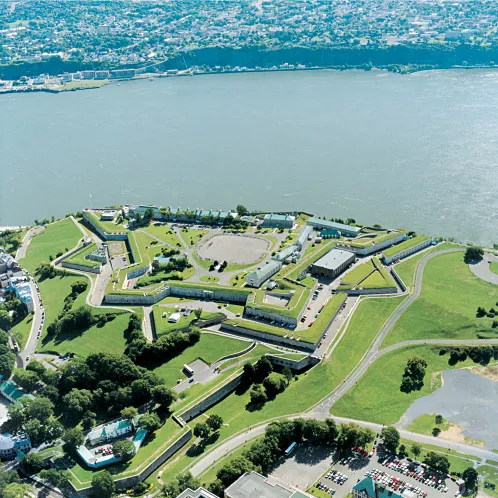
© 2009-2010 Tours Voir Québec.
The star-shaped or polygon-shaped Citadel of Québec City constitutes a huge section of Old Québec's Fortified Wall, at its southwest corner, and includes 10 interior buildings. Covering 40 acres (1,742,407 square feet or 161,875 square meters), this Citadel is the largest military fortification in North America and is still in active service. Dramatically perched on top of Cap Diamant where the height of the high cliffs reaches as much as 328 feet (100 meters) above sea level and adjacent to the Plains of Abraham, Québec City's Citadel was begun by the French in 1750, transformed by the British into a temporary fortification in 1783 and then made into a permanent fortification in the early 19th Century, between 1820 and 1831. The work on its interior buildings was completed in 1851.
First and foremost, the British wanted to be able to use Québec City's permanent Citadel as a formidable last-resort stronghold to protect themselves against:
- A potential third war against the Americans (similar to the wars of 1775 and 1812);
- An eventual French attempt to recapture the Fortified Wall (just like in 1760);
- A possible uprising by the French population living in Québec City.
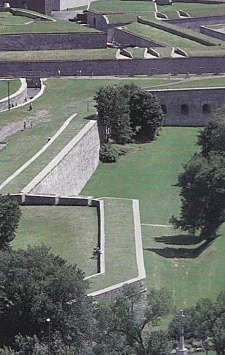
© 1998 Parks Canada
This last reason explains why some of the polygonal bastions of the Citadel are oriented toward Old Québec and not in opposite directions like its other bastions. The British felt compelled to develop a new defensive strategy for Québec City, in case an enemy attack would force their troops to retreat and wait for reinforcements, and that included a possible rebellion by the local French population.
After the addition of the permanent Citadel, Old Québec's Fortified Wall was called "The Gibraltar of North America" by Charles Dickens. Its design was typical of late 18th Century and early 19th Century defensive works in Europe. It was inspired by the fortifications designed by French military engineer Sébastien Le Prestre de Vauban in the 17th Century, under the reign of Louis XIV in France, as essentially an irregular four-sided polygon in which each angle constituted a bastion or a half-bastion by itself.
The south side of Québec City's Citadel was protected by natural obstacles: the high cliffs of Cap Diamant and the St. Lawrence River. The west, north and east sides were defended by its four major bastions, which were equipped with cannons or heavy artillery that could be used to defend both the river and the areas further inland.
Today, the Citadel is home to the Royal 22e Régiment headquarters of the Canadian Armed Forces and is still an active military base. It also houses an official residence for the Governor General of Canada and a museum. Québec City's Citadel itself is recognized as a National Historic Site of Canada. Together with the rest of the Fortified Wall and Old Québec, it was declared a World Heritage Site by UNESCO, in 1985.