

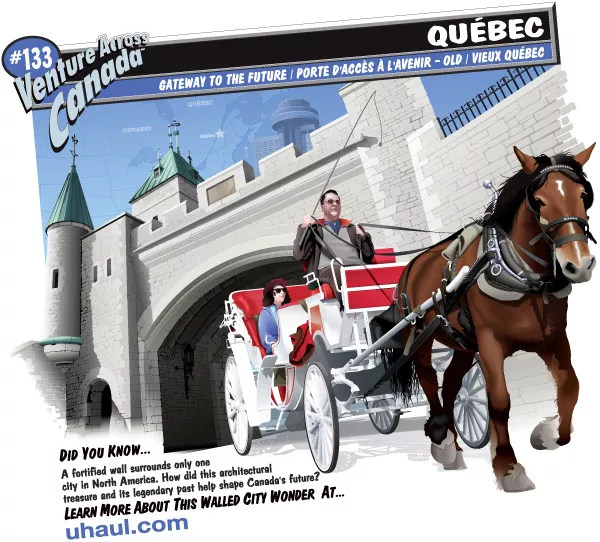
Why such a Fortified Wall?
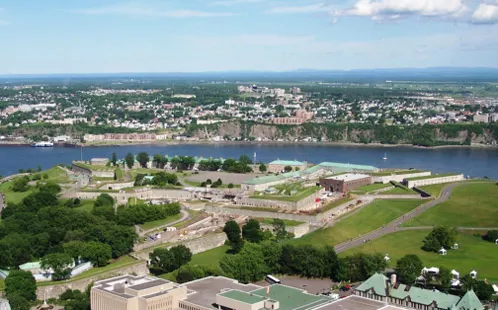
© 2007 / Photo by Carl Pépin.
Overall, the reasons that can best explain why sections of the Fortified Wall were constantly being built, improved and rebuilt for more than 400 years are the following: Québec City's exceptional location, the fact that this area was already "a natural fortress" without the Fortified Wall and became "a supernatural fortress" with it, plus imperial reasons, economic reasons and military reasons for France (from 1534 to 1759) and Great Britain (from 1759 to 1866). After 1867, urban embellishment became the primary reason for preserving, maintaining and improving Old Québec's Fortified Wall.
Let's examine these reasons more closely…
"Natural fortress" reasons – First and foremost, Québec City was located at a very special place along the St. Lawrence River. Navigation was hard on that very long river, to the point that it was considered a navigator's nightmare. It was known and feared for its rocks, reefs, sandbars, heavy fog, treacherous currents and fast-rising tides. Add to that its narrowing in the Québec City area. With cannons placed at strategic intervals on top of high cliffs dominating both sides of the river (the Québec City north shore and the city of Lévis south shore), the armed forces in control of those two shores could heavily bombard any enemy ships passing between them. The harsh climate in that area also played a key role: ice, snow and freezing-cold temperatures complicated things a great deal for any potential enemy during the long winter months. So, there it was: a double promontory made of high cliffs, overlooking the St. Lawrence River and ideally suited for building a defensive system, including a Fortified Wall practically unattackable during the long winter and unseizable during the rest of the year.
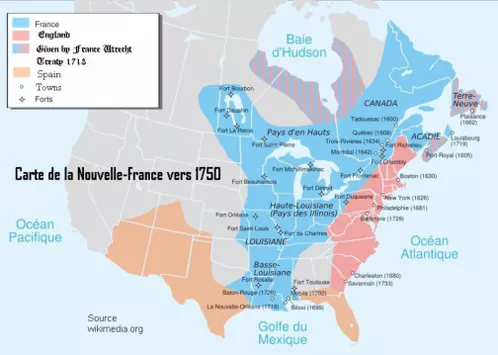
Image Sources: Google images
Imperial reasons – The "New World", as the Western Hemisphere and especially the continental landmass of the Americas were called by the European explorers at the time of the Age of Discovery (also known as the Age of Exploration, between the beginning of the 15th Century and the early 17th Century), was there for the taking. For European superpowers such as France and Great Britain, the potential ownership was simply irresistible as far as North America was concerned. They both needed more colonies to expand their empires, and North America was a prime target. That explains why the construction, improvement and control of the Fortified Wall was so important to both of them. When all was said and done, the British finished after 1759 what the French had started after 1608: the erection and consolidation of a major stronghold in North America, involving control of all maritime traffic heading toward Montréal and the Great Lakes from the northeast of Québec City as well as all maritime traffic heading toward the Gulf of St. Lawrence and the Atlantic Ocean from the southwest of Québec City.
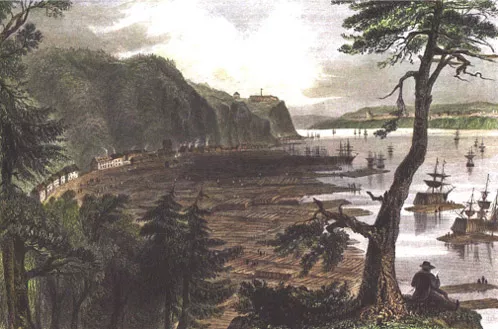
Economic reasons – When French navigator and explorer Samuel de Champlain was sailing up the St. Lawrence River in 1608, the year when he founded Québec City, he was first and foremost looking for a place to establish a fur trading post, which he did. The need to fortify that place came after and was in large part influenced by the need to protect that fur trading post from the Amerindian nations who were enemies of the French (like the Iroquois, mostly during the 17th Century) and the British. For the British, the main economic reason was the lucrative lumber trade for the wood which they badly needed to build the ships of their navy and which was plentiful in that part of the New World. Just like the French, once they were in control of the Fortified Wall, they needed to protect their economic interests against real and potential enemies. They needed to defend Québec City, the main port toward Europe, against the Americans (who attacked it in 1775), against the French (who tried to recapture it in 1760), and against the French people living in Québec City (who could rebel against British authorities). It is important to note that the port in Québec City was and still is one of the most important ports in North America.
© 2009 Service des communications
Military reasons – The site that is now occupied by Québec City and its area was already known in 1608, but the vast defensive potential of such a unique site "where the river narrows" had not been tapped yet. That changed quickly, constantly and profoundly … for the next 250 years or so. The French as well as the British military strategists understood this incredible defensive potential and aimed at exploiting it as much as they could, always having to factor in the mother country's willingness to finance the actualization of their military designs. Overall, the weak side of the Fortified Wall was its west side, because there were no high cliffs on that particular side to act as "a natural fortress" upon which to add simple fortified walls or ramparts, as was done on the north, east and south sides. So, it was that west side that required the most attention. As part of the defensive system for the Québec City area, the Fortified Wall went through five big tests over time and emerged better after each one of those five big tests, with various improvements. Those five big tests were in 1629, 1690, 1759, 1760 and 1775. They will soon be examined more closely.
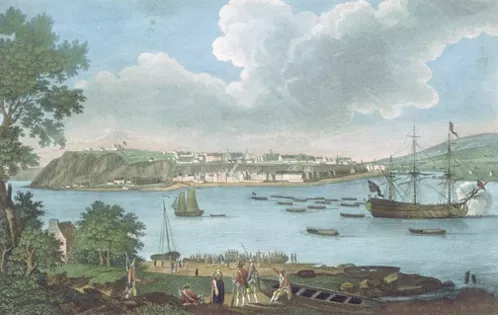
Image Credit: Library and Archives Canada
"Urban-embellishment" reasons – After 1867 and the birth of the Canadian Confederation, it was clear that the Fortified Wall had increasingly become obsolete in terms of military reasons, due to the advances in military technology. The advent of rifle artillery, which was more powerful and much more precise, transformed how war was waged at that time. Old Québec's Fortified Wall was gradually abandoned and many of its stones fell victim to pillagers. Following the departure of the British troops in 1871, there were not enough men and money left to make repairs. And then came the modern savior and beautificator of this Fortified Wall: Lord Dufferin, Governor General of Canada from 1872 to 1878. When he arrived in Canada in 1872, Lord Dufferin was immediately seduced by Québec City, by the special charm and architectural treasures of Old Québec and its Fortified Wall, by the vestiges of a legendary past. So, he came up with a glorious project for their beautification called "The Dufferin Project". He succeeded in reconciling modernization and conservation with the development of a historic monument of gigantic proportions. His designs were so fascinating that he gained support from all spheres of society at that time: public opinion turned in his favor, Queen Victoria approved his project, and every public administration from Québec City's Town Council to Canada's Federal Government contributed to its realization. Today, Old Québec and its Fortified Wall are considered by UNESCO to be a "World Heritage Site". Québec City is one of the top tourist destinations in the world. And Lord Dufferin still must be smiling at his most amazing success story.
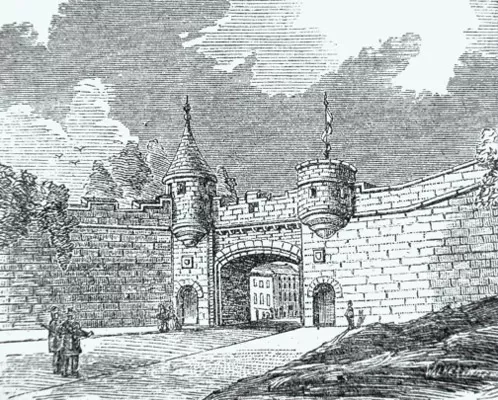
Image Source: commons.wikimedia.org
AND NOW…
Now that we know what Old Québec's Fortified Wall looks like in the 21st Century with all its different sections, and now that we understand the reasons why it was built, preserved, maintained and improved for more than 400 years…
THE TIME HAS COME…
For a new adventure in discovering Old Québec's Fortified Wall…
The time has come…
FOR "TIME TRAVEL"…
For which we need a very special tool. So, we will do it…
WITH OUR UNIQUE "TIME MACHINE".
We will travel through time and experience for ourselves the "life" of Old Québec's Fortified Wall.