
The Wall itself and its 3 main bastions
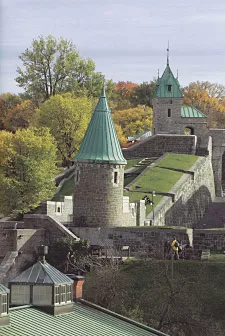
© 2006 Photo by Jacques Beardsell / Reproduced with the permission of the photographer.
We call it "The Fortified Wall" and not "the fortified walls", just as we say "The Great Wall of China" and not "the great walls of China". Both of them were built in sections through a long period of time, not "built in three days". In fact, Old Québec's Fortified Wall was built over a period of more than 400 years and can therefore be conceived as a series of fortified walls or "ramparts" forming altogether (once linked to their various gates, to the Dufferin Terrace and to the Citadel) the "Fortified Wall" as a whole of which we speak.
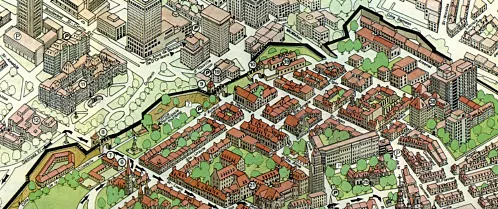
© 1990 CarteVieuxQuebec.com
Now, if you look at Old Québec's Fortified Wall on its west side, between St. John Gate and Kent Gate (which is the very next gate looking northward after St. Louis Gate and where there is no bastion), you will be able to observe once again the depth of the Fortified Wall in that area, between these two gates.
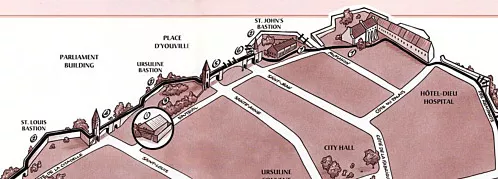
On the west side of Old Québec's Fortified Wall, there are three main bastions which were very strongly fortified with outworks in the past, from the south passed the Citadel to the north…
- St. Louis Bastion (or "Le bastion Saint-Louis" in French), between the Citadel and St. Louis Gate;
- Ursuline Bastion (or "Le bastion des Ursulines" in French), between St. Louis Gate and Kent Gate;
- St. John Bastion (or "Le bastion Saint-Jean" in French), between St. John Gate and Artillery Park (a key element in Québec City's defensive system that is also located in the Upper Town of Old Québec, but is not a section of the Fortified Wall).
© 1998 Parks Canada
To better understand the historical and military importance of such bastions as sections of Old Québec's Fortified Wall, the best thing to do is to observe, next to each other, a portion of a new map of Old Québec as well as a portion of the simplified map of Old Québec that we showed earlier.
As for the north, east and south sides of Old Québec's Fortified Wall, they were all protected and secured by a natural defensive system with high cliffs, ranging in height from 164 feet to 328 feet (50 meters to 100 meters). These high cliffs, by themselves, made those three sides of Old Québec's Fortified Wall "a natural fortress" dominating Old Québec's Lower Town as well as the St. Lawrence River. So that building more simple fortified walls (or "ramparts") on top of those three sides with high cliffs and adding cannons or heavy artillery at different intervals to those fortified walls (or "ramparts") was like transforming "a natural fortress" into "a supernatural fortress".
To better understand the historical and military importance of such high cliffs for Old Québec's Fortified Wall and the way this Fortified Wall appears today on its north, east and south sides, you only need to look at the illustration of the south and east sides of the Fortified Wall, in front and on top of the St. Lawrence River as well as Old Québec's Lower Town.