



Nesting skill
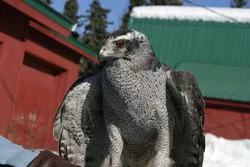
Courtesy of John Gomes and Alaska Zoo
Not the friendliest neighbor in the rain forest, the goshawk (accipitrine forest hawk) is one of the most secretive of birds when it comes to nesting. These ferocious raptors like to make their nests in mature parts of the forest that are remote and safe from human intrusion. Accipitrine hawks make their nests in trees, but the conditions in which they like to nest vary between different subspecies. Goshawks nest exclusively in old-growth and mature forests, preferably coniferous, deciduous or mixed forests. Some prefer to have very large trees, a closed canopy and an open understory, whereas others like to nest in vast, sage-covered plains. In the Tongass, goshawks like to place their nests relatively close to the trunk of the tree in which they are living. Consisting of sticks and bark, the nest itself is close to being 3' across, from 1' to 2' deep and 30' to 40' above ground. The goshawk usually constructs a new nest each year; however, it is not uncommon for goshawks to reuse the same nest that they have used during prior years. If they choose not to use the same nest, they at least return to the same breeding area. Remaining solitary throughout most of the year, goshawks begin nesting in late March or early April. Forming "pair bonds" during the breeding season, goshawk pairs remain mated in the same territory and stay with their young until they are old enough to leave the nest. These red-eyed raptors usually begin constructing their nests two months before breeding occurs, and they advertise their nesting territory by showing great displays of aerial maneuvering. Mature male and female goshawks are notoriously aggressive when it comes to defending their nests and young, but the female is the more aggressive when defending the nest. Female goshawks will scream with loud vocalization, dive-bomb, and even strike people and animals if they come to close to the nest. This outraged behavior has been observed by human beings who have unfortunately come to close to the nests for goshawk comfort!
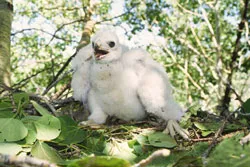
Courtesy of Mike Shipman
After the goshawk nest has been constructed and secured to perfection, the female goshawk will lay two to five bluish-white eggs that will hatch after approximately 30 to 32 days of incubation by both the female and male. During the breeding season, the female stays behind guarding her nest and precious young, while the male goshawk travels up and down, crossing and recrossing the majestic forest in search of prey for the family. Before the nestlings are covered with feathers and ready to fly, they spend time as "branchers" living in trees around their nest, always staying within the general vicinity of their parents. Mature, parent goshawks continue to provide their nestlings with food until they develop the flight skills necessary to survive on their own. Male goshawks normally develop feathers and fledge more quickly than female goshawks; however, both female and male goshawks will leave the nest permanently as soon as they become successful at pursuing and capturing prey on their own.