


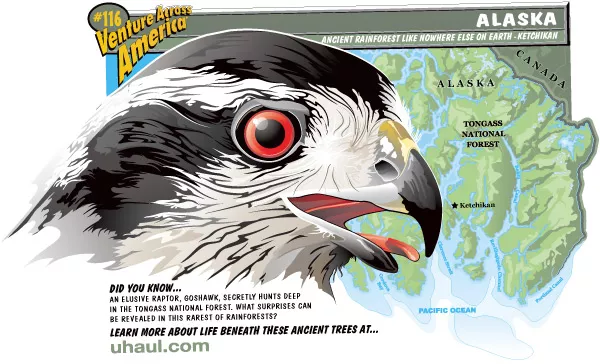
The elusive goshawk
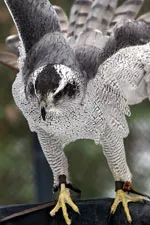
Courtesy of John Gomes and Alaska Zoo.
Legendary for their fierceness, beauty and remarkable flight skills, northern goshawks rule the old-growth sections of the Tongass and have evolved over hundreds of years. Having developed short, powerful wings with long rudder-like tails and protective eye tufts, goshawks are able to dart quickly through the Tongass's understory, beneath the colorful canopy of trees. Ornithologists, who are zoologists that deal with the study of birds, currently recognize three subspecies of northern goshawks: the Queen Charlotte, Cooper's hawk, and the sharp-shinned hawk. Goshawks are the largest, most ferocious members of the Accipiter family of forest hawks. The northern goshawk is 19-26'' long and has a wingspan of 40-48''. Goshawks, on average, weigh between 1½ - 2½ pounds, and the female goshawk is significantly larger in size. Mature northern goshawks are pearly gray on their breast and underparts, with fine charcoal-colored baring and pale blue-gray coloring on their backs, wings and tails. Goshawk flight feathers are a dark blue-gray above and pale below, lined with black. In addition to their large size, mature goshawks can be identified by the white feather stripe above each fierce, red eye. Young goshawks have brown, plush feathers on their backs, upper wings, tails and heads. They have a bold, white-feather stripe above their eyes as well. Immature goshawks have yellow to light-orange eye color, which will turn a deep, intense red as they age.
The Forest's Fiercest Raptor
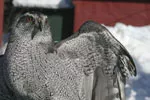
Courtesy of John Gomes and Alaska Zoo.
Perched high up on a remote branch in the heart of the majestic Tongass, the fierce, fiery-eyed, flesh-eating goshawk patrols the vast forest for prey. The northern goshawk is a fierce predator, which can often be seen darting and diving in and amongst the maze of trees. For many centuries, goshawks have been prized as a falconry bird because of their speedy pursuits and fearless demeanor. The majority of forest hawks search and dive down over open meadows to catch their prey, but the fearless goshawk uses its own effective hunting tactics to snatch its prey. The goshawk flies with a few sharp wing beats and a short glide, at the level of, or just slightly below the treetops. This tactic is effective for goshawks because they can navigate their way quickly and easily through the canopy of trees in pursuit of favored prey. Goshawks use other techniques for hunting, such as sneaking up on prey and killing it by utter shock and they even chase prey down on foot just to ravage it.
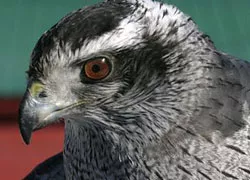
Courtesy of John Gomes and Alaska Zoo.
Goshawks hunt small to medium-size birds and mammals, such as jays, woodpeckers, squirrels, snowshoe hares, ducks, shrews, and some of the larger songbirds and shorebirds. Usually ambushing their prey on the ground, goshawks then take their kills to "plucking perches" or "butcher blocks," where they pluck and pull feathers and fur from their prey before devouring it. These birds of prey always have the advantage when they are hunting, because they are equipped with short, powerful wings and long tails which allow for accuracy and speed when navigating around forest obstacles, as well as powerful feet and legs that are capable of snatching rather large victims. Small mammals and birds do not stand a chance of escaping a goshawk.