


Blue Skies Turn Gray
Thousands of miles away from ancient Nebraska, in what is now modern-day Idaho, a super volcano was getting ready to erupt. Scientists estimate that this ancient eruption was hundreds of times more powerful than the deadly 1980 Mount St. Helens eruption in Washington State. By comparison, Mount St. Helens was an eruption that obliterated Washington forests for 200 square miles. It triggered massively destructive floods and sent searing gas, volcanic ash and rock into the air at over 200 miles per hour. This eruption in Idaho was very similar, but much more destructive; its ash covered thousands of square miles.
Volcanic ash consists of very fine, jagged particles of rock and tiny shards of broken glass less than 2mm in diameter. Glass bubbles are formed and then break apart when solid rock shatters, and searing hot magma from inside the core of the earth separates into minute particles during the volcanic blast. Because these particles of ash are so small and so light, they can float in the air and be carried by the winds and breeze thousands of miles. When the super volcano erupted hundreds of miles to the west, the jet stream carried this fine ash through the air toward the calm savannas of Nebraska. As the cloud of ash grew closer, it slowly began to block out the sun, turning the once blue skies gray.
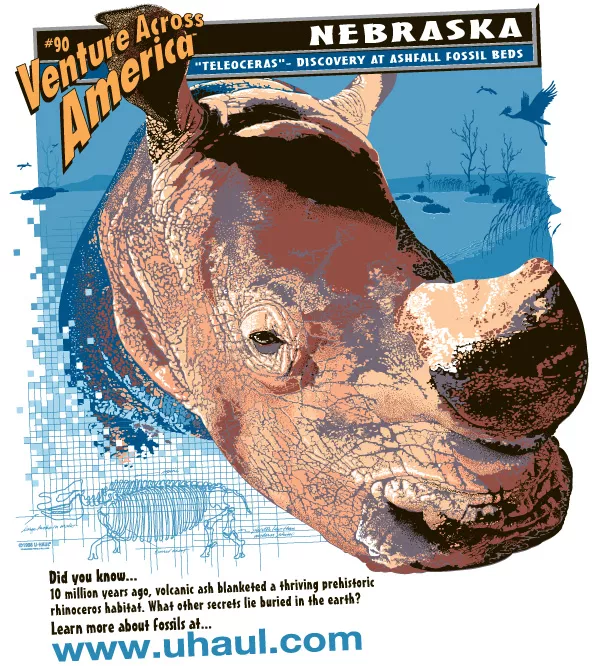
It would have appeared to be the largest, most violent thunderstorm the animals would ever have experienced, but rain would not come. Ash began falling to the ground, lightly at first, and many animals began to choke on the powdery substance. Soon and without warning, what had begun as a beautiful and sunny day had turned into a gray blizzard. The frightened animals did not understand what was happening, but instinct told carnivores such as the saber-toothed cats and the bear dogs that they should quickly take shelter in their dens. Herbivores, like the rhinos, slowly began making their way toward the watering hole, possibly hoping to find clearer air. Many mothers and their young were separated; others huddled close together in fear. The volcano erupted with such intensity that the ash continued to blow in for several days. Soon the ground and the watering hole were covered with a thick layer of ash up to 10 feet deep in the watering hole and two feet deep in the surrounding areas. What would happen to these animals? Would they be able to survive?