

The Big Dig
"Although it was difficult to resist the impulse to dig straight back into the ash bed and see what else was there," Voorhies later stated, "past experience had taught me that this would not only have endangered the fossils but also would have destroyed important evidence about the origin of the deposit."
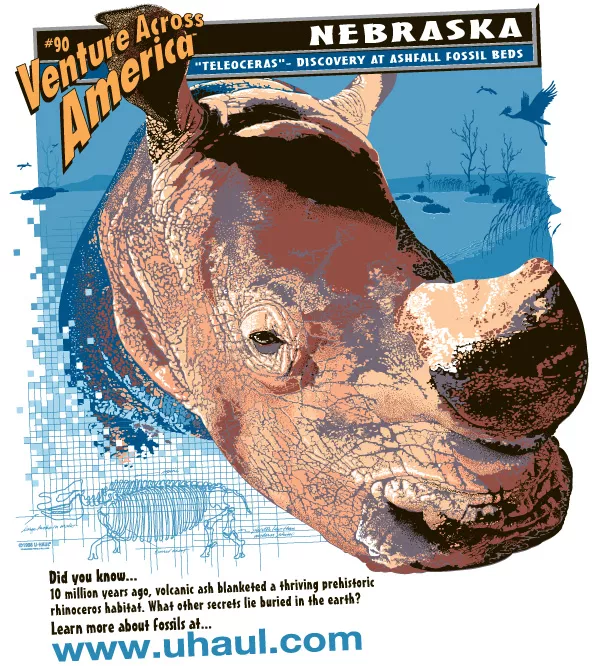
In 1977, he initiated a test dig of the area to see what was hidden below the surface. He gathered a crew from the University of Nebraska – Lincoln State Museum, and together they removed 20 square meters of dirt and ash. Extra care had to be taken to prevent removing too much ash and ruining the underlying fossils. As the team uncovered more and more of the ashbed, exposing five more rhino skeletons, they realized that they had stumbled upon a mass-burial site. This dig exposed dozens of skeletons, including those of birds, camels and horses as well as other rhinos. One of the most interesting finds was the skeleton of a pregnant rhino with her unborn calf still inside her.
Voorhies decided to name the area Ashfall, a description of the event that created this site. He then sent pictures of the find and a lengthy description of the area to the National Geographic Society seeking money for a larger excavation. The plan was approved. During the summer of 1978, a group was assembled to begin a full excavation over the course of the summer. A bulldozer was brought in to help remove the large amount of dirt and rock covering more than 600 square meters. Although using a bulldozer can be dangerous when dealing with such fragile and priceless remains, it would have taken an entire summer to move the amount of dirt that the bulldozer could move in a matter of days. Within a few hours, the workers would be able to get through the remaining three feet of ash to reach the fossils.
First, the area was marked with a large grid. The grid allowed searchers to carefully examine the layers of the fossil bed without damaging any of the fossils that were crowded so closely together. By the end of the summer, the crew found more than 200 animals - rhinos, camels, horses, giant turtles and others - were locked beneath the layer of ash, frozen in their death poses. Here, a mother rhino and baby rhino were found huddled together in a position that looked as if the baby was trying to nurse even after the mother's death.
By the end of the season, the elaborate trench system was completed to allow them to easily plot out future findings. Within the area of the ancient watering hole, there were possibly hundreds of fossils still waiting to be uncovered.