

Study Hall
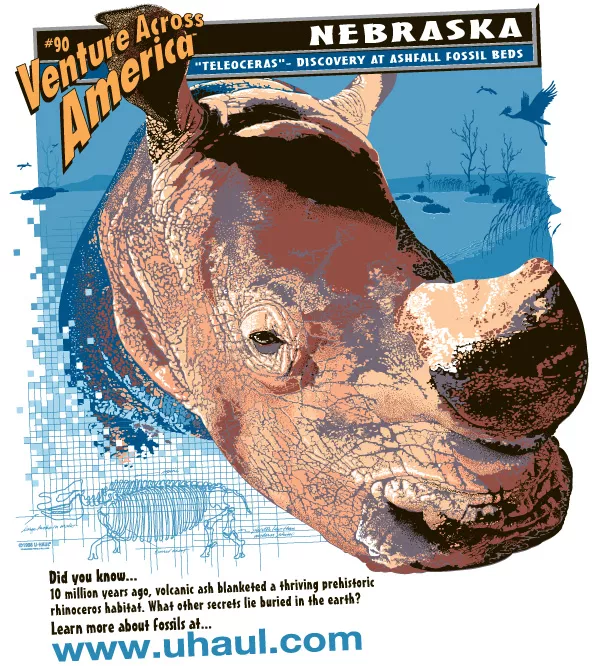
Finding all of these animals' skeletons preserved and intact was intriguing because it gave paleontologists an opportunity to examine these now-extinct animals in as natural and complete a state as they would ever see. Much can be learned by studying skeletons, death poses and teeth of these animals, and seeing the animals as wholes clustered made learning about their behavior much easier. For example, very few young male Teleoceras and only one mature male were found for about every five females. These animals apparently lived in what's known as a harem, with multiple females mating with one male, much like modern-day hippos. Study of the teeth of the young rhinos proved that they were all born during the same month of the year, exactly one year apart.
Even more astonishing was the discovery of fossilized grass seeds lodged in the teeth of these teleoceras. These seeds were a never-before-seen type of needle and thread grass. Findings like this support the theory that Nebraska had grassy savannas even before savannas developed in Africa. Having a readily available supply of grass helped give rise to animals specifically suited to eating it. Animals such as zebras and ancestors of the modern-day horse are two such animals. So far, 70 skeletons from five different species of ancient horse were found at Ashfall, some with three toes and some with a single hoof on each foot.
Ashfall had certainly become a treasure trove for paleontologists, scientists and average citizens. Only extremely rare circumstances can provide the necessary criteria to create a large-scale deposit of these amazing fossils. So let's travel back to the Miocene period once more to learn how Ashfall was created.