


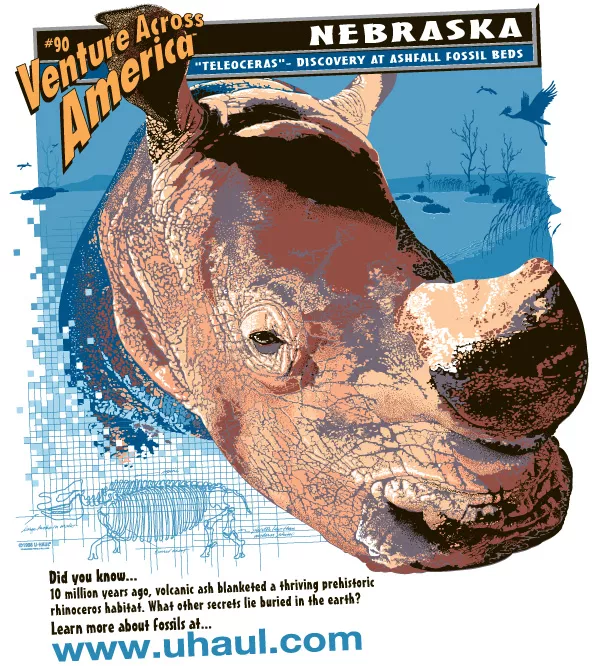
Then the Ash Fell...
Volcanic ash is not poisonous, but the tiny shards of glass that make up the ash are very harmful to respiratory systems. Volcanic ash is not soft and fluffy like the ash left by burning leaves or wood; it is hard and does not dissolve in water. This dangerous ash is what eventually led to the demise of hundreds of animals in and near the watering hole in the ancient savanna of Nebraska.
Although the animals were embedded in volcanic ash, there was no evidence that a volcano ever existed in ancient Nebraska. After much search, a good match for the Nebraska ash was found in an extinct volcanic crater in southwestern Idaho. Every volcanic eruption has a different chemical "fingerprint" so scientists can trace ash back to its source using lab work. The Ashfall ash has the same chemistry as that of the Idaho eruption that dates to 11.83 million years ago.
As the ash from the Idaho volcano blew in, it would settle on the ground, growing thicker each day. As the animals walked through the layer of dust, the fine particles would become airborne again. These tiny ash particles were small enough to have been breathed deeply into the lungs of the animals and the tiny shards of glass would ravage their respiratory systems. The smaller animals were the first ones to succumb to the deadly abrasive ash. Larger animals were not any luckier; they fell victim to the ash within a short time.
It was slow death for most of the animals, as breathing became harder and harder, and they slowly suffocated because of the damage done to their respiratory system. This is evidenced by abnormal white deposits of highly porous new-bone matter found on the bones of the lower jaw and on the shafts of major limbs and the ribs. The deposits were caused by an inflammation from lack of oxygen and have also been found on the bones of modern-day animals who have suffocated.
The smallest animals died first, with their bodies found toward the bottom of the watering hole. The larger animals died more slowly, asphyxiating from the airborne ash and deprived of nutrients by the ash that covered their food source. As they perished, some of their remains were scavenged by hungry and scared carnivores. Even the animals that tried to escape from the ash eventually needed to return to the watering hole for a drink. A herd of close to 100 rhinos eventually shuffled through the ash to the watering hole and died just like the others. The rhinos were the last to die. Ultimately, all of their bodies and the watering hole were covered by the ash. As luck would have it, the ash that killed them was the same ash that preserved their bodies for millions of years. This amazing force of nature created a time capsule that has helped to teach us about the past and can help prepare us for the future.