


The Head Bone Connected to the Neck Bone
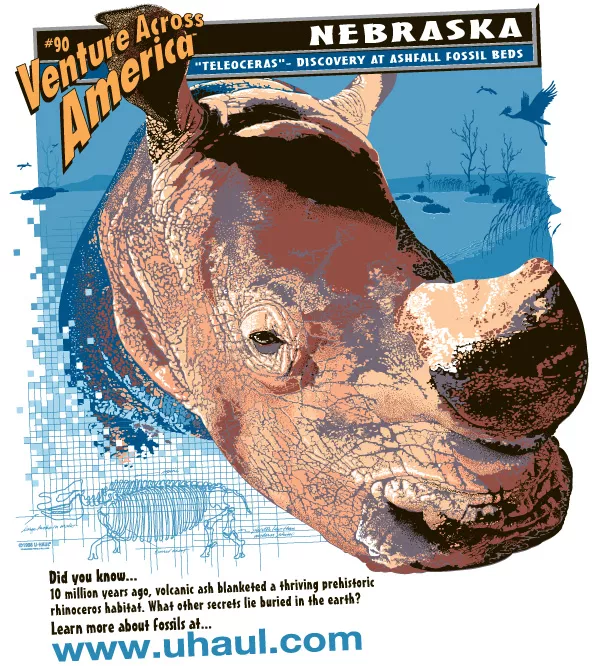
In 1971; Dr. Mike Voorhies, a respected University of Nebraska paleontologist, was walking with his wife Jane through Melvin Colson's farm in northeastern Nebraska. Voorhies had spent the better part of his career searching for the lost North American savanna, and on this day he was searching near his home in Orchard, Nebraska. Toward the end of his search, Voorhies noticed a huge exposure of gray ash on the cliff above him. Following the layer of ash as it wrapped around the cliff, he ended up in a ravine on the opposite side. In one of the smallest parts of the ravine, with barely enough room to wiggle his hips through, Voorhies found a piece of white bone sandwiched inside the eroded layer of ash peeking out from the wall of the gully above. Immediately, Voorhies recognized this as part of a baby rhino skull.
Excited, he began to work, slowly brushing the ash away from the skull, trying to expose more of the bone. Typically, a find of this type would reveal a portion of the skull, or if you were very lucky, an entire skull separated from the rest of the body. This find, however, was different. As Voorhies worked, he uncovered more and more of the skull and quickly realized that he had discovered an entire, intact baby rhinoceros skeleton! Voorhies recalled, "First from the oversized teeth, then farther back looking for evidence that the rest of the skeleton might be there. It was. Just as the old song has it:
"The head bone connected to the neck bone, The neck bone connected to the backbone…"
It was highly unusual to find complete fossilized remains of ancient animals, making this find one of the most rare he had seen. Generally, after the animals died, scavengers would tear at the skeletons, ravaging their remains and throwing bones all over. This was the only intact rhinoceros skeleton that Voorhies had seen in all of his years as a paleontologist. He couldn't help but wonder if more fossils could be found nearby. The find also raised a very important question. What would cause this rhinoceros skeleton to remain intact for millions of years, with all of the odds stacked against it?